
evite
The internet flipped this word’s original meaning

Today’s New York Times Spelling Bee letters:

I, L, P, T, V, X, and center E (all words must include E)
Merriam-Webster says…
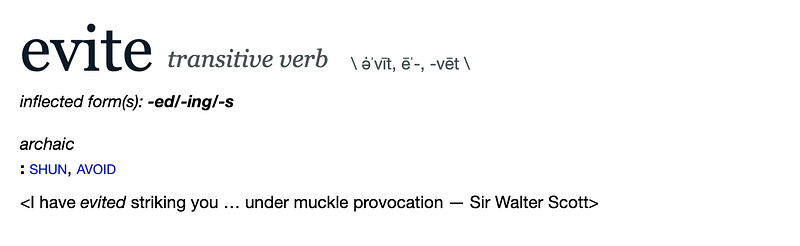
Silly little dictionary! Don’t you know evite can’t possibly be a word if the New York Times says it ain’t?
For further fascinating facts, check out the Spelling Bee Master.
What’s your favorite dord* from today’s puzzle?
My Two Cents
Once again, I purposefully lowercased the initial “e” in evite. I know that Evite is a proper noun (and unfortunately I also what Evite is), and that because the Spelling Bee does not accept proper nouns as answers, Evite would be rejected.
But there is also an evite, common noun, the original one, the one that could be accepted by the Spelling Bee. Thank goodness it wasn’t, though, or I’d be twiddling my thumbs instead of writing this column. Trust me, if you’ve ever seen my attempt to twiddle my thumbs, you’d agree writing an article is a much better look for me.
Evite cliches like the plague
Middle French or Latin; Middle French eviter, from Latin evitare, from e- + vitare, meaning “to shun”.
In turn, the word shun, a more common synonym of evite, comes to us from the Middle English shonen, shunnen, and that from the Old English scunian.
And avoid, also a better-known synonym, also comes from Middle English, but via the Anglo-French word avoider, an alteration of the Old French esvuider, itself from es- (from Latin ex-) + vuider, “to empty”. If vuider looks familiar, that’s because the modern English word void also means “to empty”, among other things.
On a personal note, the reason I don’t just think of an “electronic invitation” when I see the word evite is because, as a Spanish-speaker, I immediately see the second-person imperative of the verb evitar, which––no surprise here––means “to avoid” or “to shun”.
And in case you don’t believe me, here is a screenshot of the DRAE’s entry for evitar:
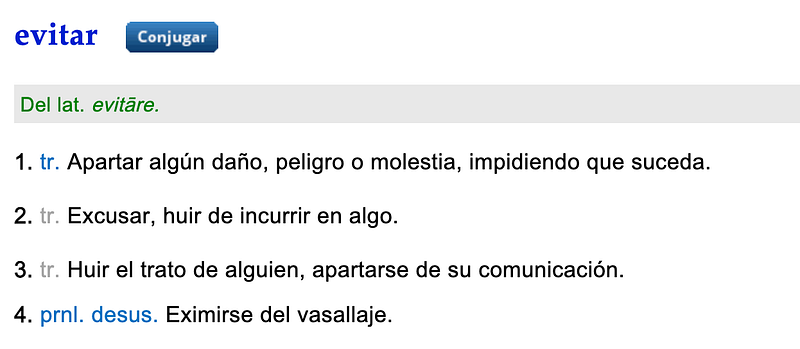
I’m sure all three or four of my eagle-eyed readers immediately noticed the word evitare, in green, right below the main entry.
Although English as a language has Germanic origins (Old English), it was heavily influenced by the French beginning in 1066 when William the Conqueror lived up to his nickname and, well, conquered England. You see, although William had a very British-sounding name, he was actually a Norman… as in Normandy, France.
The word evite is a clear example of that French influence that helped develop Middle English up to the 15th century. And French is a Romance language, evolved from Vulgar (popular) Latin. What’s another Romance Language, you ask? Oh, you didn’t? I’ll tell you anyway. Spanish. That’s why English evite and Spanish evitar are almost identical.
While it’s unlikely many English-speakers today go around saying “I want to evite my family’s next Thanksgiving”––and not meaning it in the uppercase E sort of way––, there are obviously a lot of Romance-sounding English terms being thrown around on a daily basis. Obviously being one of them. Terms being another. Basis being yet another. You see the pattern here, right?
Why I hate Evite
I don’t… that’s just the name of an intriguing-sounding article written by Auren Hoffman in 2006. And I say “intriguing-sounding” because I have not been able to find the article or an archived copy of it. Admittedly, I searched the interwebs for only about fifteen minutes or so, but still… it looks like all traces of that article are gone. And if any of you three or four eagle-eyed readers of this column can link us to it, it would be greatly appreciated. Who knows, perhaps Auren will notice I mentioned him and help us out.
Hoffman’s story was published by the tech site VentureBeat, which has since taken it down. There was some criticism surrounding the article, like this one written by Nick Douglas for Gawker, so I wonder if all the brouhaha had to do with the fact that the post is no longer available.
Evite the company was founded in 1998 by Al Lieb and Selina Tobaccowala as a social-planning website for creating, sending, and managing online invitations. In case you’ve never used or heard of the company, here is its logo:
The word Evite became synonymous with receiving an electronic invitation, usually via email back then, despite there being other competing services… I think. Truth be told, I don’t remember hearing of any competition in this entrepreneurial field.
Evite also became a noun (to receive an Evite) and a verb (to Evite). The verb form is interesting because it implies the opposite meaning of the original word. So now, by Eviting someone to a party you were eviting to evite that person. Unless, of course, you were just being nice and didn’t really expect said person to show up. How often has that gotten effed up when the clueless Evitee (yay, we coined another word!) actually replies yes and shows up! I mean, can’t people tell when they’re just an Evite formality? Sheesh!
Evite gave three options for replying: attending, not attending, maybe. A fourth option was “not yet replied”, paradoxically annulled by choosing one of the other three.
One thing that always bothered me was the “maybe” option. I never really understood why it was there. Isn’t “maybe” always implied by answer yes or no, anyway? I mean, life has a way of interfering in most people’s plans. Even gazillionaire Jeff Bezos had to delay his first Blue Origin flight due to bad weather. He didn’t, you’re saying? Oh, well, there goes that theory.
Even if you reply “yes” to an Evite, or any invitation, there’s always the possibility you may have to cancel because of something that came up or because of something you made up. And if you say “no” and later change your mind… well, as I said earlier: can’t people tell when they’re just an Evite formality? Sheesh!
My point is that “maybe” is superfluous. It’s built in to any answer you RSVP you provide in the same way uncertainty is built into our daily lives.
Take Evite, for example. After a very successful start, it was bought in 2001 by IAC (an American holding company that owns mostly media and Internet brands across 100 countries). In 2010, IAC sold Evite to Liberty Media, a mass media corporation.
Nine years later Evite was hacked in a breach that put over 100 million accounts at risk. The stolen data included users’ real names, usernames, email addresses, passwords, dates of birth, phone numbers, and mailing addresses. But Evite said the breach did not contain “user information more recent than 2013” and suggested users might want to change their website passwords. (Not that this would prevent a skilled hacker who bought the private information from destroying said users’ life outside Evite’s tiny digital world.)
Talk about uncertainty! Not for Evite… for its poor customers!
And yet, despite everything we’ve discussed today… the editors of the Spelling Bee decided that the word evite is a dord*.
You can check out my previous entry on another dord* here:
*What the heck is a dord, you ask? Here’s the answer: