
Daric
A coin’s name coined after a coin coined by a king
Today’s New York Times Spelling Bee letters:
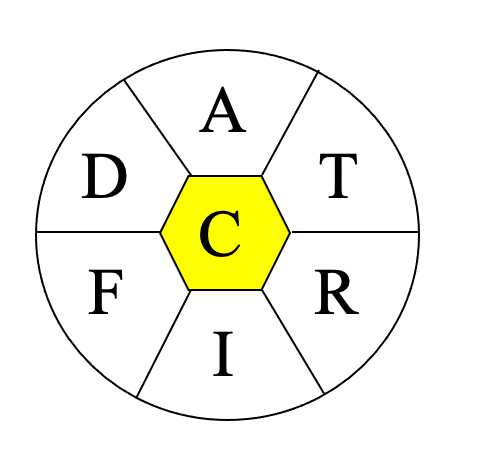
A, D, F, I, R, T, and center C (all words must include C)
Merriam-Webster says…
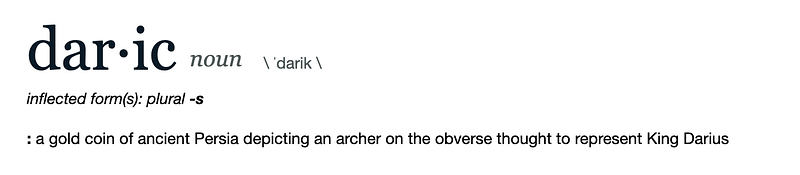
Silly little dictionary! Don’t you know daric can’t possibly be a word if the New York Times says it ain’t?
For further fascinating facts, check out the Spelling Bee Master.
What’s your favorite dord* from today’s puzzle?
My Two Cents
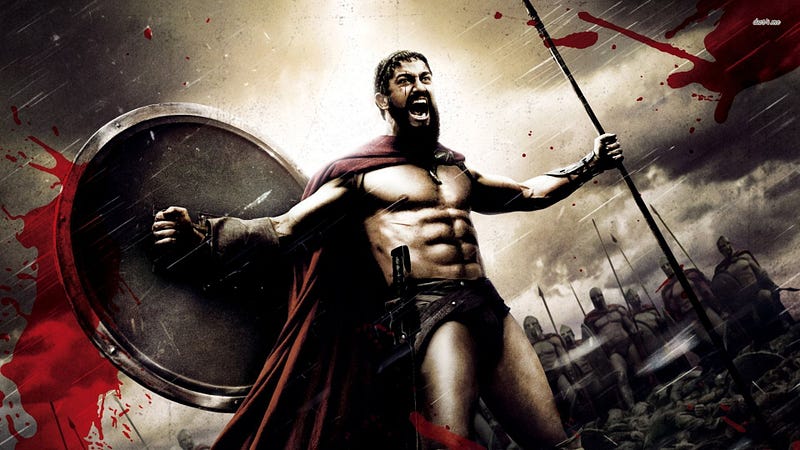
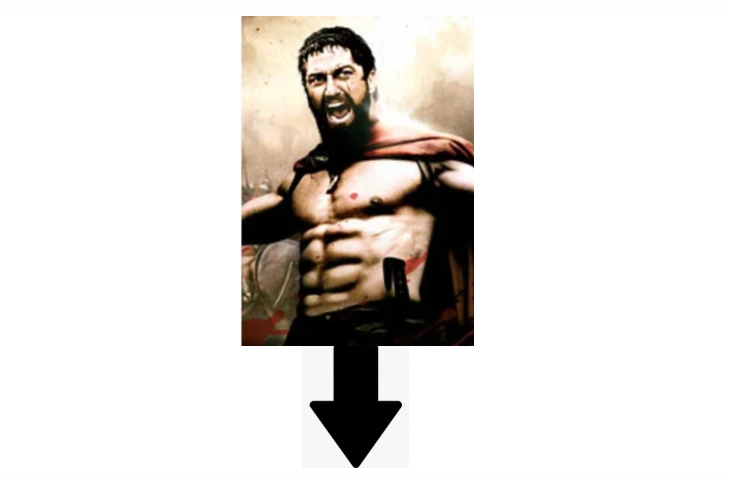
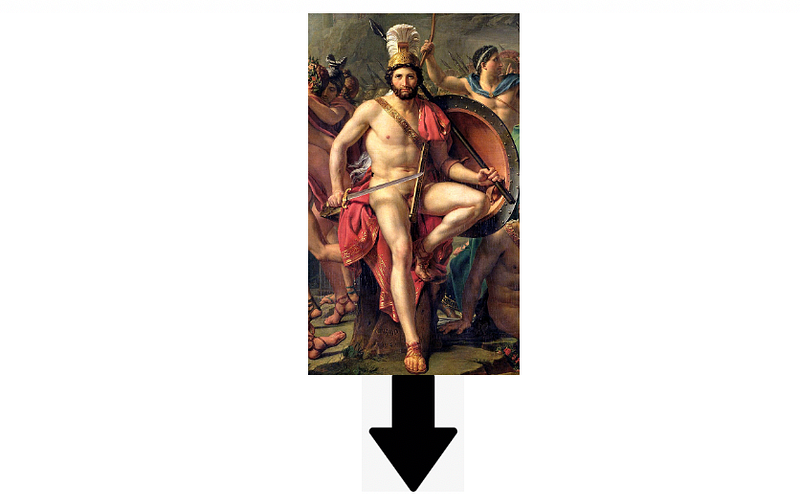
Yes, I know King Leonidas was not a daric, although it’s possible he used darics. And I know Gerard Butler is also not a daric, and has probably never seen or heard of a daric.
But I figured strategically placing a photo of Butler and his abs portraying Leonidas and his abs would draw more attention to this article than a picture of a very old coin.
It worked, right? Hang on to your hats, though, because later in today’s column I’ll demonstrate the six degrees of separation between a piece of home gym equipment and an ancient Persian coin.
Coining a coin
Meriam-Webster explains that daric comes from the Greek word Dareikos, probably from Dareios (Darius I, †486 b.c. king of Persia) + the Greek suffix -ikos, or “-ic”.
Encyclopedia Iranica (yes, there is such an awesome thing!), however, offers a competing theory: “….modern scholars have generally supposed that the Greek term dareikós can be traced back to Old Persian *dari- “golden” and that it was first associated with the name of Darius only in later folk etymology.”
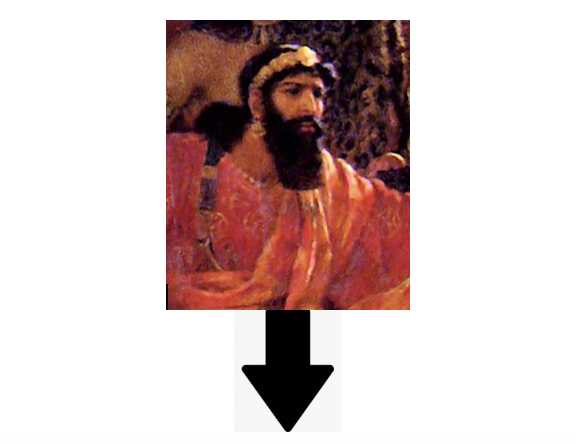
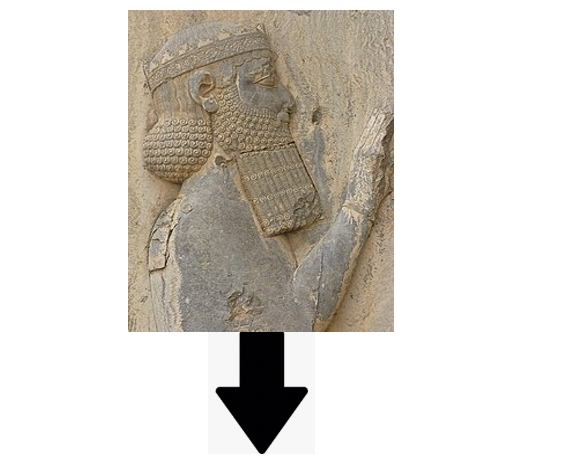
Darius I, also known by his street name “The Great”, was king of Persia from 522 to 486 B.C. He is considered one of the greatest rulers of the Achaemenid dynasty, noted for his administrative acumen and for his fantastic building projects. Darius attempted several times to conquer Greece; his fleet was destroyed by a storm in 492 B.C., and the Athenians defeated his army at the famous battle of Marathon two years later.
Thanks to that victory, there is now a widespread craze for running 26.2 miles (42 kilometers and change).
Although he wasn’t able to conquer Greece, his empire still had a respectable size:
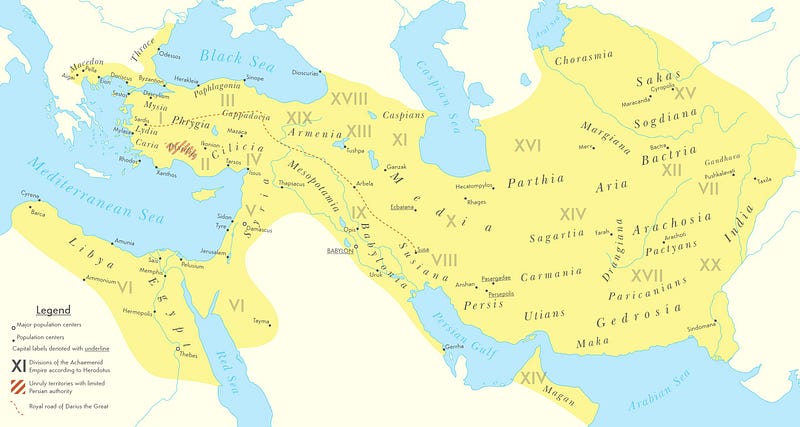
Darius’s frustration at not achieving his military goals was carried over to his son, Xerxes I, who was also known as “The Great”. I guess people didn’t have much imagination back then when it came to street names. Xerxes I did manage to conquer the Greeks, but only after a protracted battle at Thermopylae. There, a small force of Greek warriors led by King Leonidas of Sparta managed to block the passage of a much larger Persian army for a few days before ultimately being defeated.
Thanks to that loss, there was a widespread craze for watching a movie called 300 about fifteen years ago.
Spoiler alert if you’ve never seen the movie or read the Frank Miller/Lynn Varley comic series or never studied a lick of history: the Persians broke the Spartan resistance after a Greek man called Ephialtes betrayed his country by telling the Persians of another pass around the mountains.
Anyway, back to Darius I. He introduced a new universal currency, the daric, which became sort of like the bitcoin of ancient times. This coinage system was used across his extensive empire to regulate all trade and commerce. The daric was also accepted beyond the borders of the empire, for example, in Eastern Europe.
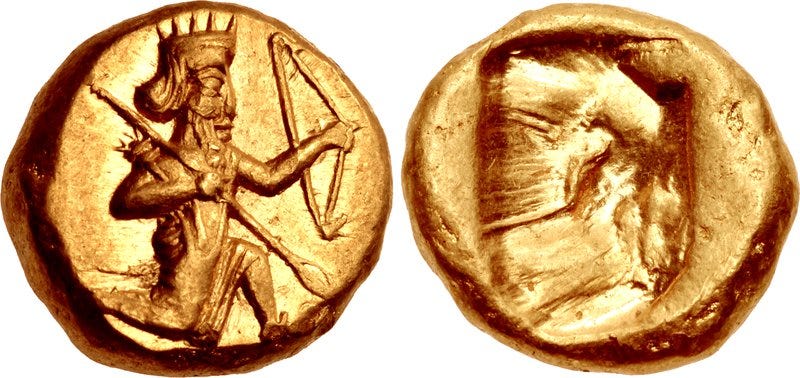
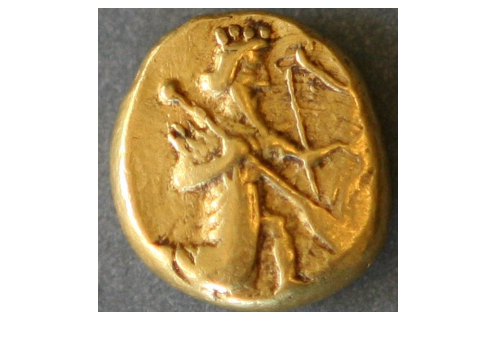
As you can see from the above picture, the coin bore the image of Darius as a great warrior armed with a bow and arrow.
There were two types of darics, gold daric and silver. Only the king could mint gold darics (although one assumes Darius himself wasn’t spending his time doing that). Important generals minted the silver ones; twenty of these were equivalent to a gold one.
The daric became a major boost to international trade. Trade goods such as textiles, carpets, tools and metal objects began to travel throughout Asia, Europe and Africa. To further improve trade, Darius then built the Royal Road, a postal system and Phoenician-based commercial shipping.
The daric also improved government revenues as the introduction of the daric made it easier to collect new taxes on land, livestock and marketplaces. Smart guy, that Darius I. No wonder he was called “the great”.
It took another great to end the minting and circulation of the daric. After Alexander the Great invaded Persia in 330 B.C., the coins were melted down… and made into coins of Alexander. Who could have seen that coming?
Six degrees of coinage
If you’ve never heard of the term “six degrees of separation”, it’s a concept that was originally described in a 1929 short story by Hungarian author Frigyes Karinthy. In the story, a group of people play a game in which they attempt to connect any person in the world to themselves through a chain consisting of at most five other people. Six decades later the phrase became very popular thanks to John Guare’s 1990 play Six Degrees of Separation and the 1993 movie based on that play.
In 1994, Kevin Bacon said, during an interview that he “had worked with everybody in Hollywood or someone who’s worked with them”. In turn, this inspired three college students to create Six Degrees of Kevin Bacon, a game in which the goal is to connect actors via films that both have appeared in together, and repeating this process until one reaches Kevin Bacon.
You can do this yourself online now, thanks to The Oracle of Bacon, created by Brett Tjaden.
Anyway, the whole point of my explanation is to preface my attempt at connecting a piece of home gym equipment to an ancient Persian coin by at most six steps, or degrees. Here goes…

Despite the fact that the daric was invented by a great and later destroyed by another great, making it a really great coin… the editors of the Spelling Bee decided that the word daric is a dord*.
You can check out my previous entry on another dord* here:
*What the heck is a dord, you ask? Here’s the answer: