
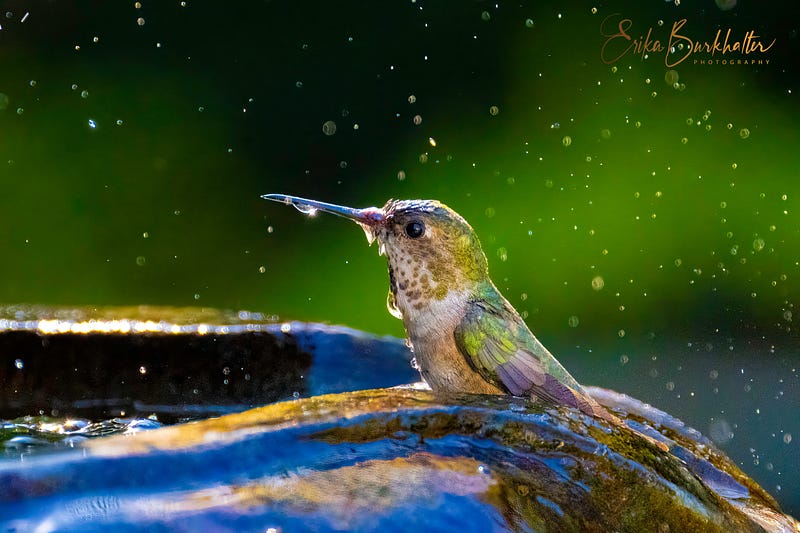
Nature Photography, Hummingbirds
Eugenia Likes to Play with Water Droplets
A tiny jewel of a hummingbird at my fountain
My backyard water fountain is a “hot spot” for birds. Many years ago we took out all of the grass and turned our garden into a sanctuary for the bees, butterflies and birds. “Hot Lips” salvia and borage and a myriad of other plants loved by pollinators replaced the lawn.
We actually certified the yard with the National Wildlife Federation as a Wildlife Habitat and pledged to provide native plants, water sources, and safe places for the wild creatures to raise their young. What I had not realized until I began researching the requirements was that various birds and insects prefer different water sources.
Some birds, like robins (and also our “Mrs. Squirrel”), prefer the still water of a bird bath. But hummingbirds, it turns out, love to play in the rivulets and trickling streams of the water fountain.
This is “Eugenia.” She’s a female Allen’s Hummingbird.
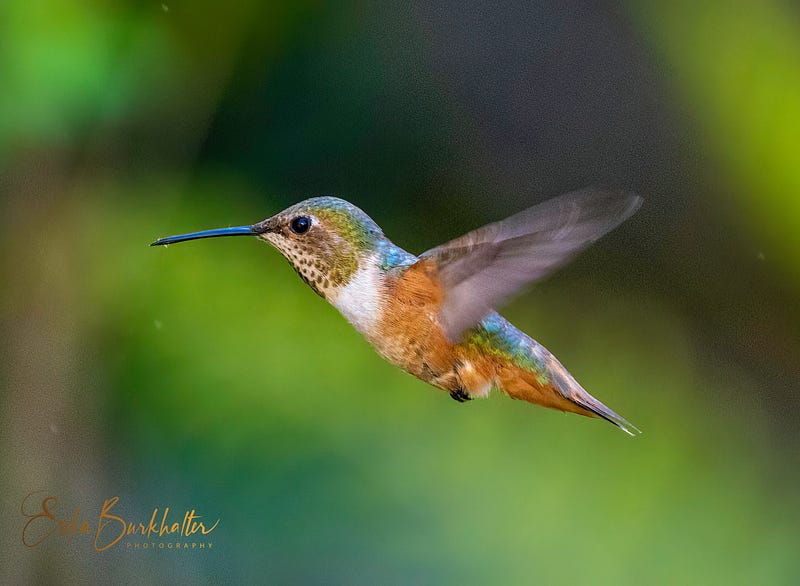
Allen’s Hummingbirds are coppery orange with green backs. Adult males have a coppery tail, eye patch, and belly that contrasts with their bronze-green back and deep reddish orange gorget.
As you can see with Eugenia, she is a bit paler than “Big Red” or “Einstein,” the dominant males in the back corner of the garden. Females and immature males will have little bronzey-red spots, like little rubies, on their throats.
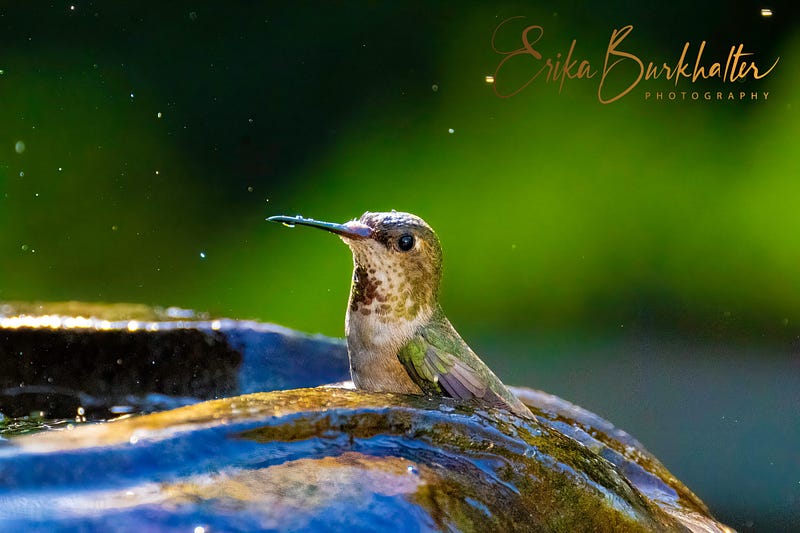
As the boys mature, those spots fill in to create the glorious ruff that you can see below on “Big Red” and “Einstein.”
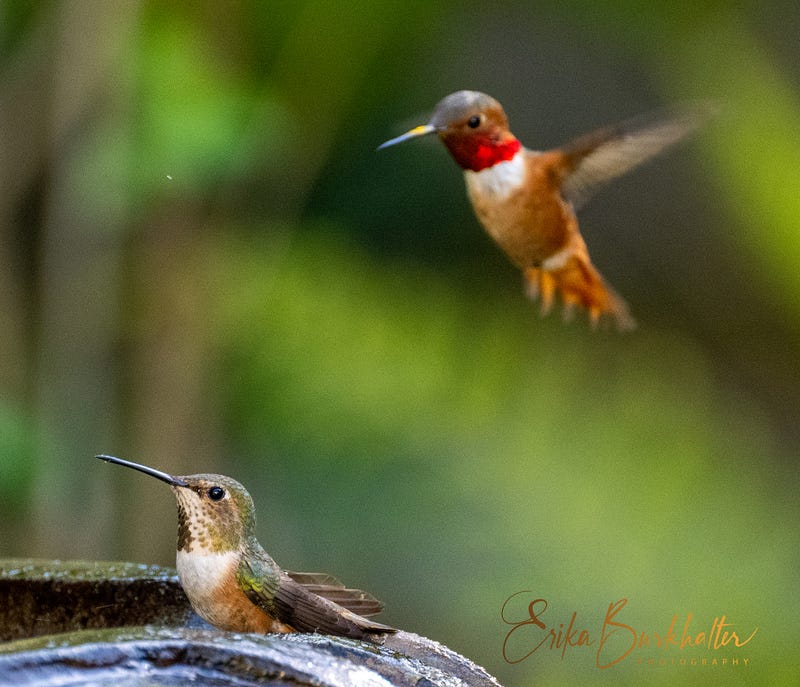
Big Red and Einstein have staked off their territories on either side of the fountain and spend all day long striking terror into the hearts of any other males who might dare to try to take a bath. But Big Red always lets Eugenia in for bath time.
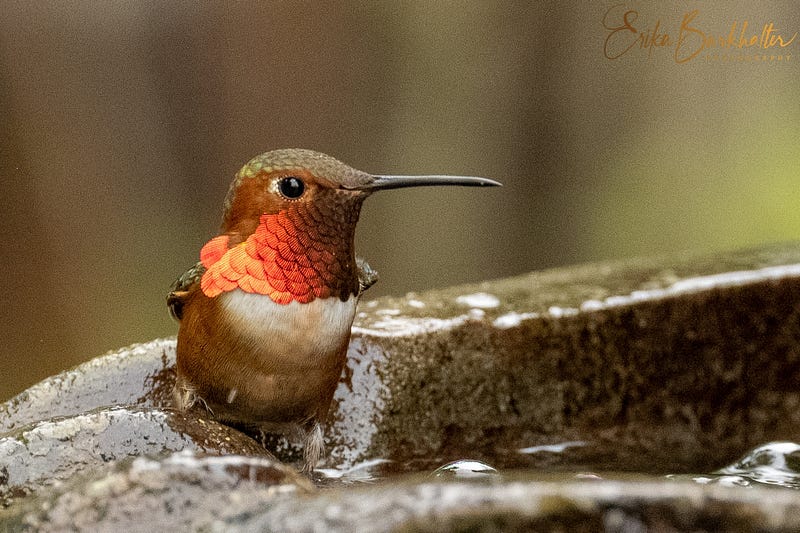
While the boys are gloriously gorgeous, I think Eugenia is just lovely as well. Her more subtle coloring gives her a little advantage too in being able to hide out better in the bushes.
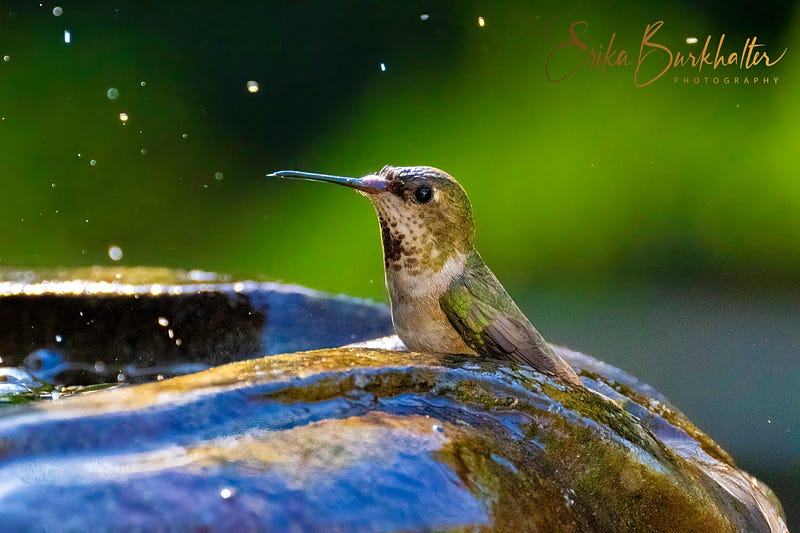
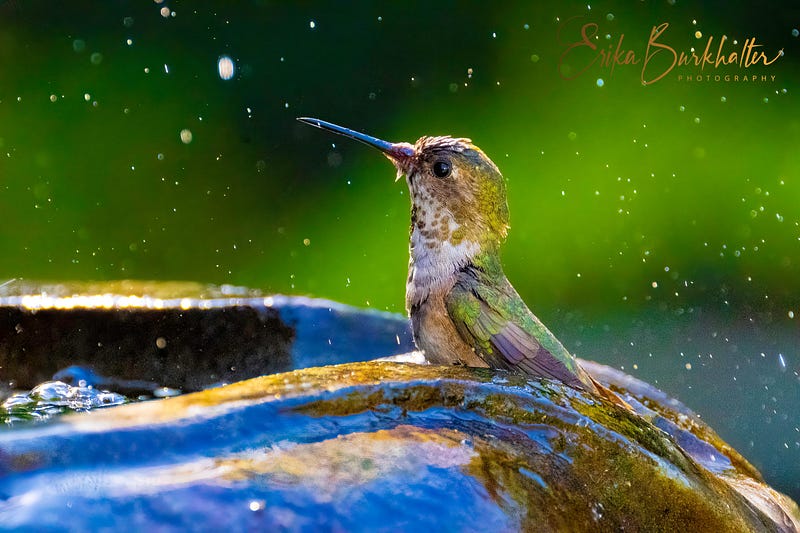
I just love to watch her sheer joy while she plays in the water trickling over the lip of the fountain. She tosses droplets everywhere.
And when she’s done with her bath, she’ll often fly up to the camelia bush behind the fountain to finish preening. In the next photo, she’s just landed and is pretty much soaking wet. You can see the droplets still flying off of her.
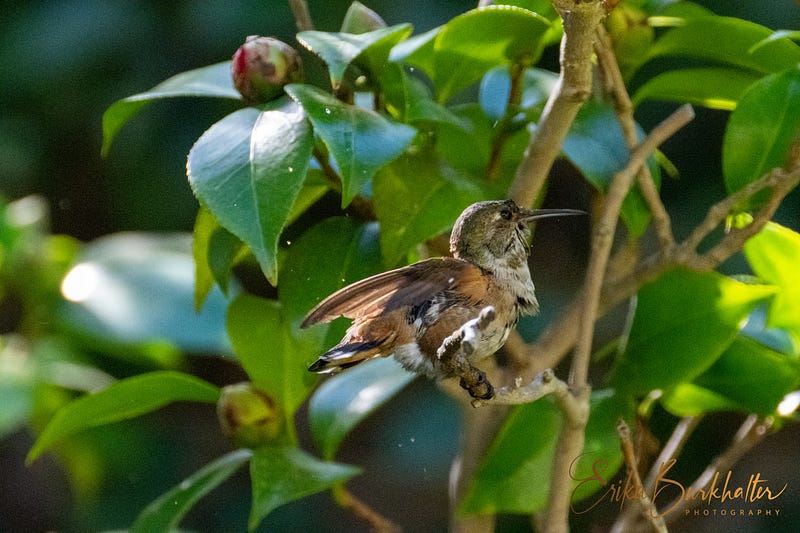
She’ll spend several minutes twisting and fluffing and straightening out her feathers after her bath.
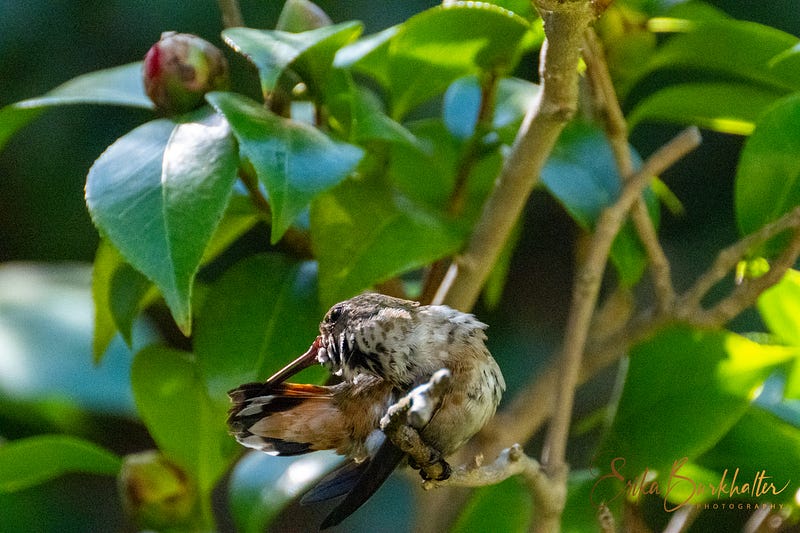
These tiny jewels are such a joy to watch. I love to photograph them because they normally move so fast that you can’t see their little faces. But their expressions, a moment frozen in time in a photo, are just precious.
I hope that you enjoyed this little foray into the world of Big Red, Einstein and Eugenia, my backyard hummingbirds. These little birds bring me endless delight.
Stay tuned for more tales of the neighborhood. We’ve also got a pair of Cooper’s Hawks who’ve moved into the pine trees on the hill. And the Orioles have returned.
To feed the hummingbirds, a simple solution of sugar to water in a 1:4 proportion is best. Please never use red dye in their food. It can cause throat cancer. Also, never use organic sugar, which is processed with molasses (which they cannot tolerate), when making their nectar. They also love all sorts of flowering plants, like salvia.
Erika Burkhalter is a yogi, neurophilosopher, cat-mom, photographer, and lover of travel and nature, spreading her love and amazement for Mother Earth’s glories, one photo, poem or story at a time. (MS Neuropsychology, MA Yoga Studies).
You might also enjoy more stories about Big Red and Einstein:
Or about the recent arrival of the Orioles:
Photos and story ©Erika Burkhalter. All rights reserved.
If you enjoyed this piece, you might consider subscribing to my stories. You’ll get an alert whenever a story gets published. While I do normally post my stories with free “friends” links on social media, if you enjoy reading on medium, you can help the many talented writers here by joining. It helps to support the arts and to keep us writing!
And, because I’ve had a few people asking lately, if you’re ever interested in purchasing a photo, just leave me a note.
Photos and story ©Erika Burkhalter. All rights reserved.
This story was a response to Dennett’s Weeds and Wildflowers “Tiny Packages” prompt. Thank you Dennett for creating such a beautiful place to display our photos and stories of the wildlife we love:
You might also enjoy some of the other “Tiny Packages” responses. There are some really beautiful ones by: Jillian Amatt - Artistic Voyages, Nicholas Tarleton, Christopher Lovelace @ChristopherLovelace, K. Barrett, Anne Emerick, Ann Litts, the intrepid Anne Bonfert and more.


