
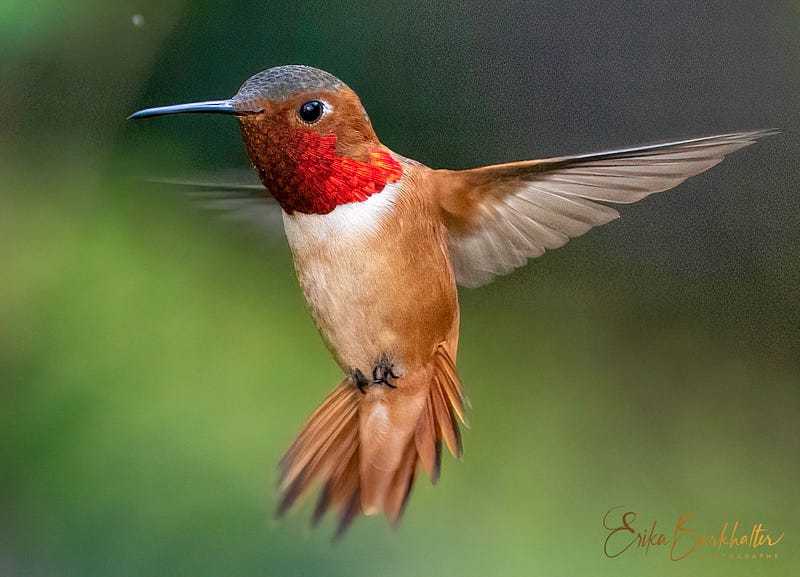
Nature Photography, Hummingbirds
Tiny Jewels
Allen’s Hummingbirds in flight and bathing in my fountain. Zooming in with my new Nikon Z9 and the NIKKOR Z 100–400mm ƒ4.5–5.6 VR S lens.
“Big Red” is a very busy Allen’s Hummingbird. He spends most of his waking hours defending his turf — which consists of the orange tree and the right hand side of the water fountain. The left side of the water fountain and the camelia bush belong to “Einstein,” Big Red’s rival.
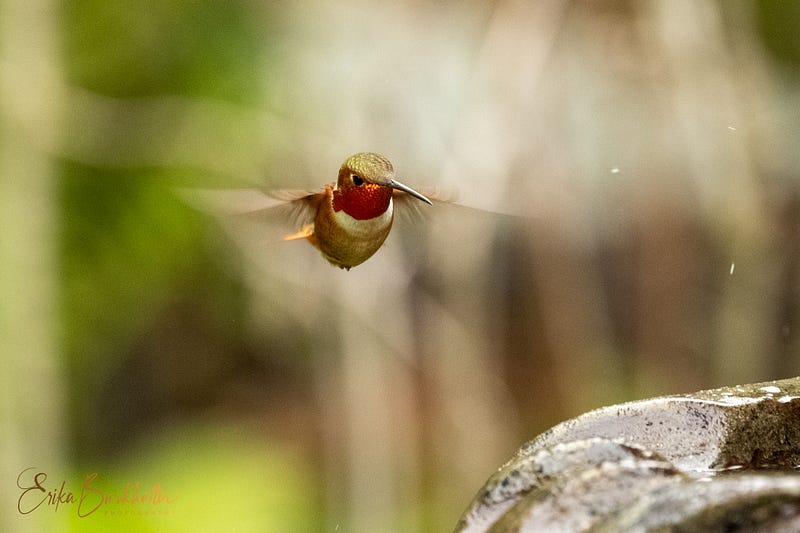
The two males seem to have their territories fairly well-worked out. I’ve often seen the two of them bathing at the same time on the opposite sides of the fountain. I’m quite sure that the fact that they can’t see each other around the water feature in the center helps in maintaining the peace.
But when another hummingbird, especially another male, attempts to slip in for a quick dip, he is quickly run off amidst a scattering of high-pitched chirps and clicks and the buzz of tail feathers specifically designed to drive terror into the other bird’s little heart.
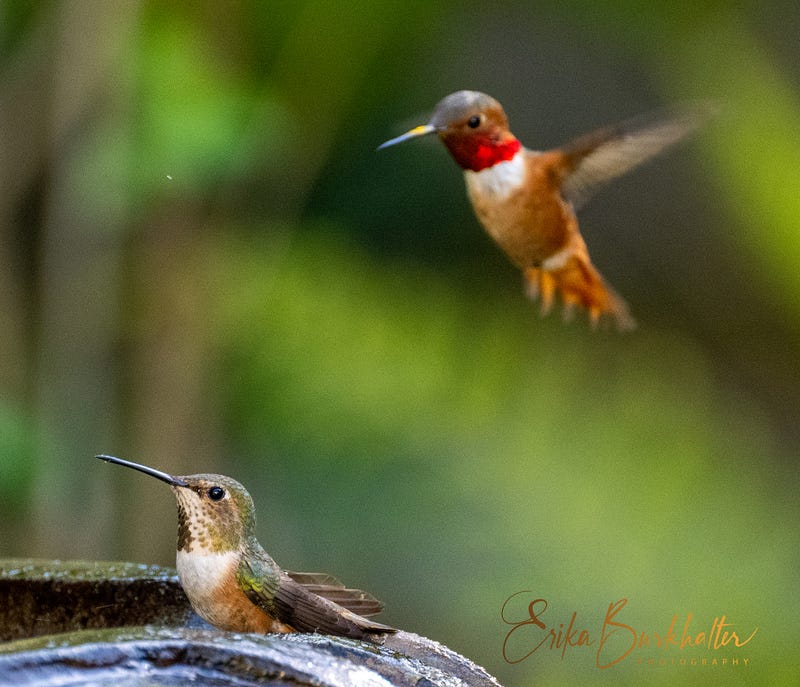
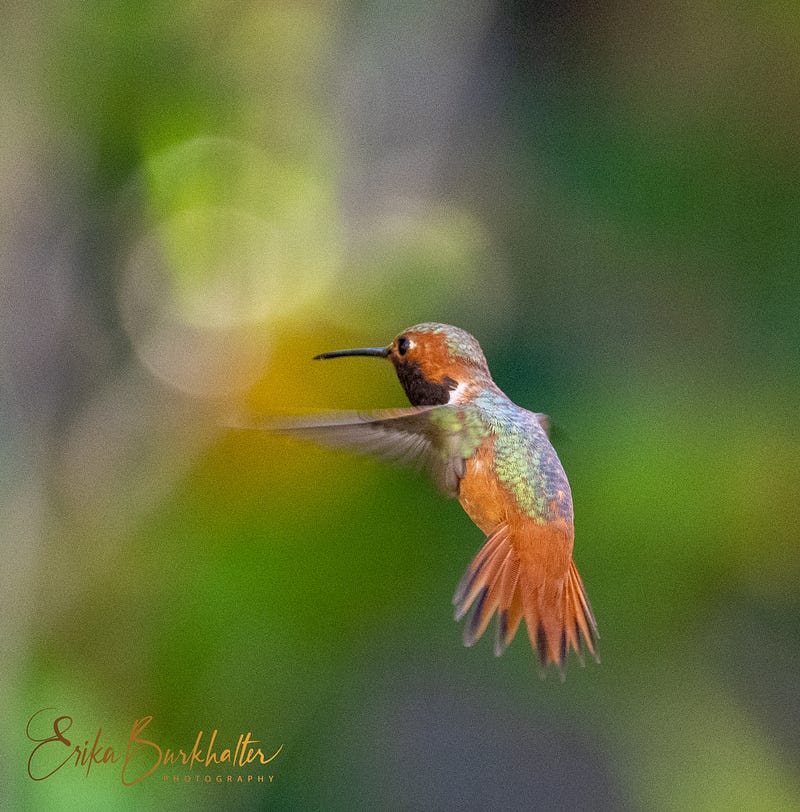
You can tell the difference between the “big boys” and the females and juvenile males by the amount of red feathers adorning their chins and chests. Big Red is clearly adorned in his full plumage. If you look closely, you can see that he looks like he is wearing a cape, that drapes over his shoulders, of iridescent scales.
Hummingbirds owe their shimmer not to pigmentation, but to tiny air pockets in their feathers.
This iridescence is similar to what gives soap bubbles, oil slicks, and some seashells their rainbow glow and it is due to the presence of structures called melanosomes, which are so tiny that 100 million of them can fit on a single hummingbird feather.
Allen’s Hummingbirds are coppery orange with green backs. Adult males have a coppery tail, eye patch, and belly that contrasts with their bronze-green back and deep reddish orange gorget. Females and immatures are a bit paler, with bronze-green above coppery sides. The females and the immature males will have little bronzey-red spots on their throats. As the boys mature, those spots fill in to create that glorious ruff.
He sure is gorgeous, isn’t he? At about 2–4 grams and only 3.5 inches long, he is tiny but mighty.
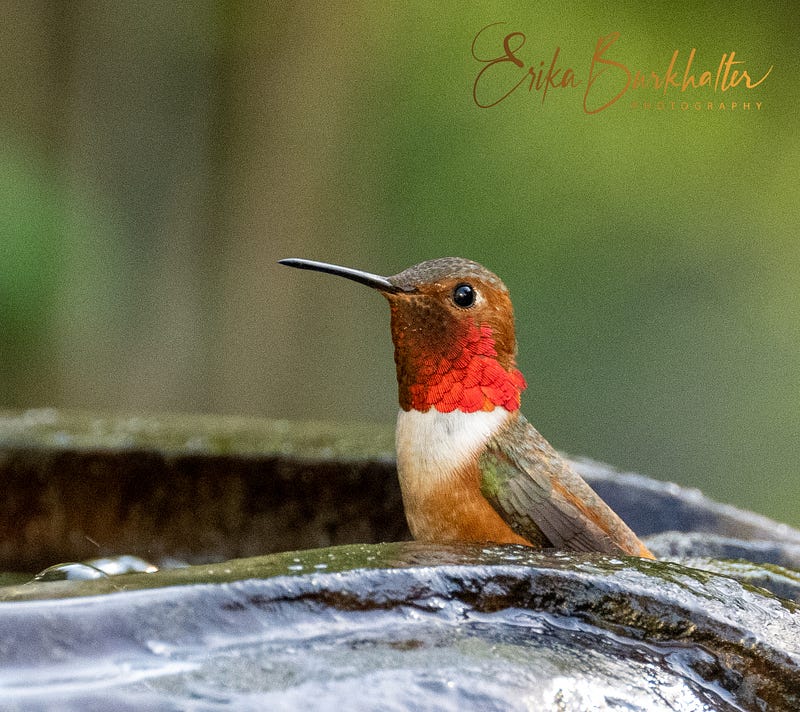
And Big Red loves to “Splish Splash and Take a Bath.”
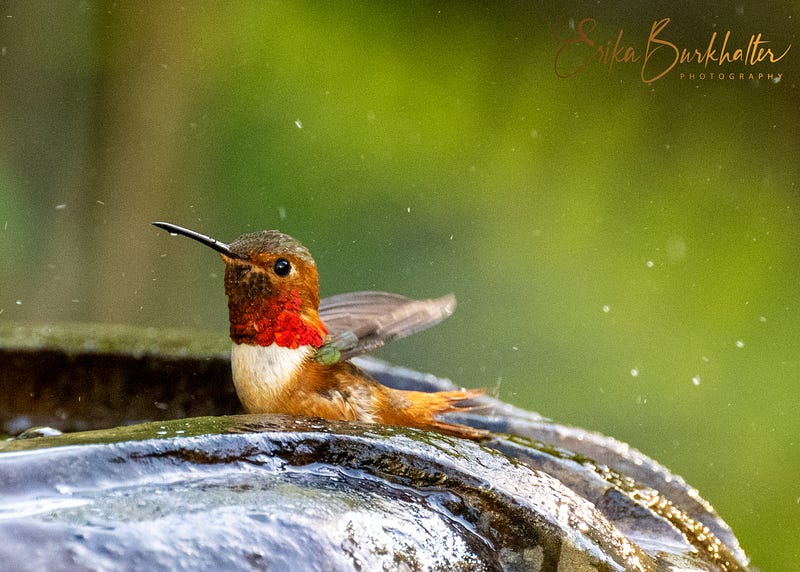
This is “Eugenia.” She loves to bathe in the fountain too. And, since she is not a rival male, Big Red tends to let her take a dip whenever she likes.
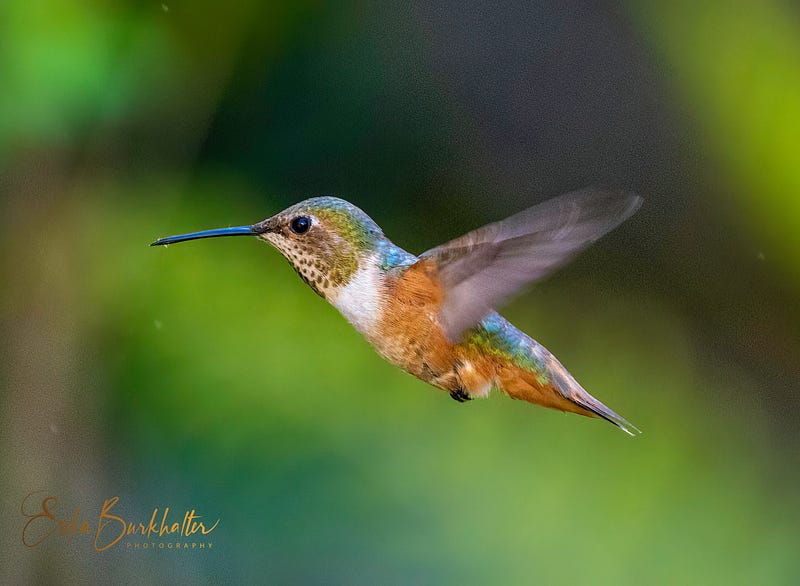
Although Eugenia has the same rust-colored and iridescent green feathers as Big Red, you can clearly see that she does not sport the red “gorget.” She has just a few tiny “jewels” bedecking her throat.
Hummingbirds’ feet are tiny and they only use them for perching, scratching, and nest building. Instead of using their feet to launch into flight, the wings do all the work. Their order name, Apodiformes, meaning footless, makes sense when seeing a hummingbird in flight. Their feet are nearly invisible. While they do have feet, they do not have knees.
In this next photo, you can see Big Red hiding out in the orange tree, on high alert.
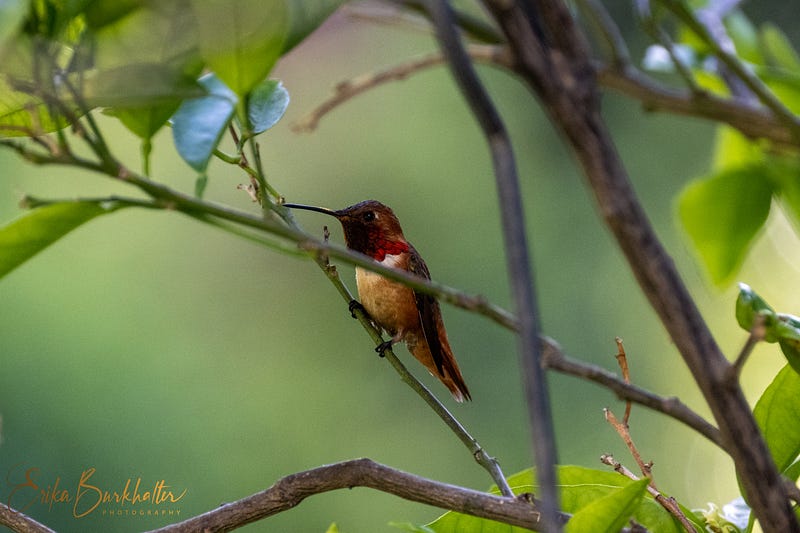
Hummingbirds’ wings rotate in a figure-eight pattern between ten and eighty times per second during flight. But, during courtship dives, their wingbeats can reach up to two hundred flaps per second.
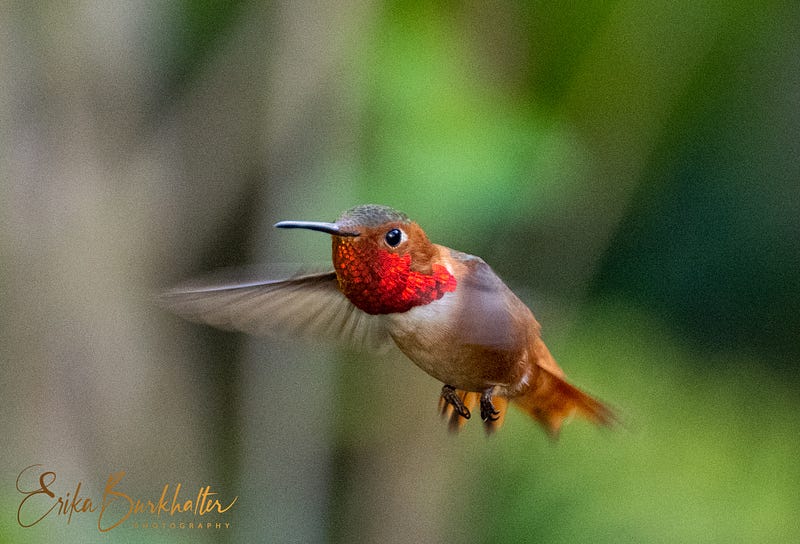
You’ve probably heard that shrill squeal they make when trying to impress a female or to run off another male. What you might not have realized is that the noise comes from the way they angle their wings and tail feathers during those sharp descents.
I hope that you enjoyed this little foray into the world of Big Red, Einstein and Eugenia, my backyard hummingbirds. These little birds bring me endless delight.
Stay tuned for more tales of the neighborhood. We’ve also got a pair of Cooper’s Hawks who’ve moved into the pine trees on the hill. And Eugenia recently had her own photo shoot….
To feed the hummingbirds, a simple solution of sugar to water in a 1:4 proportion is best. Please never use red dye in their food. It can cause throat cancer. Also, never use organic sugar, which is processed with molasses (which they cannot tolerate), when making their nectar. They also love all sorts of flowering plants, like salvia.
Erika Burkhalter is a yogi, neurophilosopher, cat-mom, photographer, and lover of travel and nature, spreading her love and amazement for Mother Earth’s glories, one photo, poem or story at a time. (MS Neuropsychology, MA Yoga Studies).
You might also enjoy:
Photos and story ©Erika Burkhalter. All rights reserved.
If you enjoyed this piece, you might consider subscribing to my stories. You’ll get an alert whenever a story gets published. While I do normally post my stories with free “friends” links on social media, if you enjoy reading on medium, you can help the many talented writers here by joining. It helps to support the arts and to keep us writing!
If any of these photos speaks to you, please message me about how to purchase an image.
You might have noticed that this was published in my fairly-new little publication, Butterfly Dreams, which I created to house some of my favorite pieces. If you’d like to stay abreast of things, you might like to subscribe.


