avatarErika Burkhalter

Free AI web copilot to create summaries, insights and extended knowledge, download it at here

3627

Abstract

on high alert, though, waiting for the impending arrival of the dominant male.</p><p id="a812">And, sure enough, the little guy has been spotted.</p><figure id="a9d4"><img src="https://cdn-images-1.readmedium.com/v2/resize:fit:800/1*3WXnJaOsu52kw6q12WsXrg.jpeg"><figcaption>“Oh no! I’ve been spotted!” Photo ©Erika Burkhalter</figcaption></figure><p id="ab38">Big Red swoops in with a clicking, screeching ferocity, intended to strike fear into the other birds’ hearts.</p><figure id="1fef"><img src="https://cdn-images-1.readmedium.com/v2/resize:fit:800/1*ALnFK-J63ACWpo3vbTXxFw.jpeg"><figcaption>“I’ll dive bomb that punk!” Photo ©Erika Burkhalter.</figcaption></figure><p id="6af8">But he sure is gorgeous, isn’t he? <a href="https://www.allaboutbirds.org/guide/Allens_Hummingbird/id">At about 2–4 grams and only 3.5 inches long</a>, he is tiny but mighty.</p><figure id="ac48"><img src="https://cdn-images-1.readmedium.com/v2/resize:fit:800/1*Wjdzefnef36Dt9fdkRu0tw.jpeg"><figcaption>“I don’t know what that youngster was thinking! This is clearly my fountain.” Photo ©Erika Burkhalter</figcaption></figure><p id="e7da">Those shimmering feathers look very different in the shadows than they do in the sunshine. If the birds are just facing in a different direction (like in the following photo), those chin feathers don’t look as red. In the previous photo, Big Red is facing into the light and glowing like a beacon of brightness. In the next one though, his throat looks much darker.</p><p id="e371">Hummingbirds<a href="https://www.audubon.org/news/hummingbirds-owe-their-shimmer-microscopic-pancake-structures"> owe their shimmer not to pigmentation, but to tiny air pockets in their feathers.</a></p><figure id="37d3"><img src="https://cdn-images-1.readmedium.com/v2/resize:fit:800/1*ID4guVLZxgvH-PCEkrfINg.jpeg"><figcaption>“Aaaaah.” Photo ©Erika Burkhalter</figcaption></figure><p id="25d0">This iridescence is similar to what gives soap bubbles, oil slicks, and some seashells their rainbow glow and it is due to the presence of structures called <a href="https://www.audubon.org/news/hummingbirds-owe-their-shimmer-microscopic-pancake-structures">melanosomes, which are so tiny that 100 million of them can fit on a single hummingbird feather.</a></p><figure id="5d31"><img src="https://cdn-images-1.readmedium.com/v2/resize:fit:800/1*rxdo3uZGLU07mRMdM4r_WQ.jpeg"><figcaption>“Baths are so relaxing.” Photo ©Erika Burkhalter</figcaption></figure><p id="0d1a">A flock of hummingbirds is known as a glittering, a shimmer, a bouquet, a hover, or a tune — all very fitting names for a group of these glimmery, chatty, little birds.</p><p id="1a09">Interestingly, hummingbirds have no sense of smell. But they are attracted to red and orange, so planting things like salvia or honeysuckle near their feeders helps to attract them.</p><p id="8bf0">To drink their sugar water or flower nectar, they move their tiny tongues in and out as fast as thirteen times a second. They can eat up to twice their body weight in a day.</p><p id="d37b">Please never use red dye in their food. It can cause throat cancer. Also, never use organic sugar, which is processed with molasses (which they cannot tolerate), when making their nectar. A simple solution of sugar to water in a 1:4 proportion is best.</p><figure id="164a"><img src="https://cdn-images-1.readmedium.com/v2/resize:fit:800/1*rzDazATV7L0IX2dyjrNW7w.jpeg"><figcaption>“I like to play with water droplets.” Photo ©Erika Burkhalter</figcaption></figure><p id="0c98">Big Red greatly enjoyed his bath before darting off again after another hummer. And I greatly enjoyed watc

Options

hing him.</p><p id="a9ed">But stay tuned for Part II of this story, because (as you can see in the following photo) a whole other drama was playing out on the opposite side of the fountain, where Big Red could not see what was happening.</p><p id="e908">Their territories are not that big and another male, who resides in the camelia bush on the other side of the garden, has claimed the left-hand side of the fountain to be his domain. So, the story continues….</p><figure id="059d"><img src="https://cdn-images-1.readmedium.com/v2/resize:fit:800/1*XoGsjwcTnXnz-bW8LN2TRg.jpeg"><figcaption>There’s a whole other “territorial battle” going on at the other side of the fountain. Stay tuned for more photos. Photo ©Erika Burkhalter</figcaption></figure><p id="7ca7">All photos were taken on a Nikon z7II and the newly-released Nikon 100–400mm (ƒ4–5.6) VR S lens.</p><p id="18ab"><i>Erika Burkhalter is a yogi, neurophilosopher, cat-mom, photographer, and lover of travel and nature, spreading her love and amazement for Mother Earth’s glories, one photo, poem or story at a time. (MS Neuropsychology, MA Yoga Studies).</i></p><p id="dbbc">I hope you enjoyed my photos and musings. You might also like:</p><div id="56d5" class="link-block"> <a href="https://readmedium.com/the-hummingbird-totem-37cde94a9daa"> <div> <div> <h2>The Hummingbird Totem</h2> <div><h3>The flash of iridescence, the hum of tiny wings moving so fast that they look like the glow of an angel, the squeal of…</h3></div> <div><p>medium.com</p></div> </div> <div> <div style="background-image: url(https://miro.readmedium.com/v2/resize:fit:320/1*uxnLjnqhj4hS7VBA9dfOHQ.png)"></div> </div> </div> </a> </div><div id="3c6a" class="link-block"> <a href="https://readmedium.com/i-may-be-tiny-but-i-am-mighty-f065533489f"> <div> <div> <h2>I May be Tiny, but I am Mighty</h2> <div><h3>The ferocious Allen’s Hummingbird</h3></div> <div><p>medium.com</p></div> </div> <div> <div style="background-image: url(https://miro.readmedium.com/v2/resize:fit:320/1*3dW5PUijHwSewh0K7CAQbQ.jpeg)"></div> </div> </div> </a> </div><div id="3873" class="link-block"> <a href="https://readmedium.com/the-wolf-moon-357b34f41259"> <div> <div> <h2>The Wolf Moon</h2> <div><h3>A Goddess poem</h3></div> <div><p>medium.com</p></div> </div> <div> <div style="background-image: url(https://miro.readmedium.com/v2/resize:fit:320/1*Aeu8c_XV-2koCc4_ibO0kw.jpeg)"></div> </div> </div> </a> </div><p id="1978"><i>Photos and story ©Erika Burkhalter. All rights reserved.</i></p><p id="cf0e">If you enjoyed this piece, you might consider <a href="https://erikaburkhalter.medium.com/subscribe">subscribing to my stories</a>. You’ll get an alert whenever a story gets published. While I do normally post my stories with free “friends” links on social media, if you enjoy reading on medium, you can help the many talented writers here by <a href="https://erikaburkhalter.medium.com/membership">joining</a>. It helps to support the arts and to keep us writing!</p><p id="8e37">If any of these photos speaks to you, please message me about how to purchase an image.</p></article></body>

“Hi. I’m ‘Big Red.’ I rule the fountain.” Photo ©Erika Burkhalter

Splish, Splash, Taking a Bath. A Tale of Two Hummingbirds at My Garden Fountain.

Zooming in with my new Nikon 100–400mm (ƒ4–5.6) VR S lens

The screeching and dive-bombing go on all day long. “Big Red,” the dominant male Allen’s Hummingbird spends most of his time darting back and forth from his perch in the nearby orange tree to the feeder and back again to the tree, where he can keep an eye on the fountain, which he clearly believes is his, and his alone.

I happened to be at my kitchen sink when I saw a flurry of activity at the fountain. So, I grabbed my Nikon z7II and my new Nikon 100–400mm lens (which I got for Christmas) and crept out into the garden. It was a bit overcast, so I wasn’t sure how well their chins would shimmer, but it was really fun to be able to “freeze-frame” the action at the fountain. The hummingbirds normally move so fast that it’s hard to see the details.

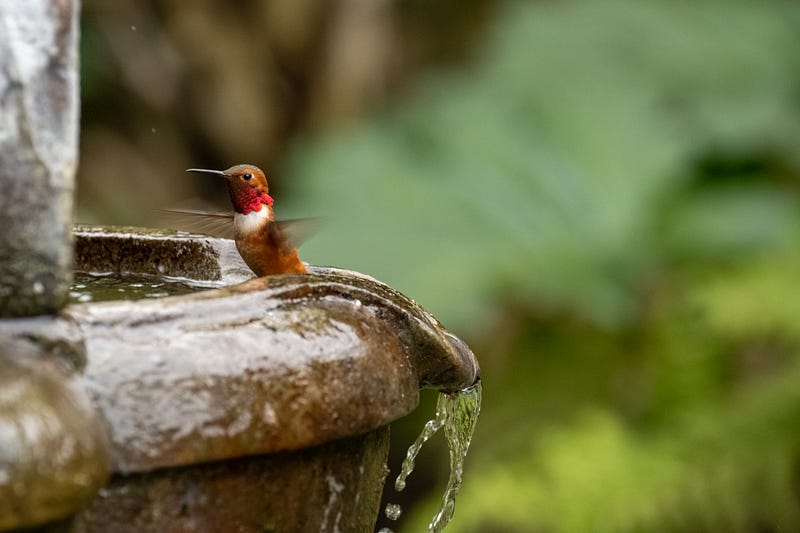
You can tell the difference between the “big boys” and the females and juvenile males by the amount of red feathers adorning their chins and chests. Big Red is clearly adorned in his full plumage. If you look closely, you can see that he looks like he is wearing a cape, that drapes over his shoulders, of iridescent scales.

But the young male in the next photo is just beginning to get his “stubble.”
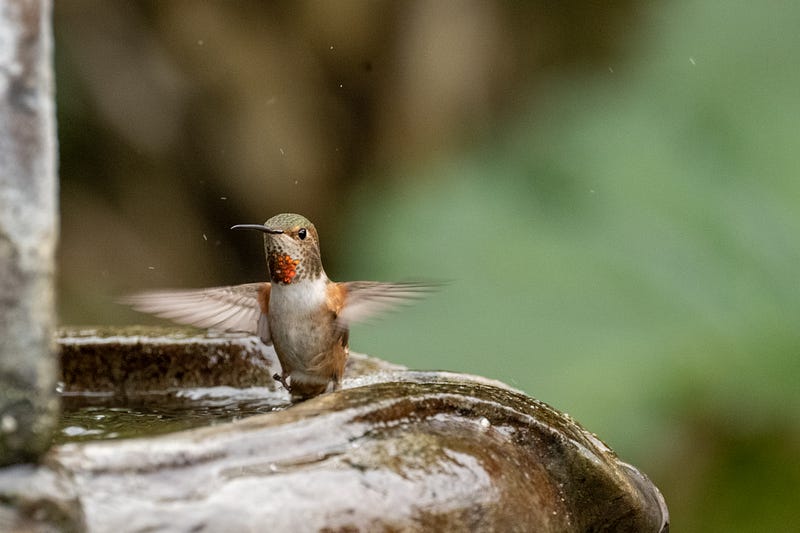
“I’ve snuck in while Big Red wasn’t looking.” Juvenile Male Allen’s Hummingbird. Photo ©Erika Burkhalter.

The girls often have a red dot or two on their chins. And the males begin to get more and more of those dots, until they all fill in when they reach adulthood.

Who knows, this juvenile might be the next Big Red one day? But, for the moment, he has to satisfy himself with sneaking in while Big Red takes to the skies in pursuit of another competitor.
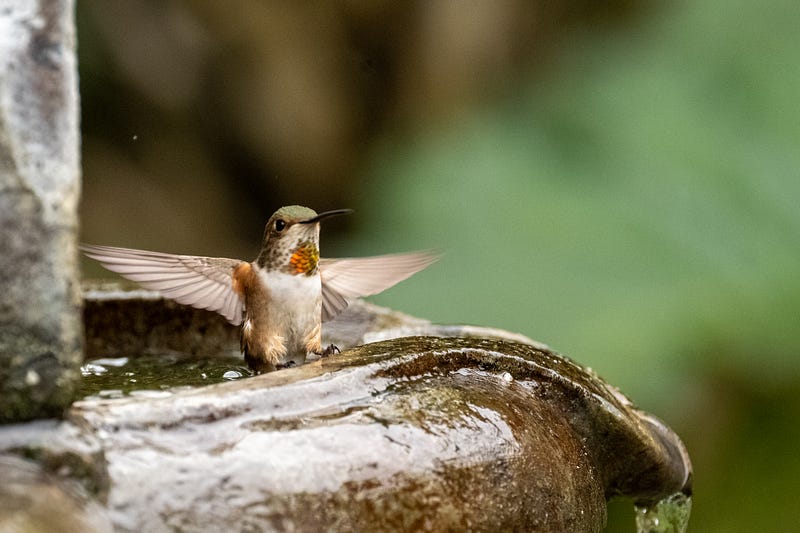
“Aren’t my little ‘pantaloons’ cute?” Photo ©Erika Burkhalter.

Aren’t his little “pantaloons” adorable?

After looking around a bit to be certain that Big Red was nowhere in sight, he relaxed.
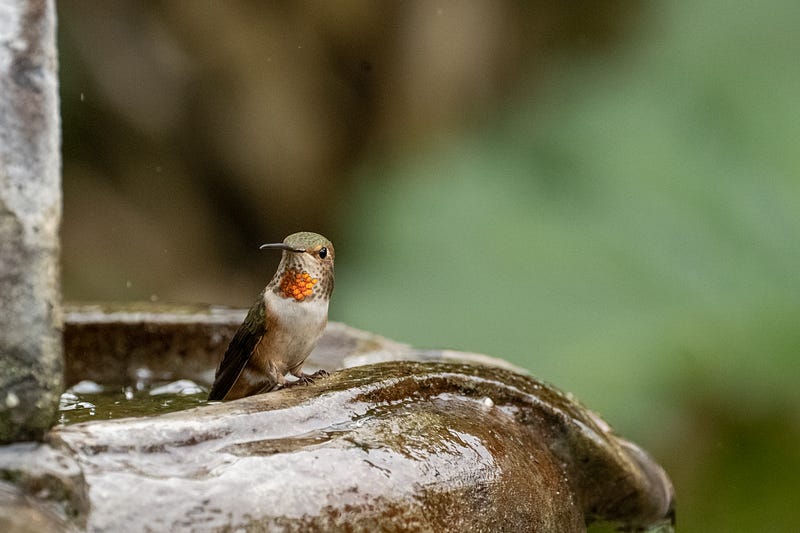
“I don’t see him anywhere.” Photo ©Erika Burkhalter

The little one clearly thought he was safe for a few moments and took a little “breather” on the side of the fountain.
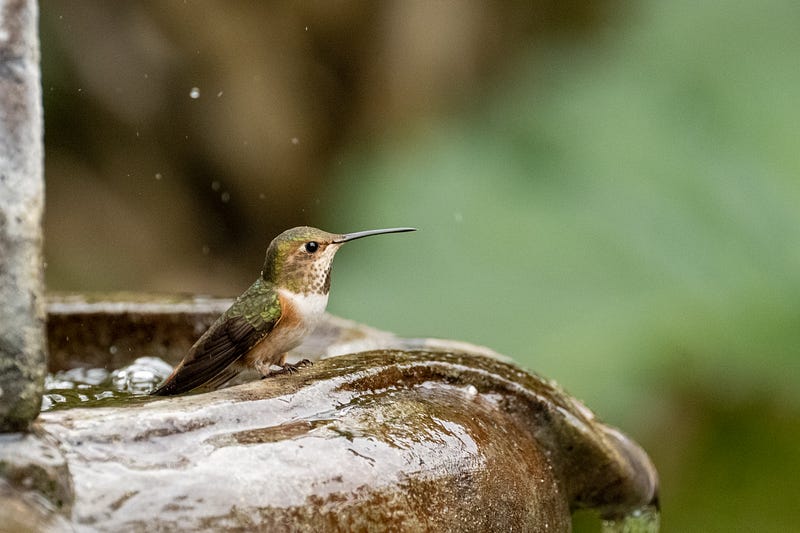
“Whew. I think I’m safe. Time for a bath.” Photo ©Erika Burkhalter

But hummingbirds cannot resist the lure of the water. They take such great delight in splashing and playing and tossing water droplets into the air.
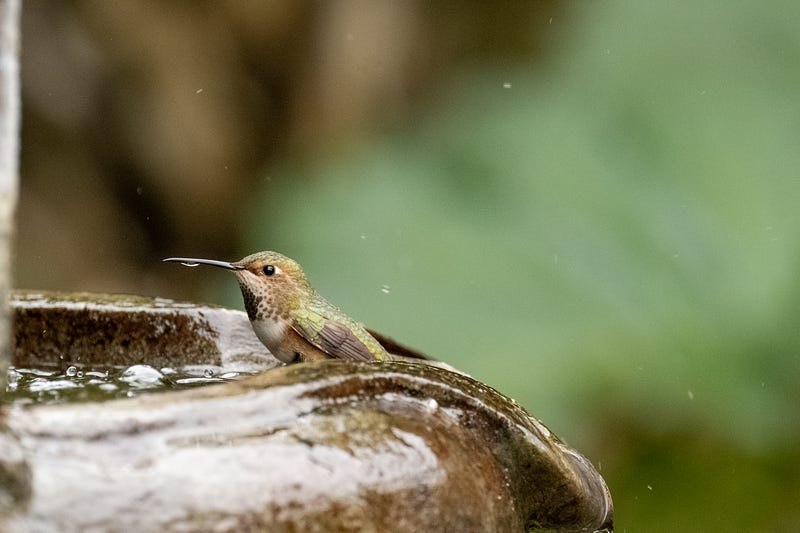
“Bath time.” Photo ©Erika Burkhalter

They’re also always on high alert, though, waiting for the impending arrival of the dominant male.

And, sure enough, the little guy has been spotted.
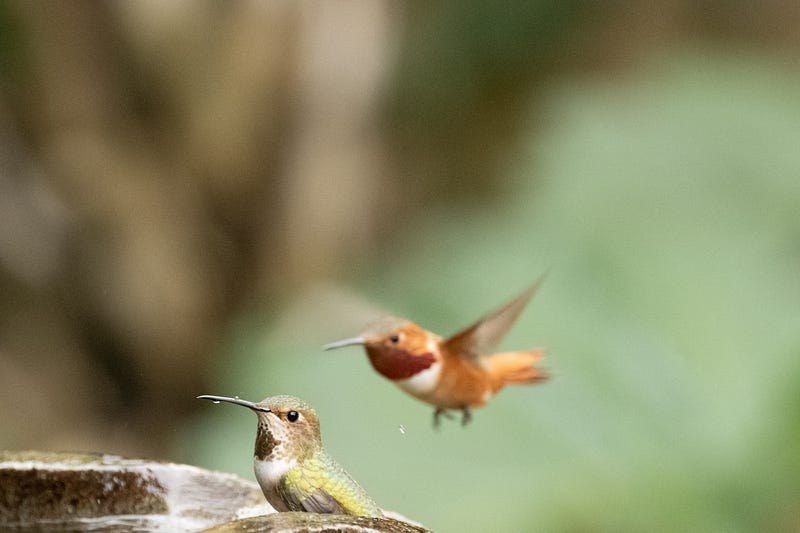
“Oh no! I’ve been spotted!” Photo ©Erika Burkhalter

Big Red swoops in with a clicking, screeching ferocity, intended to strike fear into the other birds’ hearts.
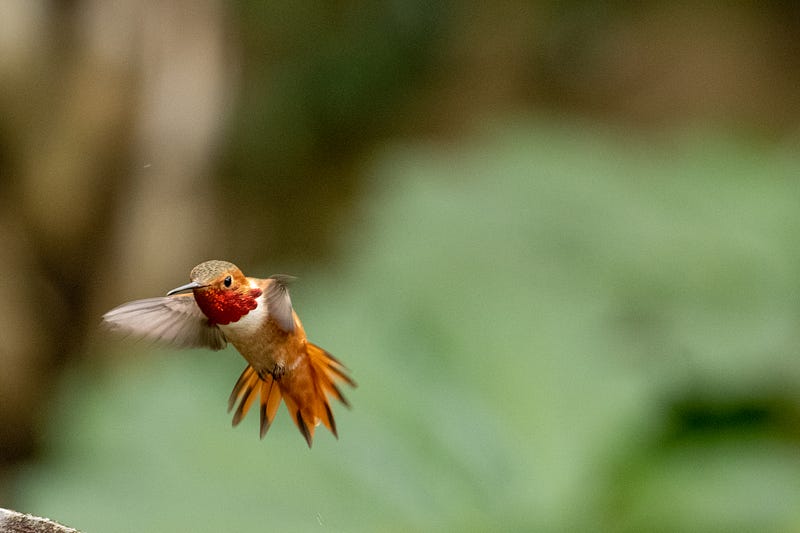
“I’ll dive bomb that punk!” Photo ©Erika Burkhalter.

But he sure is gorgeous, isn’t he? At about 2–4 grams and only 3.5 inches long, he is tiny but mighty.
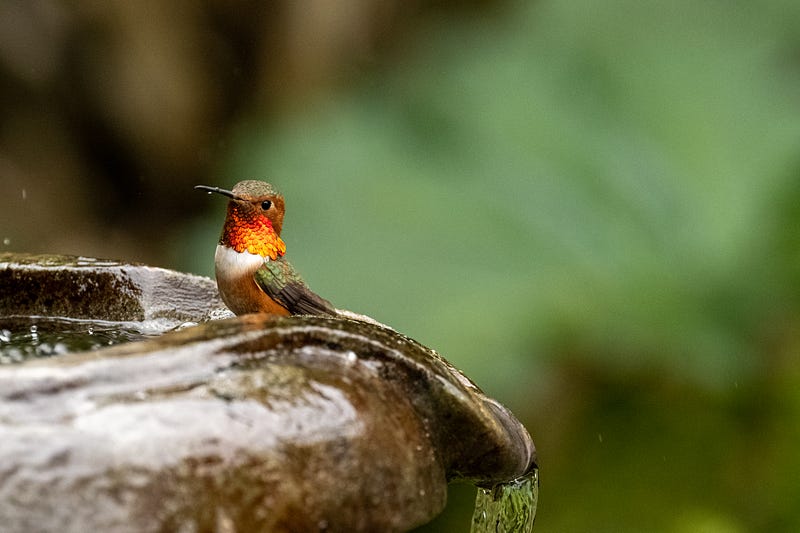
“I don’t know what that youngster was thinking! This is clearly my fountain.” Photo ©Erika Burkhalter

Those shimmering feathers look very different in the shadows than they do in the sunshine. If the birds are just facing in a different direction (like in the following photo), those chin feathers don’t look as red. In the previous photo, Big Red is facing into the light and glowing like a beacon of brightness. In the next one though, his throat looks much darker.

Hummingbirds owe their shimmer not to pigmentation, but to tiny air pockets in their feathers.
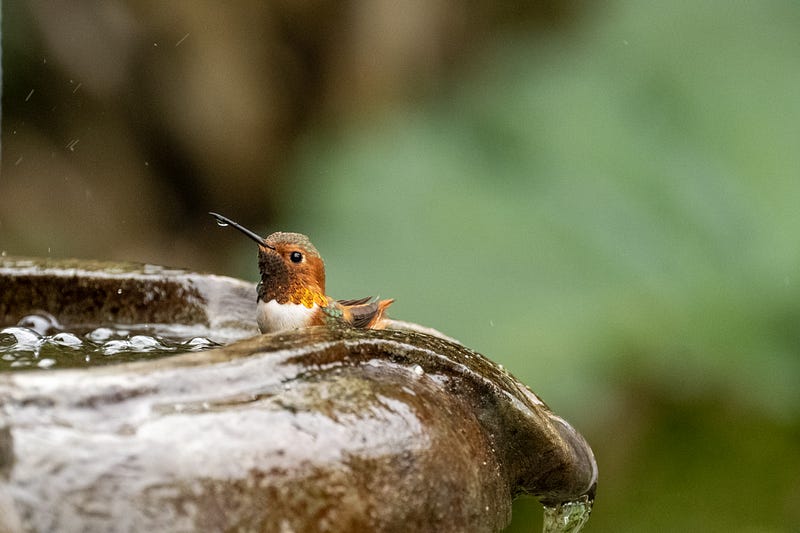
“Aaaaah.” Photo ©Erika Burkhalter

This iridescence is similar to what gives soap bubbles, oil slicks, and some seashells their rainbow glow and it is due to the presence of structures called melanosomes, which are so tiny that 100 million of them can fit on a single hummingbird feather.
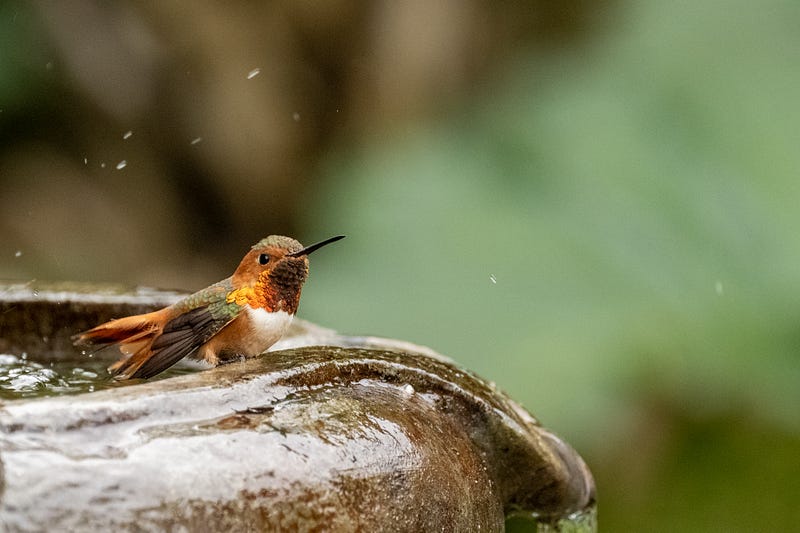
“Baths are so relaxing.” Photo ©Erika Burkhalter

A flock of hummingbirds is known as a glittering, a shimmer, a bouquet, a hover, or a tune — all very fitting names for a group of these glimmery, chatty, little birds.

Interestingly, hummingbirds have no sense of smell. But they are attracted to red and orange, so planting things like salvia or honeysuckle near their feeders helps to attract them.

To drink their sugar water or flower nectar, they move their tiny tongues in and out as fast as thirteen times a second. They can eat up to twice their body weight in a day.

Please never use red dye in their food. It can cause throat cancer. Also, never use organic sugar, which is processed with molasses (which they cannot tolerate), when making their nectar. A simple solution of sugar to water in a 1:4 proportion is best.
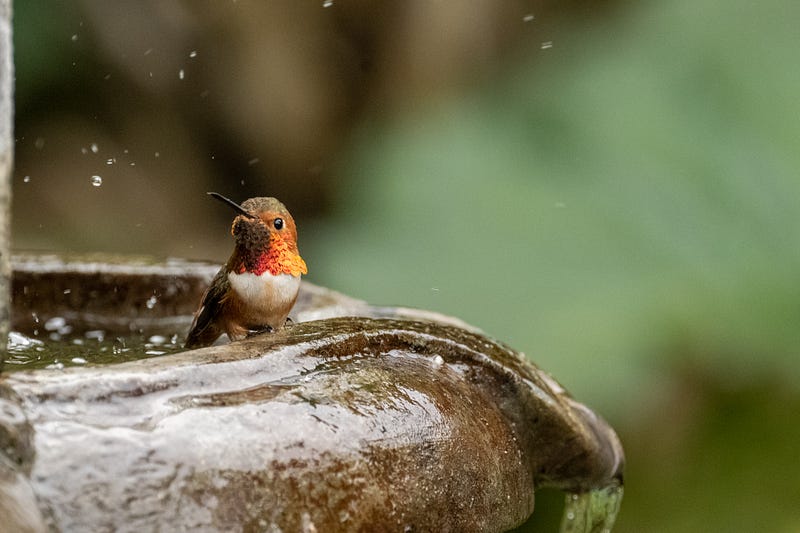
“I like to play with water droplets.” Photo ©Erika Burkhalter

Big Red greatly enjoyed his bath before darting off again after another hummer. And I greatly enjoyed watching him.

But stay tuned for Part II of this story, because (as you can see in the following photo) a whole other drama was playing out on the opposite side of the fountain, where Big Red could not see what was happening.

Their territories are not that big and another male, who resides in the camelia bush on the other side of the garden, has claimed the left-hand side of the fountain to be his domain. So, the story continues….
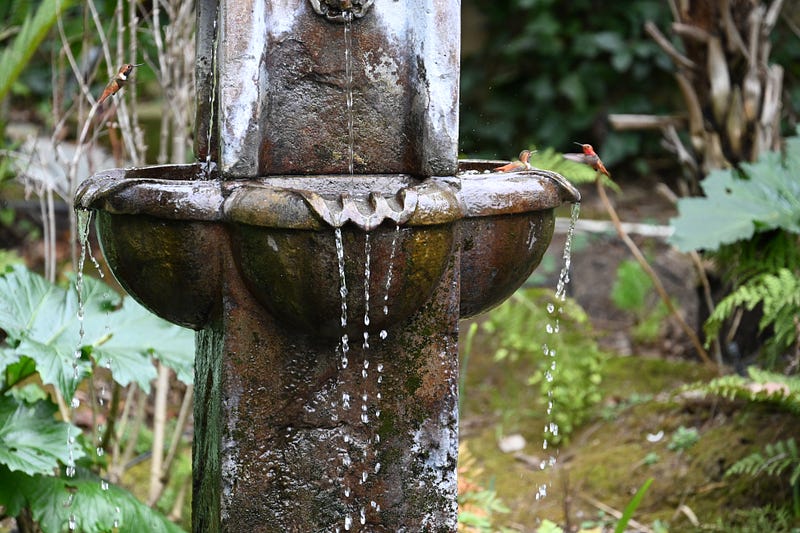
There’s a whole other “territorial battle” going on at the other side of the fountain. Stay tuned for more photos. Photo ©Erika Burkhalter

All photos were taken on a Nikon z7II and the newly-released Nikon 100–400mm (ƒ4–5.6) VR S lens.

Erika Burkhalter is a yogi, neurophilosopher, cat-mom, photographer, and lover of travel and nature, spreading her love and amazement for Mother Earth’s glories, one photo, poem or story at a time. (MS Neuropsychology, MA Yoga Studies).

I hope you enjoyed my photos and musings. You might also like:

Photos and story ©Erika Burkhalter. All rights reserved.

If you enjoyed this piece, you might consider subscribing to my stories. You’ll get an alert whenever a story gets published. While I do normally post my stories with free “friends” links on social media, if you enjoy reading on medium, you can help the many talented writers here by joining. It helps to support the arts and to keep us writing!

If any of these photos speaks to you, please message me about how to purchase an image.

Photography
Nature Photography
Nature
Hummingbird
Photography Tips
Recommended from ReadMedium