
Nature, Orioles, Photography
The Orioles are Back
The arrival of these bright beauties always announces spring
That “click click” chatter from the treetops always announces the Orioles’ return to my garden in Southern California long before I ever spot them with my eyes. Hooded Oriole pairs “talk” to each other all day long from the shelter of the tree canopy.
Their mix of chirps and cries can sometimes includes a few notes from other birds. In Arizona, they often mimic Gila Woodpeckers and Ash-throated Flycatchers.
The female, who is a much paler green-yellow than the male, who wears an audaciously bright yellow suit with a black eye “mask” and chin, is better at camouflaging herself than her mate. She blends in well with the palm leaves and the Giant Bird of Paradise which stud my hillside.
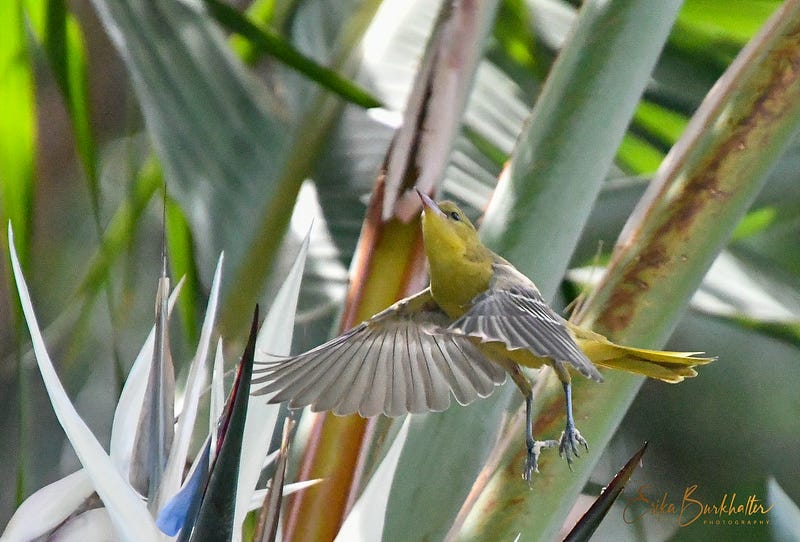
It is the sticky, drippy flowers on my Giant Birds of Paradise which lure them back to my garden each year. While I do put out sugar-water feeders for them, they cannot resist the natural nectar of these huge flowers.
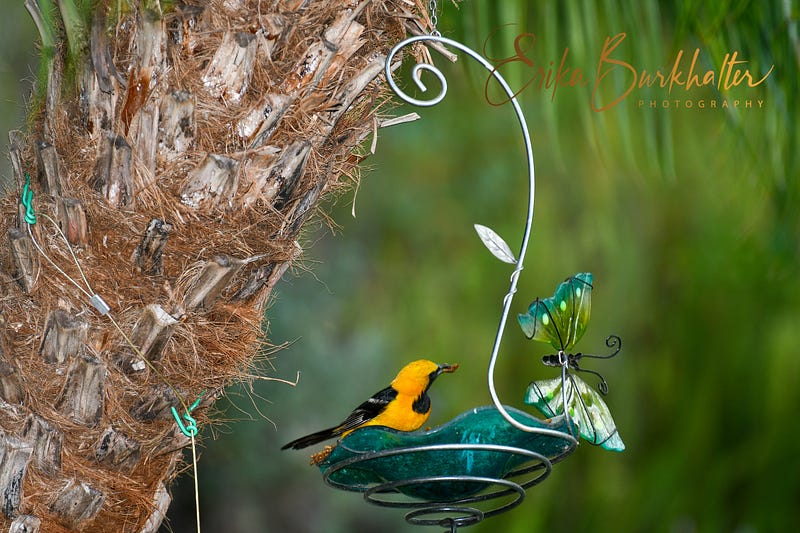
If you do feed them, be aware that their beaks are too large to fit through the holes of most hummingbird feeders (although they will attempt to drink from them). They can manage the the type of nectar feeders which hang upside down with a tube. I’ve seen them pull off some pretty acrobatic feats to get to that nectar. I bought an orange glass feeder built just for them. I has larger openings for their beaks.
It is best to make your own sugar water (1:3 parts sugar to water) and never use food coloring (which can give them throat cancer) or organic or raw sugars (which can contain molasses, which they cannot tolerate).
I often put out meal worms for them in a little hanging glass dish. They absolutely adore this delicacy. This year, I spotted the male eating my “fruit and seed” blend of bird food too.
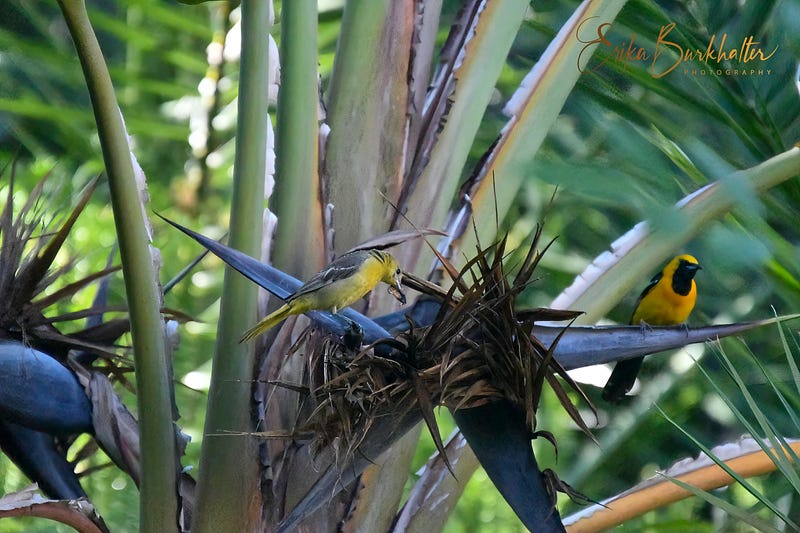
In this next photo you can see the distinct color difference between the male and female. They are perched upon an end-of-the-season dried Bird of Paradise flower, trying to extricate every last little bit of nectar that they can.
Here, in California, they are sometimes called “palm-leaf orioles” because of their tendency to build nests in palm trees. A mated pair built one of these nests in the very tippy top of one of my 100-foot-tall palms a couple of years ago. It was a feat of engineering marvel.
The female pokes holes in the leaf from below and pushes the fibers through, effectively sewing the nest to the leaf. What results is an oblong “coconut” — looking structure with an opening on each side. It was a bit like a blimp hanger with an opening on each side.
Once the baby appeared, those parents were constantly busy flying in one side of the nest with a treat and then flying back out the other side in search of more food. My husband and I spent many an evening lying flat on our backs on the decking around the pool with a pair of binoculars trained on them (I didn’t yet have a lens long enough to capture the action on film).
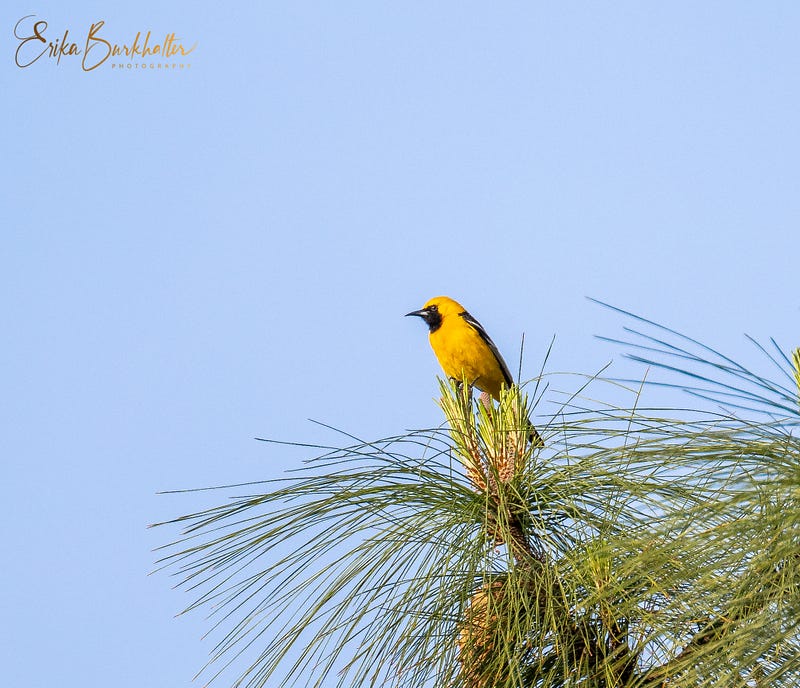
I’m really hoping that they’ll build another nest this year. We seem to have a tempting habitat for them because of the tall trees and the abundance of food.
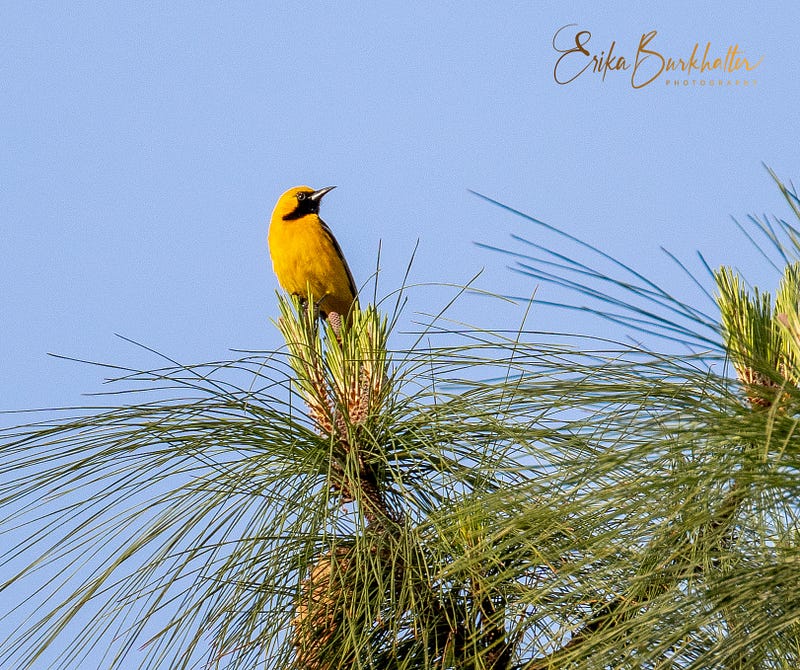
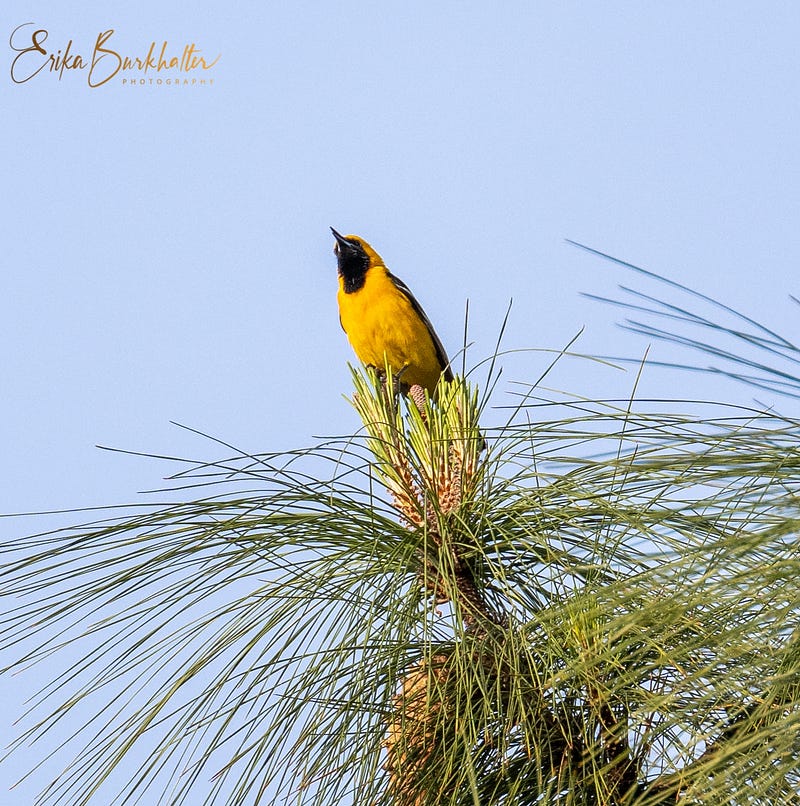
I’ve only been able to photograph the male so far. I spotted him perched, like a little king of his fiefdom, way up on top of a pine tree in my neighbor’s yard. I’ve seen the female too, but I haven’t been able to take her picture. As with most birds, you need to become a part of their environment by sitting quietly near where they tend to hang out before they will feel safe enough for you to pull out the camera.
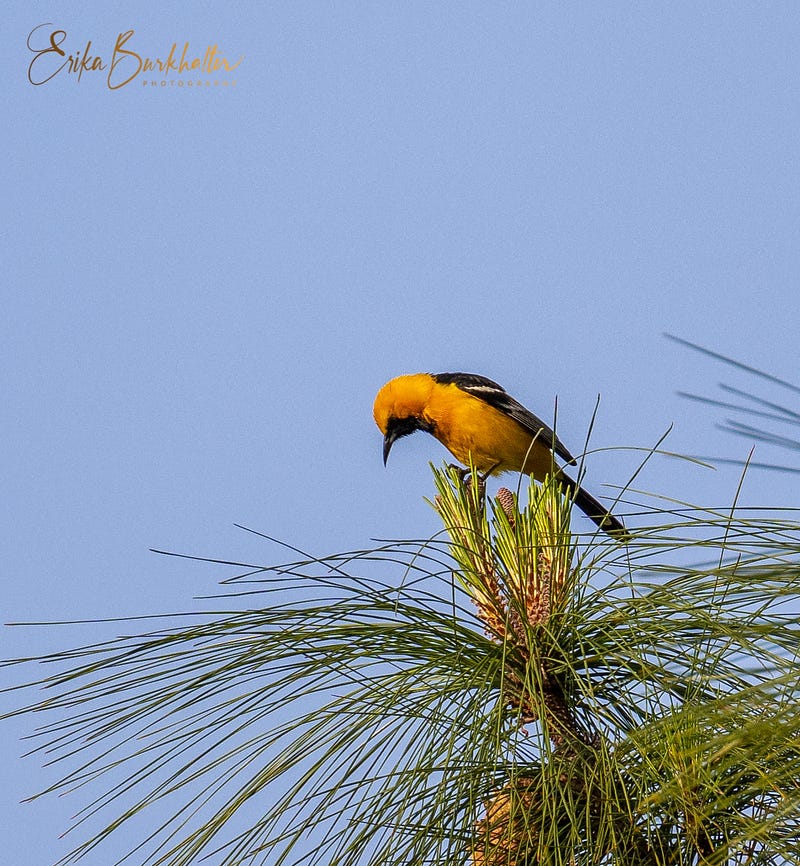
Orioles are members of the blackbird family (Icteridae), along with meadowlarks and cowbirds (you can see photos of these birds by clicking on this link). I was surprised to learn this fact.
But if you look at them, their body shape really does resemble the other birds in this family. And they all have long pointy bills which helps them get to food which other birds can’t reach. They can pry apart thick patches of grass (or Bird of Paradise flowers), can enlarge holes in tree bark, and can dig into ripe fruits to be able to get to the juice.
I’ve had my eyes peeled on the hillside lately for two pairs of mating hawks (which we think are trying to nest nearby) and I tend to have my cameras at the ready, so I’m hoping that I’ll be able to get a photo of the female Oriole soon.
But for now, I’m happy to have been able to capture a moment with the male. He was just happy and just seemed to be “taking it all in” after his long migration from Mexico. And I’m keeping my fingers crossed for another baby!
Erika Burkhalter is a yogi, neurophilosopher, cat-mom, photographer, and lover of travel and nature, spreading her love and amazement for Mother Earth’s glories, one photo, poem or story at a time. (MS Neuropsychology, MA Yoga Studies).
You might also enjoy:
If you’re interested in keeping up with my poems, photos and musings, you might consider subscribing to my stories.
If you enjoy reading on medium, you can help the many talented writers here by joining. It helps to support the arts and to keep us writing!
And, because I’ve had a few people asking lately, if you’re ever interested in purchasing a photo, just leave me a note.
Story and photos ©Erika Burkhalter. All rights reserved.


