
The Sustainable Development Trifecta
Life Efficiency, Energy Efficiency, Clean Energy
Introduction
The world faces a great challenge over the first half of the 21st century: Grant all global citizens a fair shot at a decent life while staying within the ecological carrying capacity of planet Earth. Our response to this challenge will echo through society for centuries to come.
Any successful strategy must simultaneously achieve a rapid increase in living standards and a rapid reduction in emissions. From an energy perspective, we have two sets of tools available for this purpose: energy efficiency and clean energy. Although they are very powerful, it is unrealistic to expect these sustainable development tools to reduce the emissions of rapidly growing developing nations at the required rate.
This article deploys some elementary math to uncover a third toolset, called life efficiency. As we shall see, this solution can make a tremendous contribution to the great 21st century sustainability challenge. The world is slowly starting to understand this potential, but there is a great need for further acceleration. I hope this article can make some contribution in this respect.
The 21st Century Sustainability Challenge
Historical data shows that eradicating poverty and protecting the environment are conflicting goals. It is easy to understand why — decent living standards require a certain level of material consumption, and all the materials we consume come from our environment.
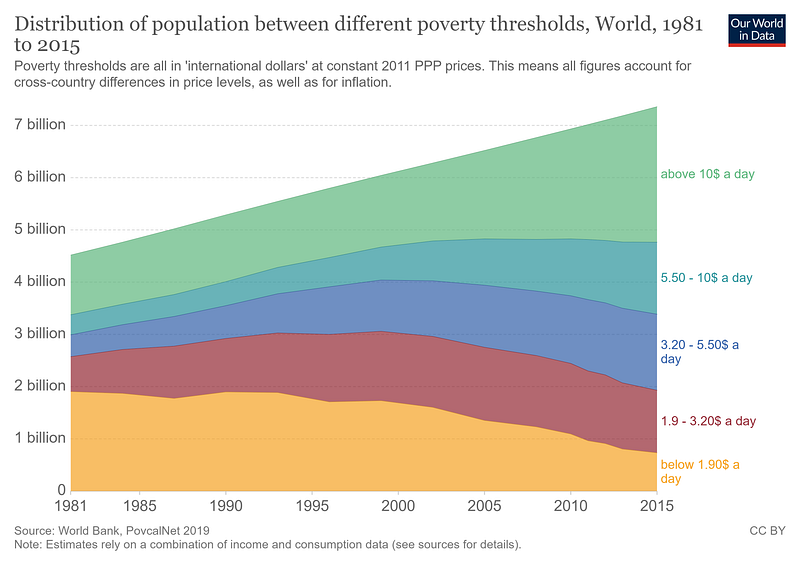
To illustrate, the graph below shows our steady progress in reducing extreme poverty.
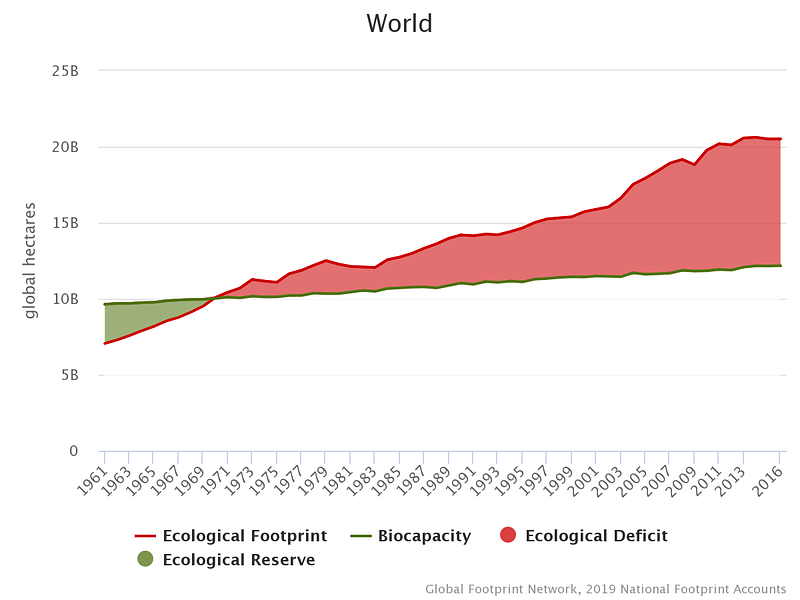
But this progress has come at the cost of a sizeable ecological overshoot. Currently, we need about 1.7 planets for a sustainable global economy.
And we still have a very long way to go. Case in point: the first graph above shows that almost 5 billion people still live on less than $10/day ($3650/year).
Have you ever tried living on $10/day? Neither have I. My minimalistic, eco-conscious lifestyle costs me almost triple that amount. This number, about $10000/year, looks like a good “decent living standard” target. But sadly, it is achieved by only 1 in every 6 world citizens today.
Between us and a world free from this grave social injustice stands a wall of ecological challenges of our own making, with climate change front-and-center. The science is clear: we need to sharply reduce our greenhouse gas emissions to avoid severe and irreversible damage. Unfortunately, current policies and pledges fall far short of this goal.
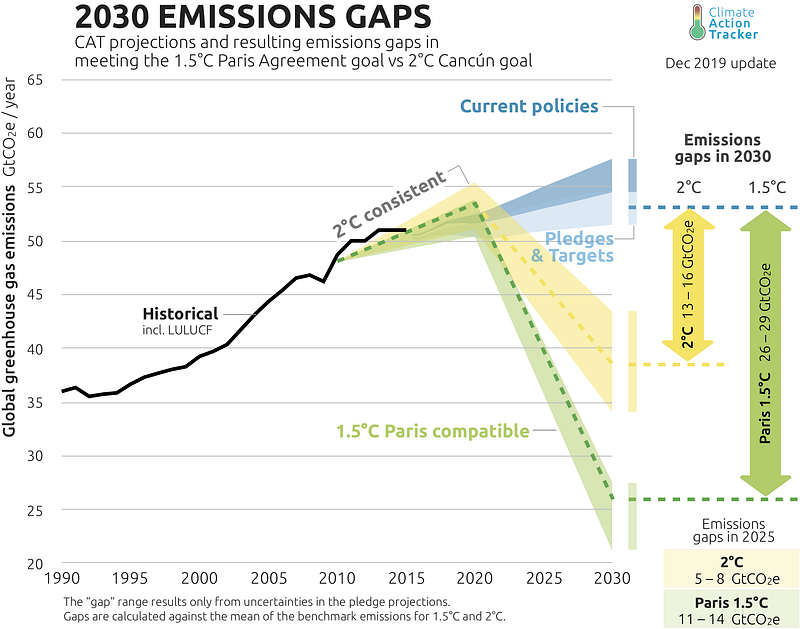
These graphs show that massive change is needed. We must shatter historical trends to accelerate poverty alleviation while dramatically shrinking our ecological footprints.
How can we accomplish this seemingly impossible task?
The Kaya Identity
In 1997, a Japanese energy economist proposed the following identity as a simple framework for contemplating this question.

Naturally, our global emissions depend on how many people our planet needs to sustain. But the Kaya identity shows us three other ratios that influence emissions:
- How much goods and services the average person produces and consumes (GDP/person)
- The energy required to produce those goods and services (Energy/GDP)
- The emissions intensity of all that energy (Emissions/Energy)
At the moment, the first ratio in this list is the key indicator of social progress. The more goods and services the average world citizen can produce and consume, the better.
Hence, GDP/person must always increase, while the global population also continues expanding. Thus, if we want to reduce our environmental impact, we need substantial reductions in the second and third ratios.
We can shrink the second ratio by using energy more efficiently. More efficient cars, better home insulation, and a preference for buying services rather than material goods all help.
Reducing the third ratio requires the development and deployment of cleaner energy sources such as renewable energy, nuclear, and CO2 capture from hydrocarbon fuels.
But this equation leaves out an essential additional lever we have at our disposal. It is about time this lever gets the recognition it deserves.
Life Efficiency
As mentioned above, GDP growth remains the central priority for national and global socio-economic development. But the fact is that we do not want more goods and services. What we want is all the happiness and longevity we think those goods and services can give us.
So, how can we measure our achievement of happiness and longevity? Arguably the best metric out there is “happy life years” — the product of a subjective wellbeing score and life expectancy.
Incorporating happy life years (HLY) into the Kaya identity looks like this:

This equation is almost the same as the original Kaya identity, aside from splitting the first ratio (GDP/Person) discussed above into two parts:
- The number of happy life years enjoyed by the average person (HLY/Person)
- The goods and services required for building a long and happy life (GDP/HLY)
This simple modification allows us to isolate the ratio we must keep increasing at any cost: HLY/Person.
It also identifies an invaluable additional lever we can pull to reduce our environmental impact: GDP/HLY. To make it easier to conceptualize and give it a more positive spin, we will work with the inverse of this ratio.
I like to call this ratio (HLY/GDP) Life Efficiency — our ability to extract health and happiness from all our effort and environmental impact.
Global Implications of Higher Life Efficiency
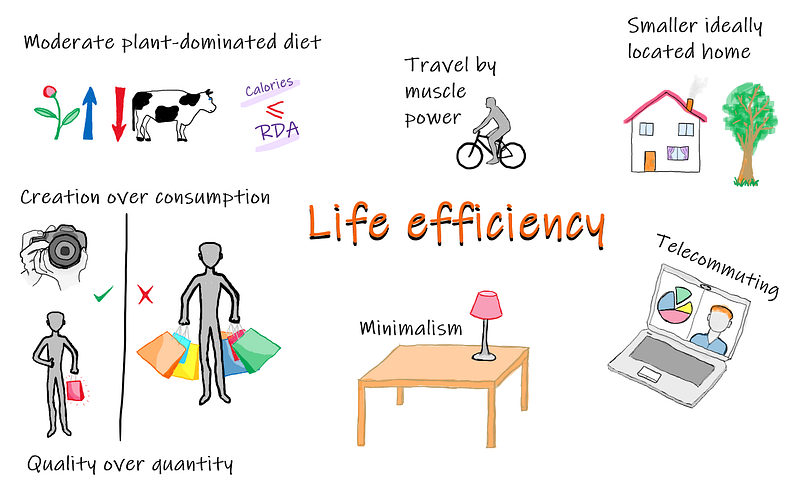
The untapped potential of life efficiency is tremendous. As shown below, life efficiency can be improved by more than 400% from the baseline of the United States. The figure also shows some simple measures for increasing life expectancy and wellbeing while decreasing spending.
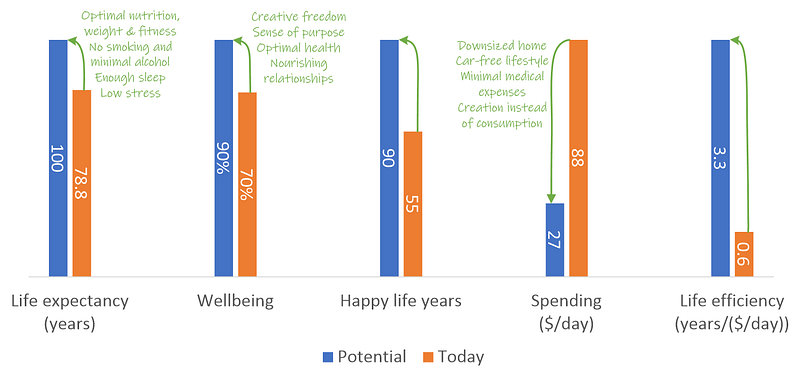
The optimal life expectancy given in the figure above is a bit of a guesstimate, based on ample proof that populations with healthy lifestyles produce many centenarians. Optimal wellbeing and spending estimates come from my own experience.
Interestingly, life efficiency can offer even greater environmental benefits than the 5x boost shown above. For example, a healthy plant-dominated diet of whole foods costs about the same as an unhealthy animal-dominated diet of processed food, but it has a much smaller ecological impact.
In addition, life efficiency offers two other characteristics that make it the perfect tool for rapidly building a sustainable and equitable society.
Rapid Deployment
Increasing life efficiency requires little more than a mindset shift. In contrast, energy efficiency and green energy require lots of capital-intensive technology to be developed, scaled up, and deployed.
If life efficiency can go viral in our interconnected society, the benefits will be vast and immediate. With movements such as the post-growth economy, downshifting, voluntary simplicity, and FIRE already gaining traction, this tipping point appears to be getting closer.
Yes, the 5x gain shown above is not a reasonable target. To give just one example, a car-free lifestyle is simply impractical for many people. But even a lowly 2x improvement will still have a massive positive impact.
The remaining 2–3x gain will take more time as eco- and people-centered urban development grows, telecommuting becomes the new normal, the health and wellness movement gathers further momentum, younger workers increasingly demand purpose over paychecks, and green peer pressure continues to mount.
Reduced Inequality
If today’s total global income could be equally distributed, we would already be over the $20/day mark — two-thirds of the way to the goal of “decent living standards for all.” But sadly, two-thirds of the world population remains below $10/day, illustrating the vast inequality in our society.
Currently, the top 10% are responsible for about half the world’s emissions. And, as little as us rich folks would like to admit it, the best way to get into the top 10% is to win the lottery of birth (i.e., pure luck).
Improved life efficiency can dramatically reduce the consumption of this lucky group, freeing up more planetary resources for the development of the remaining 90%. This will help to address the terribly unfair impact of climate change on poorer nations and leave a much larger portion of our aggregate productive capacity for building a sustainable and equitable society.
Another critical factor is what high earners with high life efficiencies choose to do with their substantial excess income. Luckily, my experience shows that figuring out how to deploy your surpluses to do maximum good for the world is much more rewarding than typical consumer spending. As wealthy individuals shake off their consumerist blinders and experience this for themselves, large changes will take place in the economy.
From a macroeconomic point of view, a sharp increase in life efficiency among upper-middle-class and wealthy individuals will increasingly direct the economy to build a better world instead of manufacturing excessive consumer goods and other wasteful luxuries. This shift will drive a very welcome redistribution of spending power around the world.
A Sustainable Life is a Good Life
After a decade of experimenting with the idea of life efficiency, I know one thing for sure: Sustainable living is no sacrifice. It is a direct pathway to a happy, healthy, wealthy, and productive life.
A sustainable ecological footprint has given me 11 consecutive years without a hint of illness, the financial freedom needed to retire at age 34, and the personal liberty and purpose required to happily work twice as much as the norm.
Massive global gains in life efficiency are 100% possible, intensely desirable, and already gaining significant traction around the world. Until recently, the idea of life efficiency has been passively ignored or actively dismissed in our consumerist society. But things are changing rapidly. People are waking up and looking for happiness and meaning beyond their primitive drive to consume.
Life efficiency may be an idea whose time has come. And the coming of age of this idea may well make a major contribution to humanity’s safe navigation of the 21st century.