
More Life from Less Spending
How to genuinely enjoy the long road to financial freedom.

You should save and invest 20% of your income for a comfortable retirement or an unforeseen crisis (such as a global pandemic).
How does this statement make you feel? I’ll wager somewhere between “meh” and “on the verge of closing this cliche article.”
Indeed, the internet is already packed with commonsense wealth advice. And despite being technically correct, it gets ignored by most. Why? Because it portrays financial responsibility as dull and uninspiring self-deprivation.
This article presents an alternative approach: finding real good vibrations in financial responsibility. And it works! For me, spending less became so deeply enjoyable that I earned my right to retire at age 34 on an academic’s salary before I even heard about the FIRE movement.
But before we embark on this beautiful road to financial freedom, let’s take a quick detour to the root of our spending problem.
The Hedonic Treadmill
(Perhaps more aptly named the consumerist hamster wheel)
The hedonic treadmill is the phenomenon where happiness levels quickly return to normal after we get a raise and start spending more. It’s why greater discretionary consumption rarely brings lasting life satisfaction.
To better understand the hedonic treadmill, we can turn to Maslow’s classic hierarchy of human needs (below). It’s easy to see that consumer spending satisfies the bottom two levels. But beyond that, things become rather murky. Yes, consumption can impact the top three levels, but can you really buy love, esteem, and self-actualization?
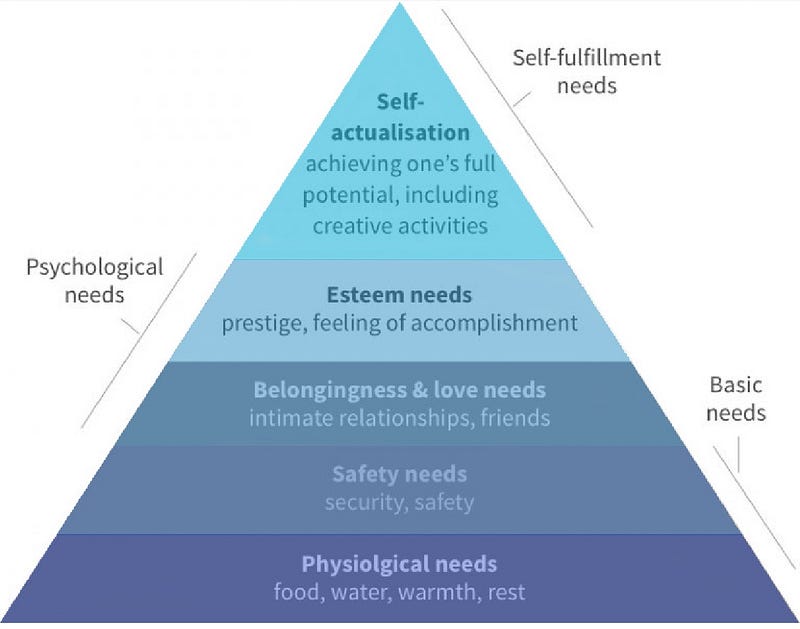
Massively overstating the weak link between consumption and higher human needs is the main objective of the advertising industry. And they should get an A for effort, I must say.
Hence, most people who have their bottom two levels well covered are still running on their consumerist hamster wheels, desperately chasing the advertised promise of happiness-through-consumption.
We need to stop — for the sake of the individual and the planet.
Here are four steps to ditching the hamster wheel, putting your feet on solid ground, and joyfully embarking on the road to financial freedom.
Discover the Deep Satisfaction of Growing Wealth
1 Seeing your wealth grow is an awesome feeling. And the feeling gets even better when wealth is expressed the right way.
Financial Resilience
Simply put, financial resilience is the number of years your wealth can sustain your current lifestyle:

This simple formula directly measures how much of your time and initiative genuinely belongs to you. In other words, it measures your freedom.
People have fought and died for freedom throughout human history. We just love it. That’s why seeing your freedom grow is such a fabulous feeling.
So, let’s take a closer look at the calculation of financial resilience.
Assets and Liabilities
For many people, their home will be their biggest asset, and their home loan their biggest liability. Cars (after depreciation) and car loans often come next.
Also subtract any other debt, such as student loans and credit card debt.
Finally, add your various financial assets like stocks, bonds, and cash.
Living Expenses
The best way to quantify your living expenses is to print out your annual bank statement, add up all the withdrawals, and remove anything that counts as an investment from the resulting total.
For monthly loan repayments, only the interest payment part counts as an expense. The rest can count as an investment.
Track Your Financial Resilience over Time
The first estimate will take you some time. But once you know where to get all the information, the occasional update goes much faster.
I update my assets and liabilities once a month, which takes me about 15 minutes. I also invest an hour or two each year to update and analyze my living expenses. The resulting data looks like this:
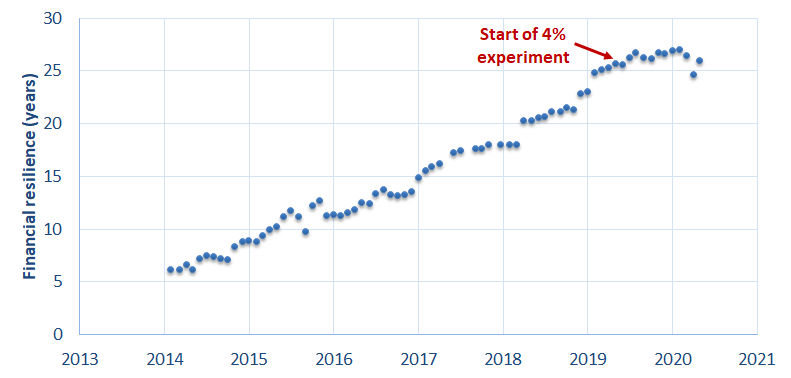
About one year ago, I started an interesting experiment to see if I can live only off my investment returns according to the 4% rule, giving me full ownership of my own time and initiative (true freedom).
I’m looking forward to discovering whether the old 4% rule still works. The ongoing crisis offers an interesting early investment challenge.
Get Hooked on Smart Lifestyle Design
2 The human mind loves a good challenge. And there are few challenges more interesting or important than deriving more happiness from less consumption via smart lifestyle design.
Once you get into it, I can tell you; you’ll be hooked for life. It’s just so incredibly interesting and rewarding!
The best place to start this grand, planet-saving experiment is with the Big Five middle-class expenses. Let’s take a look.
Home
Goal: Trade size for location, correctly accounting for just how deeply an ideal location can cut the other big expenses on this list.
Downsizing your home is one of the best automatic triggers for saving money. Not only will your mortgage payments shrink, but so will your utility bill, maintenance bill, and your spending on generic stuff.
With all these savings, and others down the list, you may just find yourself able to afford a place in a very cool part of town!
Car
Goal: Invest the great savings from losing the car into a home in an ideal location where car ownership is unnecessary.
Your car is costing you a lot more than just gasoline. There’s maintenance, insurance, financing costs, and the big one: depreciation. In the US, the average car costs its owner about $9000 per year.
Why not use some of that $9000 to choose your home in an excellent location where car ownership is unnecessary, saving lots of time, money, rush-hour frustration, and environmental impact?
But wait, there’s more: Travelling by muscle power instead of fossil power will also do wonders for your health, general fitness, and body image.
Health
Goal: Build an ideal healthy environment where illness (and the enormous costs it entails) simply does not happen.
Developed countries spend over $5000 per person per year on healthcare ($10000 in the US). And a massive 90% of this cost results from lifestyle diseases.
Want to make a great contribution to society? Build a truly healthy lifestyle.
More exercise from an ideally located home is a great start. A healthier relationship with food is the next step. And you can expect further benefits from reduced stress and better sleep after ditching your hamster wheel.
Food
Goal: Design your perfect zero-compromise diet where healthy eating becomes deeply enjoyable, practical, and affordable.
The average household food bill is close to $8000 in the US. There are two key ways to cut this large expense while simultaneously boosting health.
First, simply buy less food by reducing food waste and sticking to the recommended daily calorie intake. I know, easier said than done, right? Luckily, a passion for smart lifestyle design also increases motivation for healthy living. Ride this motivation to a leaner you.
Second, prepare your food at home. This becomes surprisingly easy when you free up all that time and energy previously wasted on the hedonic treadmill. Designing your unique zero-compromise diet will seal the deal.
Kids
Goal: Design your life so you can ace this 20-year project or make a firm choice to invest all this time and energy elsewhere.
Raising and educating children in today’s complicated world takes a tremendous amount of time, energy, and money. This article puts the cost at $14000 per year.
If you want kids, make sure to only commit to this responsibility if you can give them the best shot at life. That is, you currently save more than $14000 per year and can always give them priority access to your time.
Otherwise, the world offers a rich array of fascinating alternative possibilities for investing this time and energy.
Fall Deeply in Love with Creation
3 Humans are inherently creative creatures. Creation can bring just as much joy as consumption and offers way more fulfillment.
Personal Liberty
Many have died for the personal liberty we take for granted today. But the sad thing is that so many remain in economic slavery, working jobs they hate to keep that consumerist hamster wheel spinning (below).
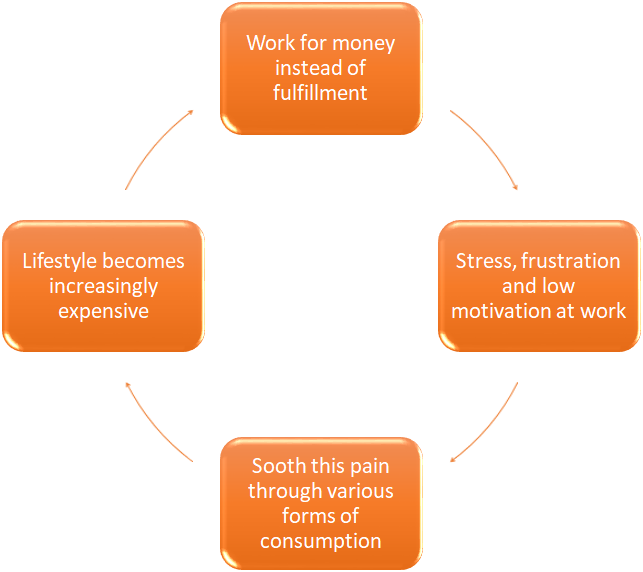
Personal liberty is the first thing you’ll start taking back on that glorious day you step off the hedonic treadmill and start the journey to financial freedom.
Creative Freedom
Greater personal liberty grants you a higher ownership share of your own time and energy. And the good thing is that today’s world offers an amazing array of fascinating things to do with time and energy that are truly yours. As illustrated below, capitalizing on this freedom creates a lovely feedback loop that generates even greater freedom.
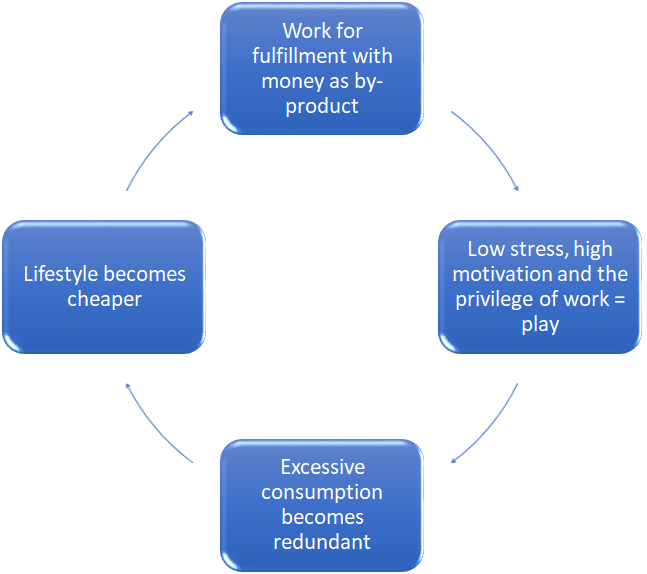
Getting this virtuous cycle up and running is tough, especially in a world constantly pushing you to chase happiness through consumption. But once you have it running smoothly, you’re free to take back your personal liberty.
How? Well, a cheaper lifestyle gives you many options. Perhaps you could look for a more relaxed job, reduce your degree of employment, or even start your own business.
My choice was reduced employment. Sure, my job was OK before, but now that I’ve dropped the 50% I like the least, it’s genuinely awesome! Most of the remaining 50% I’d happily do for free. The money is just a nice bonus.
Purpose
Inspiration can get supercharged if you develop a deep sense of purpose behind your creative endeavors. Our world has no shortage of pressing problems, so worthy purposes are easy to find.
A strong “why” is key to leveling up your experience of life. And if you manage to win the personal liberty to directly pursue your “why,” well, that’s probably as close to Nirvana as we mere mortals can get.
Express Yourself through Investment
4 We all have some ideas of what we’d like the world to look like. Investment is your opportunity to express those ideas.
Spending less to achieve financial freedom is not about hoarding all your cash and stuffing it in a mattress. If we all do that, the economy will crash, and the world would become a pretty sad and defensive place.
No, spending less is about redirecting cash flow from the production of unnecessary consumer goods to the development of creative solutions you feel the world desperately needs.
Put Your Money Where Your Mouth is
Whatever economic sector or world region you support, there’s a fund out there for you. For example, I invest mostly in sustainability and developing nations, reflecting my passion for sustainable development.
Yes, the stock market has a reputation for being risky. And crises like the one we’re facing now illustrate why. But if you do it right, diversified equity funds can be just as safe as any other investment (only offering much better returns).
The critical question you need to ask yourself is this: Will I ever have to sell my shares out of desperation? If your answer is “no,” there is almost no risk. If you had to answer “yes,” please first build up your rainy-day savings to the point where “no” becomes a safe answer.
This reasoning works because you can only lose money in the stock market if you sell your shares for less than you bought them. Anyone who can always wait out the inevitable downturns will be justly rewarded.
Make Investment Personal
Once your investments have given you a satisfactory level of financial resilience, the next level awaits: investment in your initiatives.
Since starting my 4% retirement experiment, I have dedicated all my income to this purpose. It’s still early days, but I can already tell you one thing with confidence: These little personal investments flood me with more endorphins than any consumer item I’ve ever bought!
Thus, even if I lose everything (as I would with most consumer purchases), it would still be worth it. And if my investments actually pay off… oh, my… wouldn’t that be a rush :-)
The Joy of Spending Less
Consumerist society prods us to chase happiness through consumption 5000 times a day. Financial responsibility, on the other hand, is portrayed as a grudging sacrifice we must make to earn a decent retirement.
I want to shout from the rooftops that this is total BS! For anyone who has the bottom two levels of Maslow’s pyramid well covered, spending less will get you to the top of the pyramid much faster than spending more.
And as a nice bonus, we’ll get a more sustainable planet and a much healthier and more financially resilient society.
So please, see for yourself. Discover the satisfaction of growing wealth, get yourself hooked on smart lifestyle design, fall deeply in love with creation, and express yourself through investment.
The resulting liberty and purpose will show you a beautiful side of life you never even knew existed.


