
How to Build a Lifelong Healthy Diet
In a world just begging you to binge on empty calories.
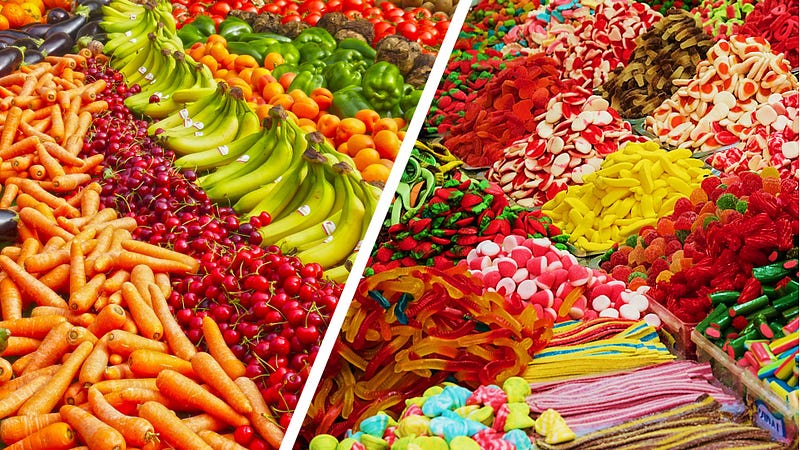
Why is it so ridiculously hard to maintain a healthy diet?
Think about it… We all know it’s crucial for long-term health and vitality. Most of us even have a pretty good idea of what a healthy diet looks like. Yet, consistent healthy eating remains one of the big struggles of modern life.
There’s a simple reason behind this great struggle: Our environment.
Yep, the environment we live in today just begs us to binge on empty calories. Hyper-palatable nutrient-free treats line the aisles at our local supermarkets and dominate the menus of the fast-food outlets along our daily commutes.
And we simply cannot resist. The powerful food cravings we evolved over more than 200 millennia of scarcity are as strong as ever. But in today’s world of caloric abundance, this instinctive drive is cutting our lives short.
Evolution will need many more generations to figure this out.
We cannot wait that long.
The Solution: A Healthy Environment
There’s just one way out of this conundrum:
We must build a dedicated healthy eating environment to shield us from the negative effects of our primitive food cravings.
It took me over a decade of trial and error to construct mine. But it sure was worth it! Thanks to my healthy environment, I’ve not been sick for more than 4000 days, and easily maintain my ideal weight and fat percentage.
With the right game plan, a healthy eating environment can be constructed in much less time than it took me. Yes, it needs some investment of time and energy. But once your environment is set, it can genuinely last a lifetime!
Sound good? OK, let’s go through the five key steps to building an environment for lifelong healthy eating.
Step 1: Clean Your Home Environment
Your home is the little corner of this world over which you have the most control. Hence, a lifelong healthy diet starts with the foods you allow into your home.
The logic behind this first step is simple: Not buying unhealthy food is a whole lot easier than not eating unhealthy food already in your home.
Thus, the emphasis shifts from eating healthy to buying healthy.
One way to make this a lot easier is to shop at stores specializing in healthy, whole foods. If no such options are available, focus all your available willpower into a few seconds of bravery when walking past the empty calorie aisle in your local supermarket. Those brave few seconds can secure your healthy eating environment for a whole week into the future.
Whatever you do, be sure to allow only healthy foods into your sacred home environment.
A healthy home creates a healthy you.
Step 2: Zero-Compromise Foods
This is the make-or-break step. Without it, empty calories will keep crawling back into your home environment despite your best efforts to follow Step 1 above.
Simply put, we need to make sure that healthy eating is genuinely pleasant and not some painful sacrifice.
To do this, we must gather an assortment of food that ticks four boxes:
- Health
- Taste
- Convenience
- Affordability
There are plenty of options that score full marks on this simple test, but the tricky thing is that there’s no one-size-fits-all solution. Yes, there are some good general guidelines, but finding just the right solution for you will inevitably involve some trial and error.
To help get you started, here are some of my favorite zero compromise foods:
Breakfast: The Superfood Combo
My breakfast is the perfect example of a zero-compromise meal: It’s packed with recognized superfoods, is a genuine joy to eat, takes a whole 2 minutes to prepare, and is ridiculously cheap.
The main ingredients are nuts, seeds, and berries — about 4 types of each.
Nuts are bought in big mixed packs and berries in convenient mixed frozen packs. Seeds are a little trickier, but I found a great solution in buying them in bulk online, giving me a greater variety at 3x lower prices than the small packs available in the supermarket. These bulk seeds are then premixed in big batches for maximum convenience.
The link below gives a detailed description of the breakfasts I make from these superfoods.
So, do yourself a big favor and check out your local nut, seed, and berry resources. In most places, you should be able to conveniently get your hands on a good variety at a good price. Once you do, you’re only a little experimentation away from a lifelong healthy breakfast!
Lunch: Meat as a Vegetable Dressing
I very much enjoy a warm lunch. But fitting such a luxury into a busy modern lifestyle can be tough. Luckily, there’s a simple solution:
Cook in bulk over the weekend and freeze portions in microwave-safe containers for easy grab-and-go weekday lunches.
Since breakfast accounts for almost half my calorie intake, I don’t need a big lunch. This allows me to get more portions out of a given amount of cooking, requiring only about 5 minutes of prep time per meal.
In terms of health, the key principle is to maximize the vegetable content.
I eat meat (about 5% of my calorie consumption) for the sole purpose of making vegetables tasty. Most of my lunches are based on a foundation of two-thirds minced pork and one third veggie mince used to make lasagna, bootie, or chili con carne. But the vegetable/meat ratio is way higher than normal.
I strongly encourage you to try this “meat as a vegetable dressing” philosophy with your favorite cooked meals.
Gradually increase the vegetable content, together with a mild increase in spices and other flavorings. You might be pleasantly surprised at how far you can push this simple idea for automatic health.
Dinner: Less is More
Most people consume most of their calories in the evening. For me, it’s quite the opposite, mainly because a light dinner is important for good sleep quality and my large breakfast is so enjoyable.
My favorite zero-compromise dinners include crushed avocado with smoked salmon on some healthy seed-sprinkled crackers, scrambled eggs with spinach, an omelet filled with canned mackerel with cucumber on the side, or even just a few pieces of fruit.
Step 3: Accept Imperfection
Even when your zero-compromise diet is well-established, flawless dietary discipline is not a realistic objective.
90% healthy eating is quite doable, 95% is a healthy challenge, but trying to reach 100% is just frustrating (and frankly not worth the small improvement over 90-95%).
Sometimes the human mind legitimately needs tasty food to get back to a productive state. Other times, prioritizing taste over health is quite healthy for your relationships. This step is about these times.
Identify Healthier Alternatives to Empty Calories
Accepting that you cannot reach perfection does not mean you should swing completely to the dark side. Indeed, addictive and dangerous empty calories should still be avoided whenever possible.
So, invest some mindfulness to proactively identify legitimately tasty healthier alternatives to your favorite empty calories.
These treats don’t need to be super-healthy — they just need to not be self-destructive. Good examples include dark chocolate, salted or chocolate-coated nuts, various berries (works well with yogurt), 100% fruit juice and dried fruit.
Even though these healthier snacks can be just as delicious as self-destructive empty calories, they’re often more expensive. This actually presents an interesting test:
If you can’t get yourself to pay a little extra for a healthier snack, you clearly don’t need that treat as badly as you thought.
Deal with Cravings in a Healthier Way
At times, we really need some good food to get back to a healthy mood. For me, unwanted food cravings sometimes kick in after an unusually challenging day or when I get stuck on a tough scientific problem. Over the years, I’ve tried all sorts of ways to suppress this craving, but ultimately, I had to concede that food sometimes is the only viable solution.
The key in these situations is to satisfy that irrepressible food craving without resorting to empty calories.
A very effective solution I found is simply to have tomorrow morning’s big and tasty breakfast of nuts, seeds and berries tonight. This breakfast is super healthy and very filling, so it’s quite easy to quickly restore balance by skipping breakfast the next day.
Don’t make a habit of giving in to any emotional food craving though.
The rule I live by is that I must resist the craving and start on another activity at least three times before I earn the right to any (healthy) emotional eating. This bit of tough love is necessary to make sure that cases of emotional eating remain nothing more than a rare exception.
The Empty Calorie Rule
My rule about empty calories is simple: I eat them only when I get them for free in a pleasant social situation.
Of course, if you’re lucky (or unlucky) enough to get free empty calories in pleasant social situations all the time, this is not a healthy rule. But for most people, this will be a good healthy eating compromise.
When I need to bring something tasty to a social gathering, I go for the healthier taste sensations mentioned earlier. It costs me a little more, but it’s worth it to do this little bit of good for the health of my friends and family.
Step 4: Deal with those Binge Instincts
Gorging ourselves at every opportunity has long been a key survival instinct. Today, it’s a serious health risk, particularly when you’re binging on empty calories (which, let’s be honest, is mostly the case).
Here are two ways to deal with those binge instincts in a healthy way:
Eliminate Binge Triggers
Next time that binge instinct kicks in, make sure to raise your awareness and identify the key trigger. Then, spend some quality time thinking about ways to permanently eliminate that trigger from your environment (or at least weaken it).
For me, watching anything on a typical binge-watching platform like YouTube or Netflix is a serious binge-eating trigger. Hence, I don’t have a Netflix account and use RescueTime to temporarily block YouTube after a rather short amount of watch time.
For you, it might be something different. Whatever it is, your life is sure to be better and longer without it.
Fast After the Feast
Every year has a couple of festive occasions where the goal is to eat, drink, and make merry. In my book, it’s fine to give your binge-instincts free rein on these rare occasions. Show the host how much you enjoy their great cooking and focus on just having an awesome time with your friends and family.
After such a feast, the key is to restore balance ASAP.
And the best way to do this is to immediately follow the feast with a half- or full-day fast (depending on how enthusiastically you feasted).
If you do this well, you can return to your zero-compromise healthy diet the very next day with no lasting ill effects.
Step 5: Track Your Progress
Tracking your progress over time can be an excellent source of sustained motivation and direction.
This article lists three great metrics for tracking your diet and its effects: empty calorie consumption, Smart BMI, and the number of sick days per year.
Keep a record of the number of empty calories you buy every week, track your weight on a nice graph with a band for your ideal Smart BMI (my example is shown below), and see how many months (or years) you can string together without getting sick.
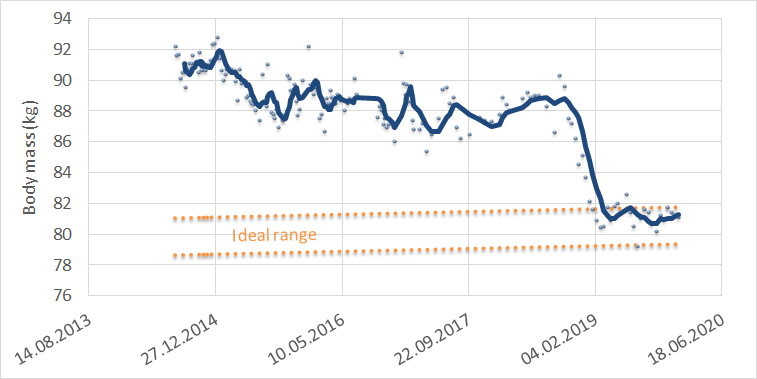
When done in isolation, such measures can be quite depressing when you fail time and time again. But when this is done in combination with the steps above, it turns into an awesome source of motivation and satisfaction.
Good Luck!
After a decade of studying healthy living and sustainability, I’m convinced that a smart environment enabling a permanent healthy lifestyle is the single best gift you can give yourself, your family, and your planet.
Our modern world with its countless highly pleasurable self-destruct mechanisms does not make this easy. It will take time, focus, and quite a bit of experimentation before you find your unique optimal solution.
But always remember that the creation of a healthy environment is a one-time investment. Once you get it right, it lasts a lifetime!
And when your environment finally clicks into place, it will easily spill over to your family. Then to your friends, and even to some of your colleagues.
So, this decade, give the wonderful gift of lifelong health!