
Edmonia Lewis (1844–1907) Prominent American Sculptor
She resisted being marginalized, exceptionalized, eroticized or exoticized, therefore I will try not to do that here.
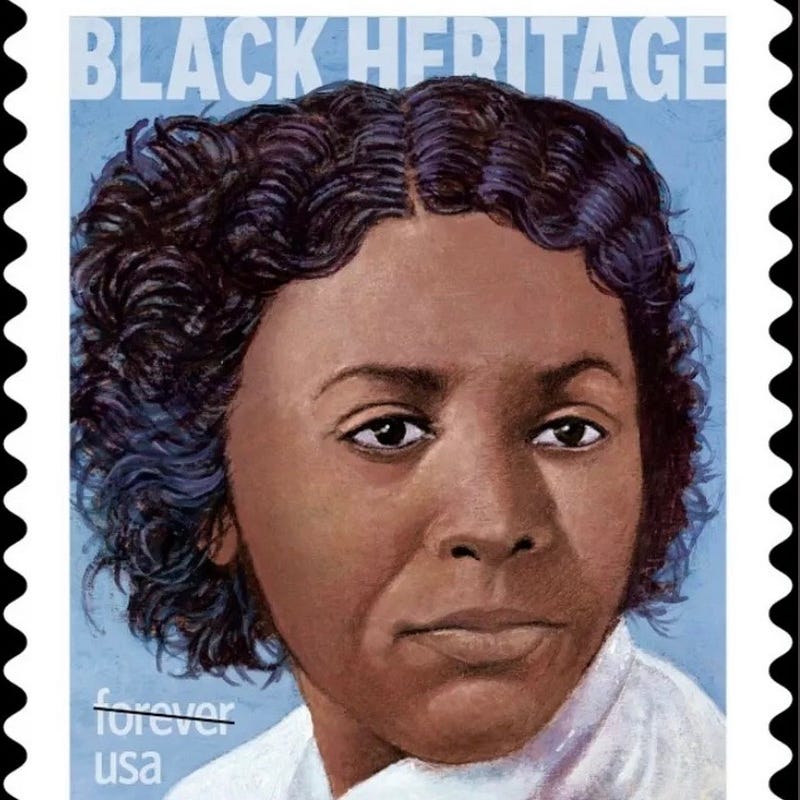
I was so happy to see that Edmonia Lewis was given a postage stamp:
U.S. Postage Stamp Will Honor Edmonia Lewis, a Sculptor Who Broke the Mold
Who is Edmonia Lewis?
Edmonia Lewis defies classification while at the same time has been classified over and over again. If she can’t be classified, then she is demonized and if she can’t be demonized then she is erased and if she can’t be erased then she is blamed when all this woman wanted, it seems, was to pursue her art, be taken seriously, be free to compete on a level playing field with other people: meaning white people — and people who were taken seriously by the art world: men. She resisted being marginalized, exceptionalized, eroticized or exoticized. Therefore I will try not to do that here.
She succeeded in not allowing people to know about her personal life. Therefore, it has been challenging for people to lump her into one particular group or write her off. We don’t know if she was a feminist, although she must have been some kind of a feminist to break all these glass ceilings. She was for sure Edmonia Lewis, an outstanding artist and sculptor who lived life on her own terms.
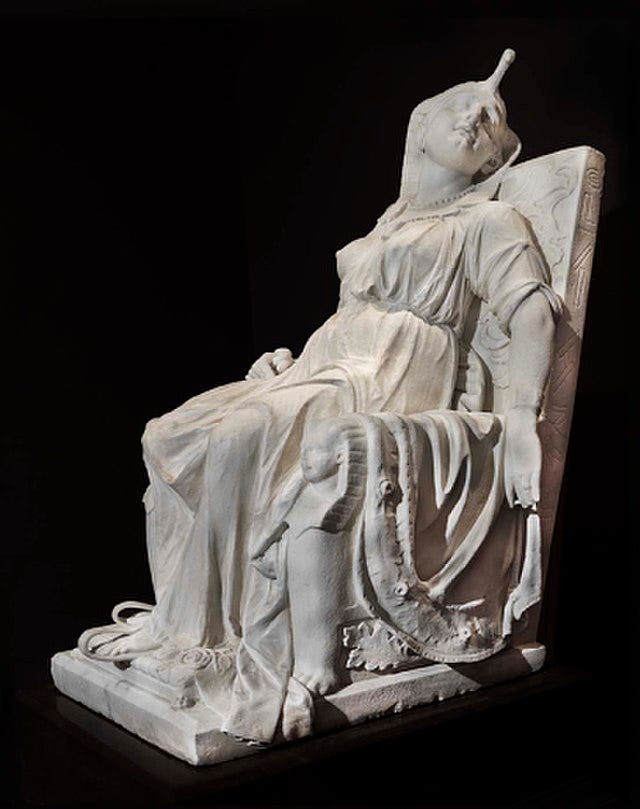
She did accomplish her ambition.The battle was well fought. Whether or not she was happy, we have no idea. Although Frederick Douglass reported her as being happy when he visited her studio in Rome.
She disappeared into the European continent eventually. Only recently did we find out where and when she died, we don’t know how.
Early life
Lewis was born in upstate New York to a mother who was a member of the Chippewa nation and a father who was a free black man. Her parents died when she was very young and her brother, 12 years older, took it upon himself to make sure she was educated and see to her future.
Lewis was eventually admitted to Oberlin College. While there, a scandal ensued and she was accused of attempting to poison some of her friends. An angry mob took matters into their own hands and took Lewis out to a field where they abused, raped and beat her. She barely survived. Though she was found not guilty and allowed back into the school, she was a marked woman.
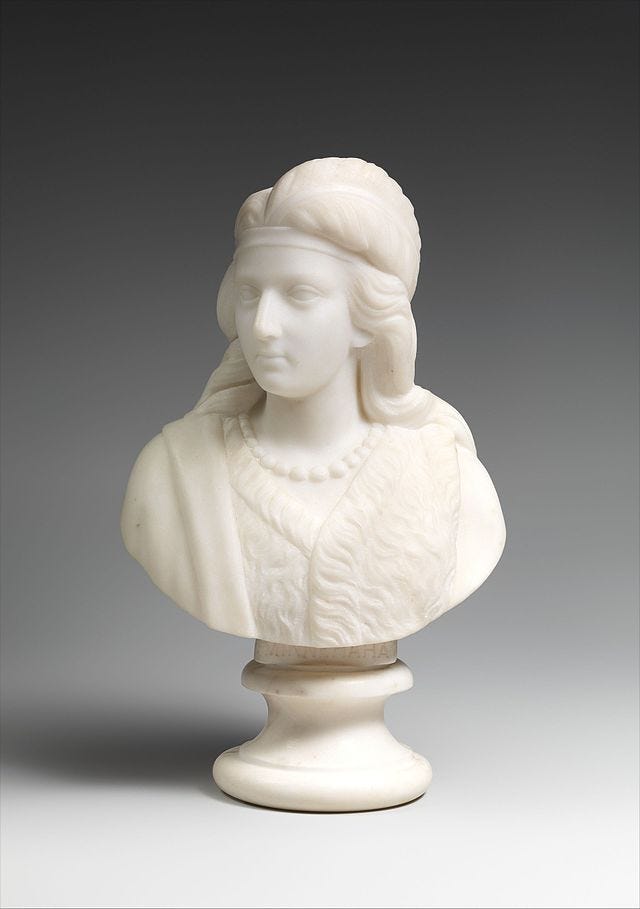
The following semester she was accused of stealing and then not allowed to graduate. Lewis ended up in Boston where she was helped by the abolitionist community there and, once she found her passion, sculpture, that same community helped her find a way to pursue it.
Charity with strings
Unfortunately, as these things often go, charity does not come without strings, the community supported Lewis as long as she did what they thought or wished for her to do, behaved as they wanted her to behave and when she showed herself to them as her own person, with a mind and will of her own, (she was faulted for having a bit too much of both) she began to lose some of the support.
The famous abolitionist Lydia Maria Child who first took her in and promoted her, then began to chide Lewis in letters to her friends: “What she undertakes to do . . .she will do, though she has to cut through the heart of a mountain with a pen knife”(Buick 15). And this is a bad thing?
Thriving in Rome
Lucky for Lewis, she had the opportunity to leave Boston and pursue her dream, to go to Rome and work with a group of expat artists there in what was then the center for sculpture in the free world. In Rome she completed her most famous works, returning to the U.S. intermittently for 10–12 years to promote her art and sell it. Then we lose touch with her .
“Away from America, Lewis found that the categories ‘black’ and ‘white’ manifested themselves differently. In a New York Times interview of 1878 titled ‘Seeking Equality Abroad,’ Lewis states, ‘I was practically driven to Rome in order to obtain the opportunities for art culture, and to find a social atmosphere where I was not constantly reminded of my color. The land of liberty had no room for a colored sculptor.’ The writer ends the interview with a rather ambiguous statement by Lewis about race and her experience in Rome: ‘Miss Lewis makes no secret of the reason of her return to Rome, which she has adopted as her home. ‘They treat me very kindly here,’ she said, ‘but it is with a kind of reservation. I like to see the opera, and I don’t like to be pointed out as a Negress’”(Buick 18).
We know that Lewis had a self-consciousness around how she was viewed since she is known to have always worked her own marble so she could never be accused of having someone else create her art. This reveals a fierce determination.
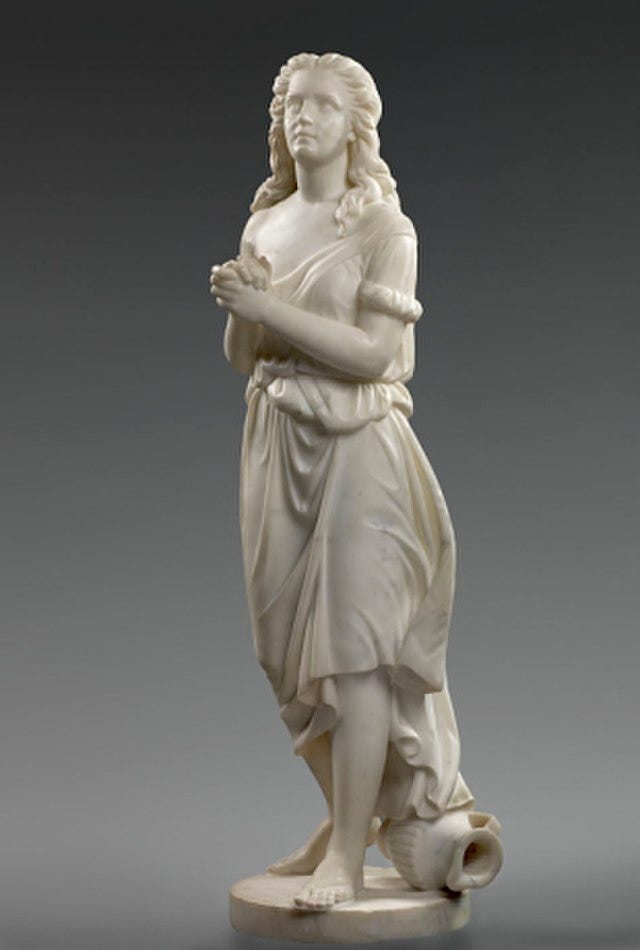
In Rome, Lewis was part of a group of feminist artists who cross-dressed and many of them, including American actress Charlotte Cushman and sculptor Harriet Hosmer were “out” lesbians. It is not “proven” that Lewis was a queer woman, but many people believe she was. Again, another classification I hesitate to saddle her with. Buick does not bring this subject up in her book but many websites claim her as a queer foremother. It is clear that she adopted their form of dress.
However, Lewis is also referred to as being very Catholic and becoming more so later in life, the bulk of her later works being sculptures of the Virgin Mary, of which very few remain.
Later Years
“Evidence suggests that Lewis was a lifelong believer and quite devoted. After 1876, her patronage and production were almost exclusively influenced by her Catholicism. In an interview in 1871, she expressed her devotion to the Virgin, stating, ‘I have a strong sympathy for all women who have struggled and suffered. For this reason the Virgin Mary is very dear to me.’ The number of Virgins that she made during her lifetime amply supported her stated devotion, especially since Virgin and Child imagery was an uncommon subject for American Neoclassical sculpture”(Buick 26).
I honor Lewis for her fierce will, her strong determination to achieve that which she wished to achieve, and to be defined by, and live her life, on her own terms.
©Theresa C. Dintino
Buick, Kirsten Pai. Child of the Fire: Mary Edmonia Lewis and the Problem of Art History’s Black and Indian Subject. Duke University Press 2010.
OTC: Kirsten Pai Buick, Art History Professor. The Oberlin Review. https://oberlinreview.org/15769/news/otc-kirsten-pai-buick-art-history-professor/