
DIGITAL LIFE
Driven by Data
The marvel of modern GPS
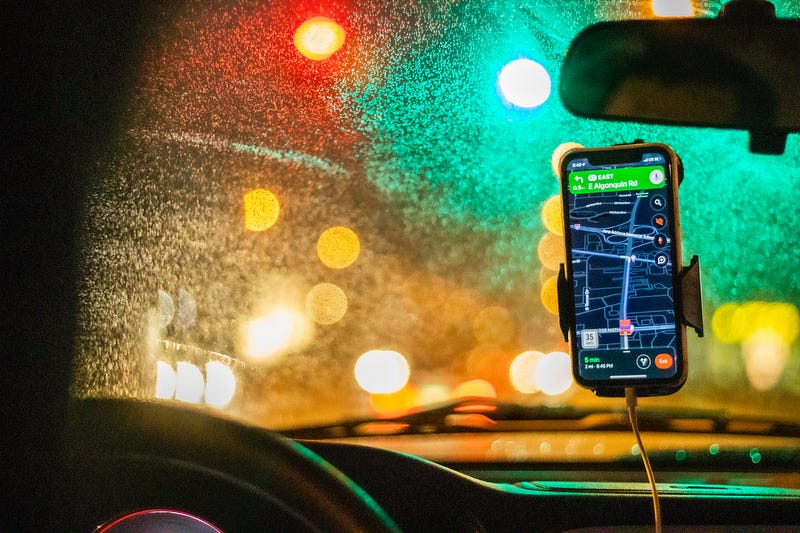
In the pre-GPS days, I once watched my parents battle it out with a map in the middle of the Mojave desert. With sweat trickling down their cheeks and ill-concealed looks of confusion stretching across their face, it was like watching suburbanites try to assemble IKEA furniture without the manual. Frustrations quickly flared and culminated in a full-throated shouting match as the air conditioner labored like a marathon runner in the final mile.
Even with memories of the Eisenhower administration, crank dial phones, and cordless lives, the map before them tested them to their core that day as the car stood there stalled along the sandy terrain.
In fact, that fateful day in that sweltering desert heat was the only time I ever saw a map used. I had no idea our car was even home to such ancient artifacts when the sanctified piece of papyrus emerged with loud crinkles from that hallowed compartment apparently reserved for such occasions. Watching my parents even attempt to interpret squiggles on this gaping map was like learning that the two could read hieroglyphics.
I’m not old enough to remember the days when these strange cartographer tools still held value. But I’m old enough to remember a day when getting directions to your friend’s house in another state would require burning through a month’s worth of printer ink and creating a dictionary-sized packet worth of MapQuest directions. With luck, you’d end up in the right district as your destination.
But if you made a wrong turn? You were out of luck.
Redirecting? Pshhh. It would be another decade until we’d hear a robot explain that it was recalculating our route. In the early digital days, a wrong exit or one-way street meant you were lost.
And if by some miracle you made it as far as point B, you’d have to hope that you had a friend waiting there kind enough to risk their printer on your return trip. Where the story of GPS has been one of near-exponential improvement, the story of printers has progressed more slowly than download screens during the dial-up days. Printing MapQuest directions demanded olympian level feats of the clunky contraptions. Before page counts even reached double digits, they’d be shaking back and forth erratically atop their desks to the savory sounds of cyborg sex.
But seemingly overnight, MapQuest was replaced by clunky GPS modules that sat lumberingly atop car dashboards. They were the crowning jewels of automobile owners from coast to coast.
As long as the adhesive on their underside lasted, the box-shaped navigators could effortlessly get drivers from destination to destination with little more than a clumsily-typed command. They could direct you toward local restaurants and airports and just about any address on the grid — assuming you were patient enough to use the built-in touch screens and tolerant enough to listen to whatever disjointed robo-accent emerged from them.
But at the drop of a dime — or a paradigm — smartphones gained GPS capabilities. And suddenly, MapQuest was a distant memory and GPS modules began serving as dashboard ornaments. Some simply fell into seat wells unnoticed —destined forever to teeter quietly back and forth along dusty floors as forgotten relics of another time. By the time that travel was democratized to the point of “Hey Siri” commands, people practically forgot that their trusty GPS devices ever existed.
Now, a drive across the country depends only on a little wi-fi or cellular signal. With a handless command, a cushy sofa becomes a launching pad into the world.
This transition isn’t just technological; it’s deeply emotional. The very essence of ‘being lost,’ a sentiment many of us once felt each time we traveled down unfamiliar roads, has transformed. Today, there’s a reassurance in knowing that a guide, always ready and always accurate, sits right inside our pockets.
To make matters more impressive still, we have an interstate highway system. With only occasional hiccups, we can travel at careening speeds through forbidding landscapes, and along 5 lane roads that stretch beyond even the line of the horizon.
With unspoken nods of agreement, we enter onto turnpikes and freeways, listening to any song under the sun, and we travel once-unthinkable distances with passive disregard.
The notion that these roads were built still never ceases to amaze me. The idea that enough concrete was laid, and enough salaries were paid for roads to wind through mountainsides and along sheer cliffs and underneath rivers and bays is hard to believe. The roads stretch from coast to coast, even continent to continent, without interruption. And now in the middle of nowhere, we have rest stops equipped with Big Macs, Cinnabons and aisles so full of chips and candy they can comfort even the loneliest of truckers.
Why am I ranting about interstates? Well, A GPS without highways is like Netflix without chill or travel without tunes.
The scope of the interstate highway system is difficult to grasp. And the magnitude of the GPS innovation, too, is simply impossible to overstate. But they’re marvels that often go muted. It’s easy to forget what a privilege it is to stream music from the automobiles that once didn’t even have radios with the lowest reception.
In our day to day lives, it’s easy to forget how rapidly we moved from a world of horses and buggies to cars with seat warmers and sub-woofers guided by satellites soaring at inconceivable heights. And this transformation is hardly just a Western phenomenon. In many parts of the world, regions that once lacked infrastructure have leapfrogged straight into a futuristic world of GPS navigation.
But it’s hard to understand the significance of an achievement when the only world you know is one that changes rapidly. It’s easy to forget the luxury it is to be able to report speed traps, hazards, and car accidents to the other drivers cruising along the interstate. And now, with a subtle shrug and a couple button taps of the infinite information machines mounted beside us, we make the journey safer for all of us.
The ways in which travel has changed within the last couple of decades are truly difficult to fathom. With live satellite data dictating nearly every turn along cross-country trips, GPS can anticipate how long traffic delays will take, and land you at your destination within minutes of your projected ETA. It can even account for your Burger King stop in Des Moines.
There are few achievements so critical to life on earth as bridging the gaps between disparate regions with concrete roads and learning to navigate our growing labyrinth with the slap-in-the-face ease of the digital age.
Beyond mere navigation, the ubiquity of GPS has led to profound shifts in our societal behaviors. Traditional jobs like map-making have all but vanished, while new careers in tech and app development have sky-rocketed.
Our very sense of spatial awareness has changed, relying now on digital voice assistance more than actual landmarks. While this has certainly made travel more efficient, there’s a growing concern that our innate navigational skills might be waning. But maybe this was only a natural progression in a world that so often sees McDonald’s arches before they do rivers and trees.
Whatever the case, there’s something extraordinary to be said for the way that GPS technology suddenly opened the world to anyone with a cellphone and a willingness to explore.
You know what costs just over 3/5 of a gumball per day? Supporting the aspiring writer whose article you just finished! Additionally, by the powers vested in me, I’ll grant you unlimited access to the work of all the writers on this platform. All you have to do is sign up through this link here! Can you spare the equivalent of just over 3/5 of one gumball per day? 🧐


