

HOW TO DRAW
Drawing Distance
OR: ‘how to create the illusion of depth’
This session is about making things look distant in drawings.
In the painting above left, you can see that the dog is looking far away — maybe he’s wondering what’s over there. There is depth in this picture.
Taking out all the colour, it still looks as if the dog is looking to far-flung pastures.
Even without the dog in the foreground, there is still an impression of distance.
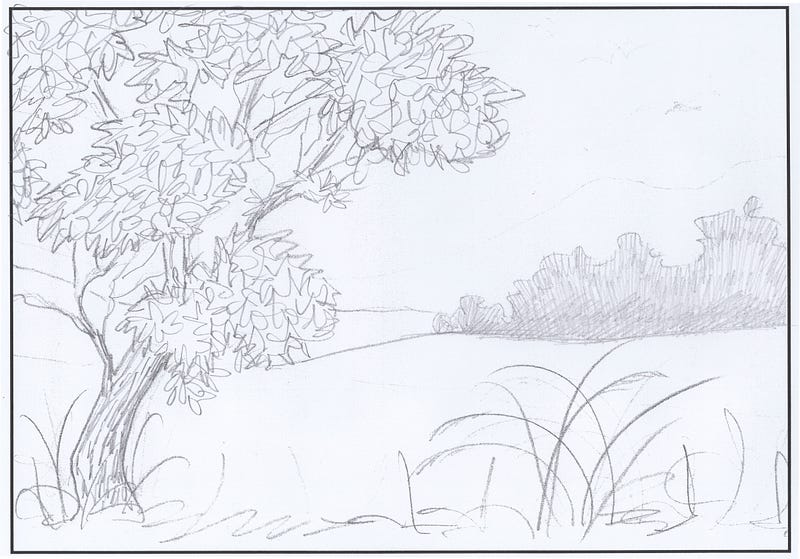
This is all done using several methods which can be shown in a line drawing — here is an initial sketch of a landscape:
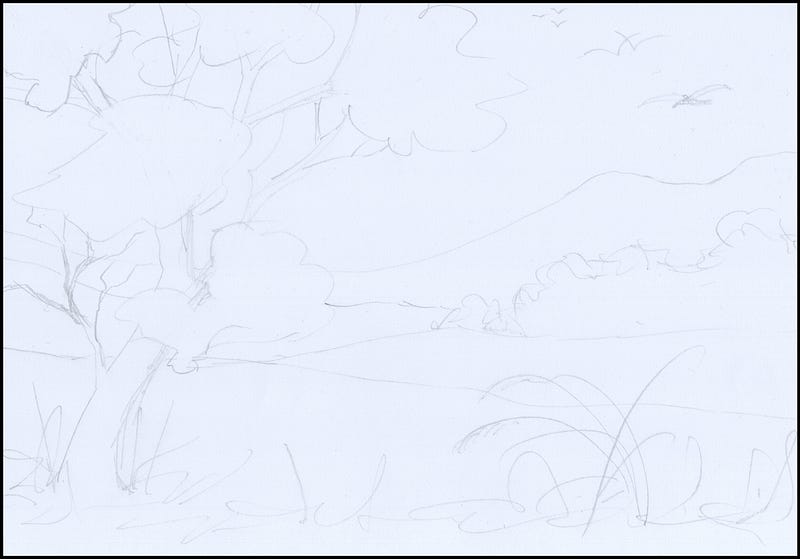
I’ve had to darken it a bit so it shows up. You might look at this initial sketch and think there is some distance in it already, but that’s because your brain knows you’re looking at hills in the distance because they are overlapping each other, and have trees in front of them, too . Therefore, some must be further away than others.
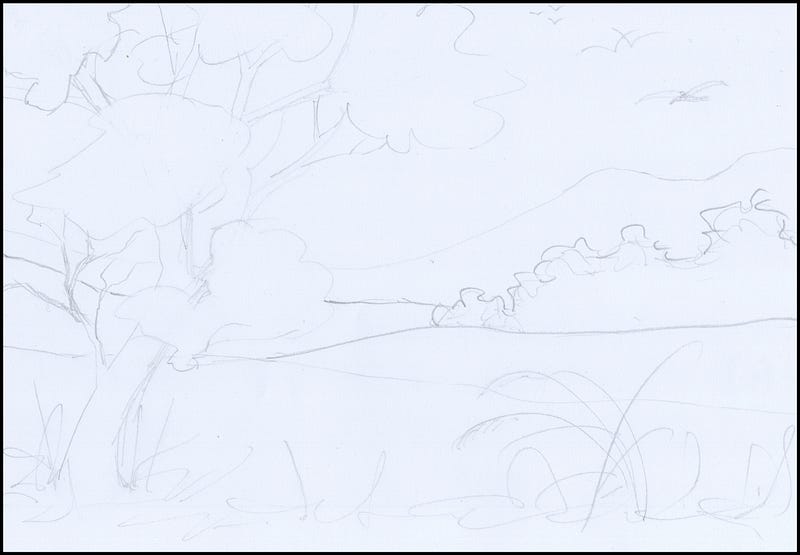
However, if you darken the lines of the middle distance — that is, the hill and a band of trees — you have immediately made it ‘look’ far away, rather than simply knowing it’s far away because your brain has worked out that it is because of the overlapping hills.
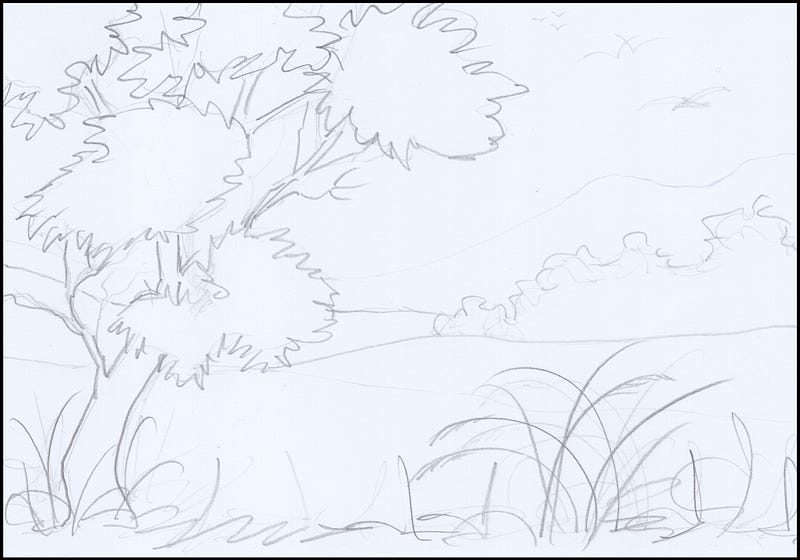
Coming closer to the viewer, darkening the relevant lines in the foreground — in this case, the tree and some grass, makes the middle distance , without touching it, look further away, and the furthest hill looks further away again — in fact, so far away it’s almost disappeared.
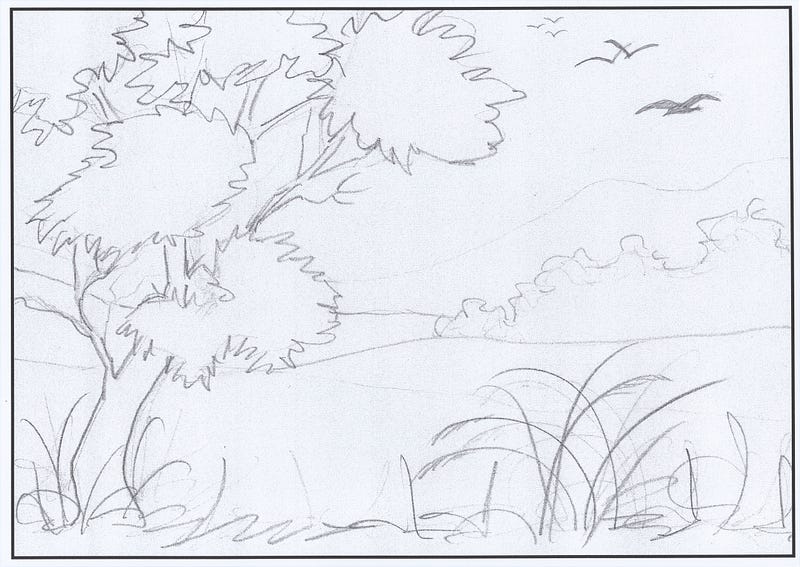
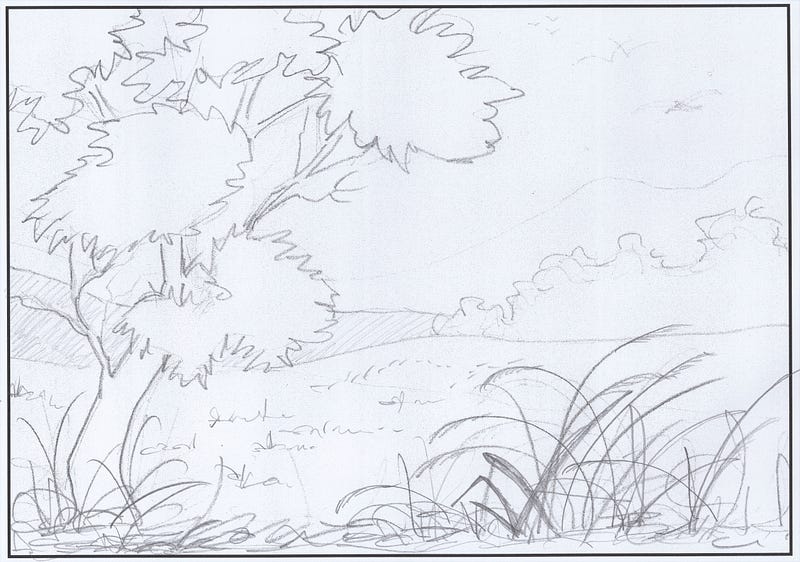
There are other ways to increase the illusion that should we step into the picture, it would take many hours of walking before we made it to the far hills.
Birds in the top drawing — the furthest three birds are paler than the two mid-point birds, and the nearest one is darkest. They also increase in size as they get nearer to us, and in the nearest one, there are more details which it wouldn’t be possible to see in the furthest ones.
The trees in the next drawing are just a formless mass in the middle distance, but in the foreground we can see the tree’s shape, its branches and its leaves — which are indicated although not specifically drawn.
The grass in the third drawing on the left can be seen in clumpy trails in the nearest field, but as individual stems in the foreground, including the actual seed heads on some of them.
Heaviness of line, size of object, and details or the lack of details, can all help create the illusion of depth.
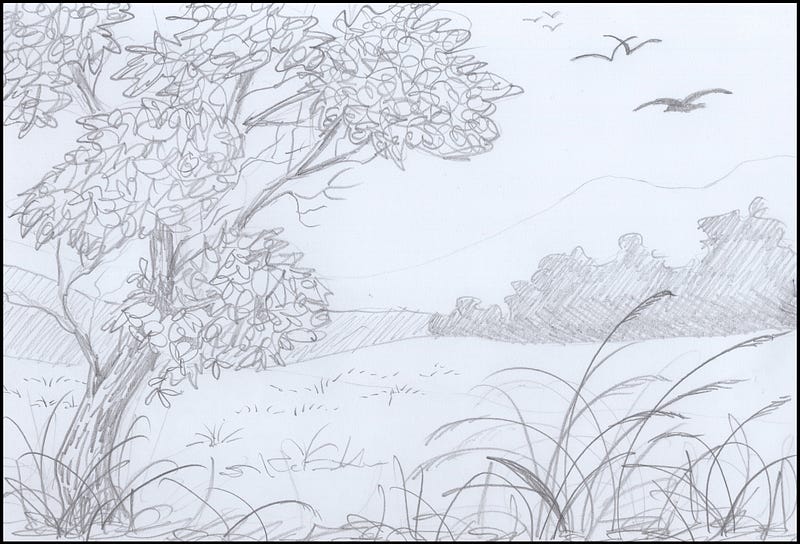
The drawing above shows the birds, trees and grass all together in one picture, adding to the feeling of depth in the landscape.
This has been a speedy trip through the subject of creating depth in a 2D image using a rapid sketch to demonstrate some basic techniques.
This is the kind of drawing that you can do very quickly while waiting on the phone, or as a day-dreaming doodle to practice getting depth into your drawings. Any practice you do will be valuable.
There will be further sessions demonstrating more techniques.
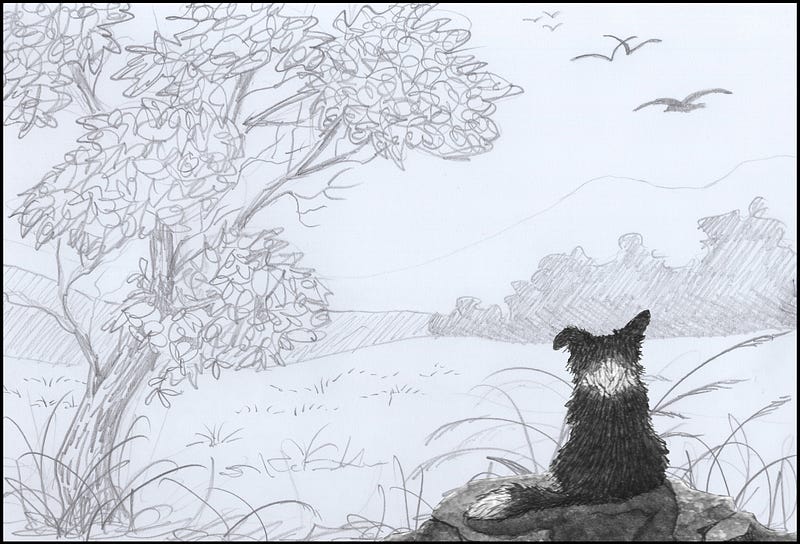
To finish off, and to push everything even further away from the viewer, I’ve added in a dog sitting on a rock staring into the distance. He’s darker, he’s bigger, and you can see individual hairs in his fur. You know he’s right here and the view is way over there.
If you have any questions about this session, do put them in the comments section.


