
HOW TO DRAW
How to Draw a Corgi
How to draw Corgi Woofer
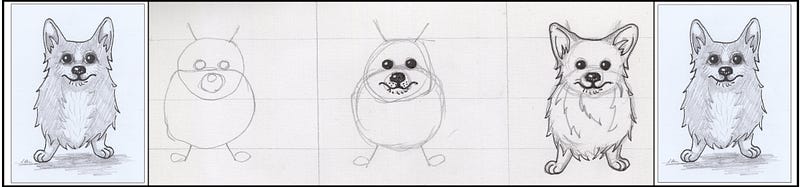
It might give you more confidence to tackle Corgi Woofer if you’ve already drawn Basic Woofer from the previous session ‘How to Draw a Dog’, but, if you haven’t done that session and just want to crack on with this one, no worries — this session will give you all you need to draw a corgi.
The dog that resulted from the ‘How to Draw a Dog’ session is this pup, Basic Woofer:
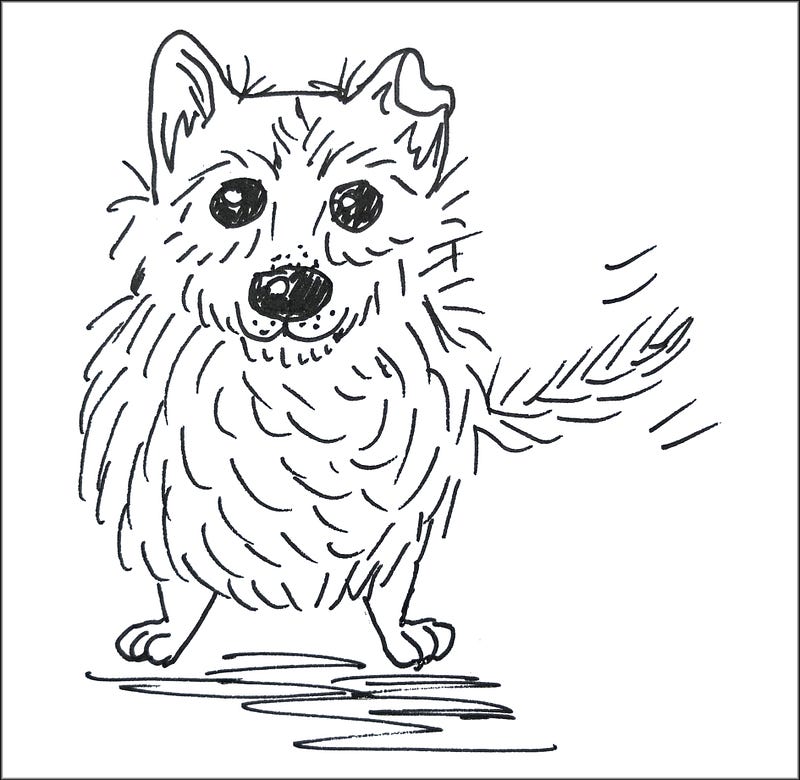
We will draw Basic Woofer again only with features that will make him look like Basic Corgi.
I asked a room full of dog-lovers what makes them recognise a dog as a corgi. They replied:
- smiley mouth
- boopable snout
- upright ears
- stumpy legs
- thick, but smooth, short coat (not counting fluffies)
- lots of mascara
- eyebrows like fat caterpillars
There are more (loaf-like, colour of coat, bob-tail, long body, sploot), but they don’t apply just now. We’ll do them later.
Smiley mouth
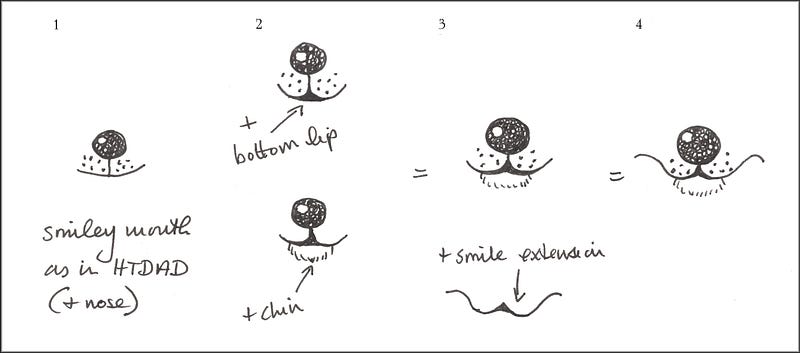
- start with a smiley mouth and nose as in ‘How to Draw a Dog’ — including some dots on the muzzle to indicate whiskers
- add a bottom lip to make more of the mouth
- under that, add a furry chin
- you can see in (3) how they go together and then add an extension to the smile
- you can see in (4) how the smile extension becomes the bottom of the face
Boopable snout
In the above diagram I’ve inked in the nose in such a way that it’s not solid black. That’s to indicate the texture you’ll find on a dog’s nose.
The grooves and lines within the surface of the nose is what gives it its texture. This is unique to every dog, like fingerprints in humans.
The easiest way to suggest this texture is to fill in the shape with a circling motion of your pencil or pen, remembering to leave the white highlight.
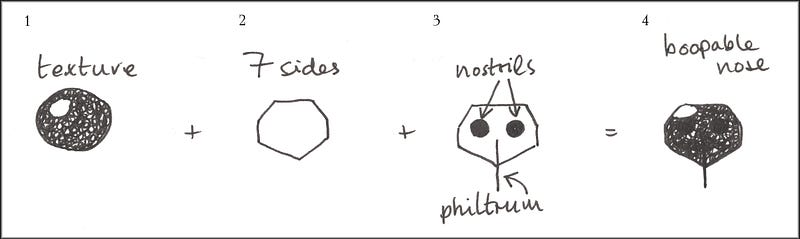
(2) Woofer’s nose is a bit wider than it is deep. It has seven sides with a flat top, and a point at the bottom of it.
There are two nostrils to breathe through, (which is handy) — so they’re not textured like the outer layer of the nose and can be represented as solid black. The dark line that runs down the middle of the nose to the lip is called the philtrum — it helps to keep the nose moist. (3)
When you’ve pencilled all the pieces in place and you’re ready to ink the nose, round off the corners, except for the bottom one which is quite pointy.
And (4) you have a boopable nose! (Well — Woofer does.)
Upright ears, stumpy legs, thick smooth coat
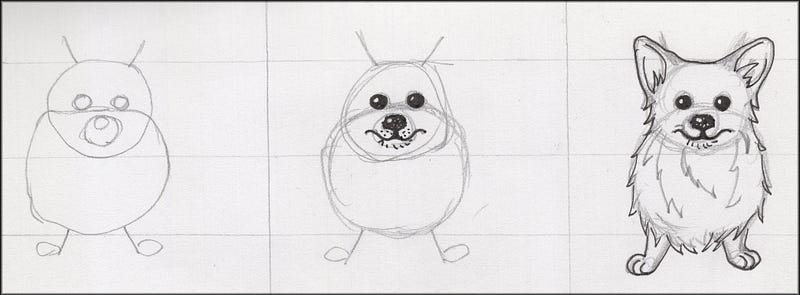
Following the stages in ‘How to Draw a Dog’ makes Basic Woofer come to life. In particular, for Corgi Woofer, add in a smiley mouth, boopable nose, upright ears, stumpy legs and a thick, but smooth coat.
If you compare the coat to the one on Basic Woofer, you can see this one looks thicker and smoother, whereas his is scruffier and hairier. All these things are suggested rather than the individual hairs drawn in.
You have to be looking all the time at what you’re drawing to make sure it’s the way you want it to be to achieve the desired end result. That is, make a habit of sitting back and looking at the overall effect, as well as concentrating on the bit you’re drawing at the time.
Looking at this dog above I realise his ears are not upright enough. Upright ears are a defining characteristic of a corgi (obviously corgis have their ears in other positions, too, but for this exercise we are drawing a basic woofer that we recognise as a corgi).
So, I’ve changed his ears to more upright (see above).
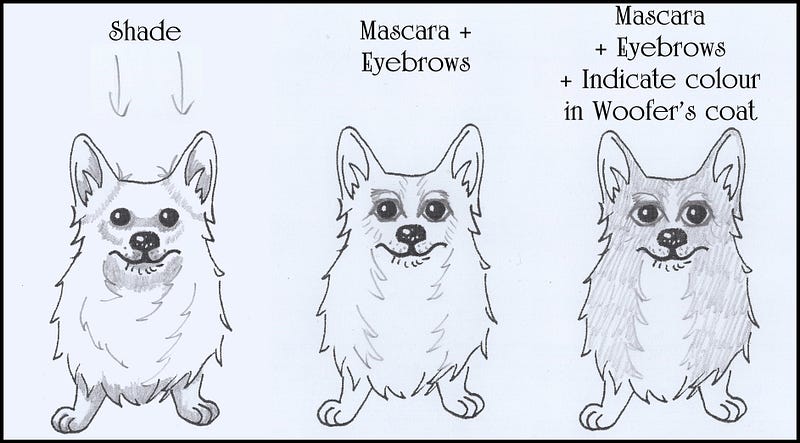
The first corgi shows where shade would naturally fall just from the light coming from above — which it does tend to, especially if you’re outside. Shade would be under the line of the eye socket, within the corners of the eyes and under them; under the nose and mouth and chin; inside the ears; and on Corgi’s belly; also the inside of his legs and along his toes. If you think about any kind of ‘ledge’ that might stick out a bit then shadow will be underneath it. Just think your way through your dog’s build and you’ll know where shadows need to be.
The second corgi shows the addition of mascara all around the eyes, and some caterpillar eyebrows. The third also has some pencil shading just to show that the coat is different colours in different places.
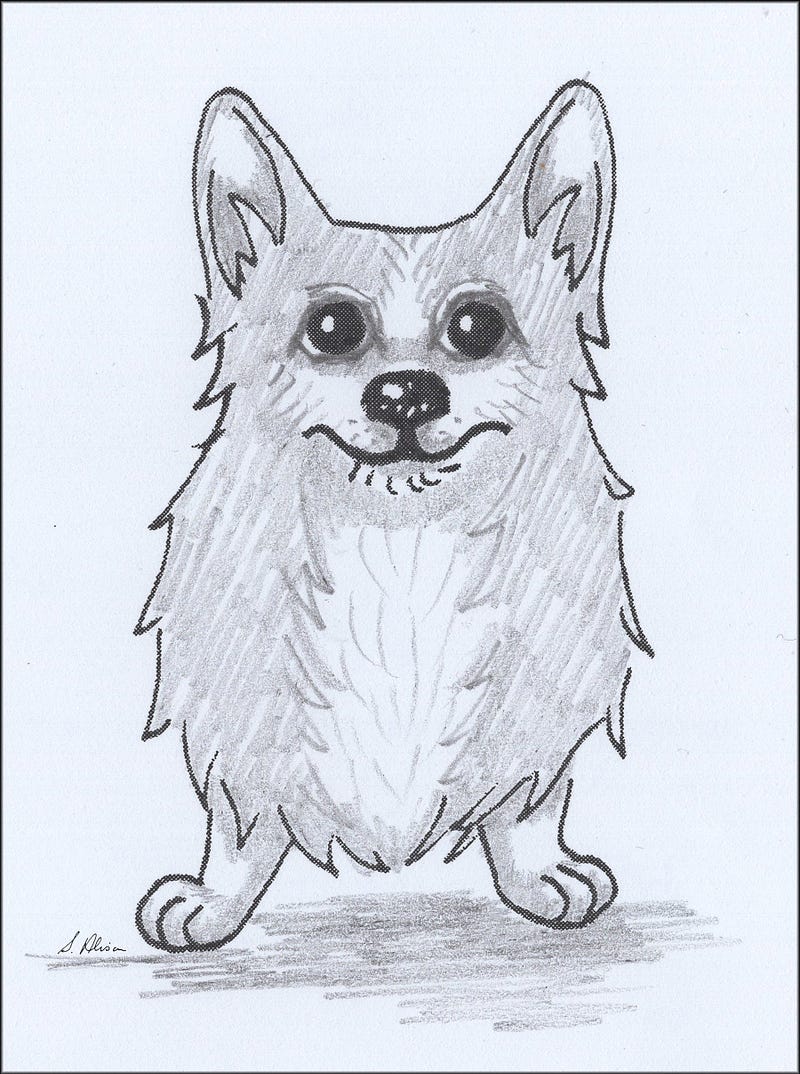
Here is Corgi Woofer with all the bits we’ve mentioned in one place, plus a shadow under him to show he’s connected to the ground.
There are many things to think about when drawing anything — in successfully drawing Corgi Woofer you now have the information required to draw almost everything.
There is more to say about mascara and eyes in general — this will be the subject of another session.
If you have any questions about this session, do put them in the comments section.
Anytime you want to go right back to the start, here’s How to Draw a Dog:


