
Double Down on Darwin’s Doubt
What did Darwin really mean by his “horrid doubt” quote — find out what his convictions were and where his data led him
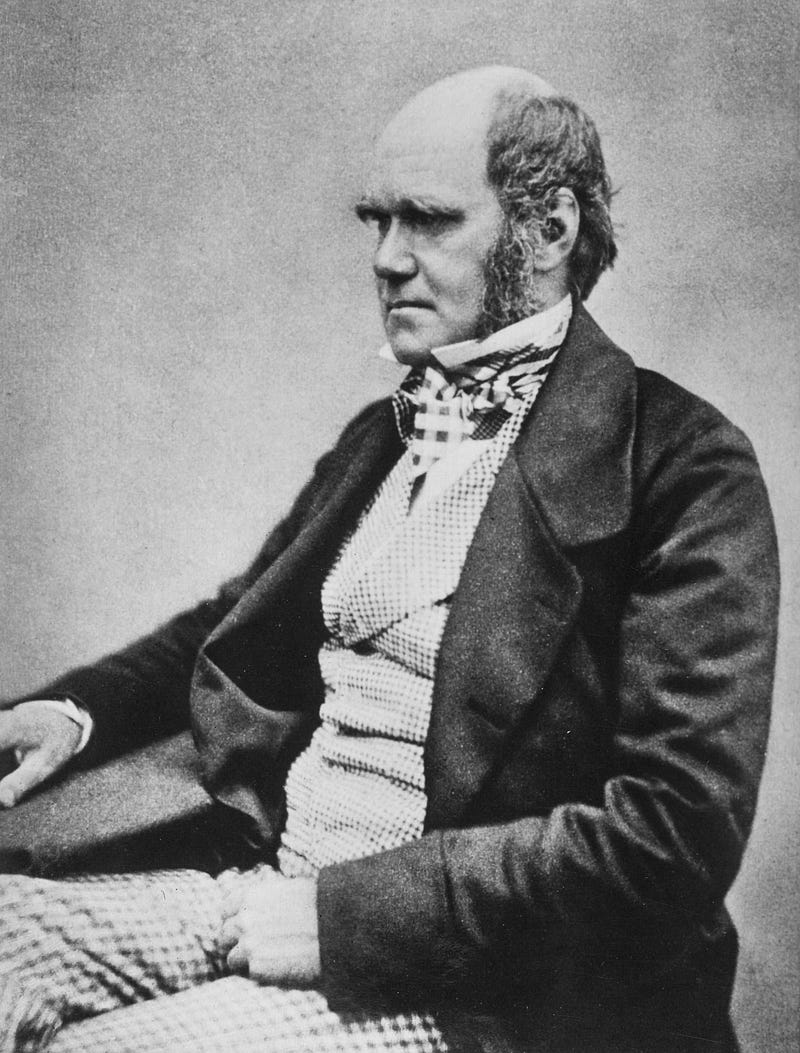
Philosophy is hard!
I just read a fascinating article by Gerald R. Baron on the underlying assumptions of physicality in the sciences today — he says scientists err presuming there is no purpose behind physical laws. And he uses Charles Darwin’s “horrid doubt” quote as a key argument.
I’m a biologist studying molecular genetics and biochemistry, the mechanics of how yeast cells grow and divide. I think I fall squarely into the materialism camp, if I understand that term rightly. I assume no purpose behind the physical world and the laws governing it. I do enjoy reading about the philosophy surrounding the work I do, but I rarely understand enough to argue one way or another — it all seems way above and beyond me. Philosophy is hard!
Arguing philosophy is not my purpose here. I don’t have the tools to do so.
Instead, I am here for a much smaller purpose: to defend doubt, to give context to Darwin’s expression of doubt, and hopefully to rescue what I believe is his horridly mis-quoted quote of “horrid doubt”:
“But then with me the horrid doubt always arises whether the convictions of man’s mind, which has been developed from the mind of the lower animals, are of any value or at all trustworthy. Would any one trust in the convictions of a monkey’s mind, if there are any convictions in such a mind?…”
The false dichotomy of right and wrong in science and the importance of doubt
As you might expect from my profession, I’ve read Darwin’s On the Origin of Species twice, cover to cover, as well as his two-part biography by Janet Browne. And I’m not even the most fanish of his fan boys. And I always found one of the most stunning features of Darwin’s book and his theory of evolution by variation and natural selection, is how right he was despite how little was known at the time, and also how wrong he often was at the same time.
I try to tackle the false dichotomy of right and wrong in science, in my recent post on the dating of mitochondrial Eve.
As right or wrong as some of Darwin’s specific ideas were, his theory of evolution by variation and natural selection has been and continues to be the foundation of all we do in biology. The fact that Darwin could be as right as he was, without the benefit of genetics or molecular cell biology, is a defining achievement of the humanities (the same goes for Mendel discovering genetics at roughly the same period of time — with the same caveats of errors and limitations in his own laws of inheritance). This is no different from the fact that Isaac Newton’s laws of motion and gravity were the most influential and useful mathematical and physical tools, which accelerated our modern engineering society as nothing else did. Nonetheless Newtonian equations had limitations that took Einstein to correct with his general relativity (look up the motions of Mercury and why Newtonian physics broke down so close to the Sun’s massive gravity well).
No biologist today takes Darwin’s seminal book as the current understanding of evolution — and no one faults Darwin for the errors that scientists have been correcting since his books were published.
If a scientist as brilliant as Darwin can be found wrong on various points, how wrong must each of us be on our own ideas?
One of the most well-known corrections to classical Darwinism was Stephen J. Gould and Niles Eldredge’s hypothesis of Punctuated Equilibrium, which stated that species remained unchanging for significant periods of geological time during periods of environmental stability, but that species were capable of very rapid evolution in response to major changes. Their theory was based on fossil evidence showing just that. Punctuated Equilibrium was in stark contrast to Darwin’s ideas of constant gradual changes, which were not supported by fossil evidence.
Meanwhile, today, Punctuated Equilibrium is also undergoing challenge and modification — thus science, in general, goes.
Ideally, no one remains faithfully stuck on an old theory — no matter how classical and no matter how revered the author. Science itself is a process of evolution (take your pick, a slow constant change, or a punctuated equilibrium, of theories).
The reality, of course, is that we humans tend to fall in love with our own ideas — we often lose our capacity to doubt ourselves. Young scientists often have to wait for the literal extinction of the “old guard” for their newer ideas and hypotheses to be given a fair hearing and scientifically rigorous testing. Old folks like their old ideas; and old folks often hold onto the reins of power.
Doubt is not a fault in science.
Doubt is and should be a central feature of normal scientific inquiry and even in our daily habits. Another word for this built-in doubt is humility. (Being frozen with doubt, however, is a neurosis — the apparent contradiction is that we must act decisively despite the doubt — and there are strategies for that: such as constantly collecting data and the ability to quickly change course as the data dictates.)
Hopefully there is a dawning realization that working science is not about being right or wrong. It is about the degree of usefulness. If a theory accurately and precisely predicts future events, then it is useful and is kept. It is discarded or modified depending on how far from reality the theoretical model is. As humans, we make a judgement, place a binary value, of right or wrong on those ideas which are kept or discarded. But science is, in some ways, cold and dispassionate. Right and wrong are are not the correct metrics.
The essential point is that a healthy doubt overlies the entire discussion of the usefulness, the predictive ability, of a theory, and whether a particular hypothesis is disproved or not. That doubt ensures a good scientist is not locked rigidly into a position, nor does it prevent them from moving forward.
Darwin’s doubts — a proper expression of scientific humility
I believe many take Darwin’s “horrid doubts” quote very much out of context. William Graham wrote “The Creed of Science” in 1881 railing against a religious conviction, or creed, which he perceived in Darwin’s and Darwinian supporter’s views of evolution. Darwin wrote a letter to Graham praising his book, in which Darwin expressed his own horrid doubts.
But — please read the short letter from Darwin to Graham dated 3 July 1881, for the proper context of his horrid doubt quote, here.
Note Darwin’s key point to Graham in the middle of his first paragraph:
“… there are some points in your book which I cannot digest. The chief one is that the existence of so-called natural laws implies purpose. I cannot see this. Not to mention that many expect that the several great laws will some day be found to follow inevitably from some one single law, yet taking the laws as we now know them, and look at the moon, where the law of gravitation — and no doubt of the conservation of energy — of the atomic theory, &c. &c. hold good, and I cannot see that there is then necessarily any purpose.…”
Let’s repeat Darwin’s key point: There is no purpose behind the natural laws.
It is in this context that after another intervening sentence Darwin continues writing to Graham:
“… But I have had no practice in abstract reasoning and I may be all astray. Nevertheless you have expressed my inward conviction, though far more vividly and clearly than I could have done, that the Universe is not the result of chance. But then with me the horrid doubt always arises whether the convictions of man’s mind, which has been developed from the mind of the lower animals, are of any value or at all trustworthy. Would any one trust in the convictions of a monkey’s mind, if there are any convictions in such a mind?…”
Please note, even more importantly: Darwin shares Graham’s conviction that the universe is not random, that it is directed, and has a purpose!
Now — do you see? It is clear exactly why Darwin feels his horrid doubt. The horrid doubt points to Darwin’s own convictions that the universe is directed, that it is not a result of chance. That there is purpose outside of the laws of physics. He has this horrid doubt about his own convictions of purpose and direction in the universe… because his mind is derived from that of a monkey.
Despite his lifelong demonstration of brilliance, Darwin rightfully doubts his own deepest convictions because he knows that he and all of us are recently evolved monkeys and our brains are filled with error. Our most brilliant thoughts are NOT reliable. We are inherently fallible.
Deriving knowledge and conclusions from convictions and thinking inside one’s head, Darwin is saying, is a sure way to become a monkey. Knowledge must come from evidence outside our heads. From observations and testing of nature.
You can see how his horrid doubt is an expression of humbleness and doubt toward an esteemed author, with whom he shares a deep conviction.
Darwin’s letter to Graham was not an isolated incidence of humbleness. He was humble throughout his career. Especially note the decades he spent developing and doubting his theory of evolution, resisting all pleas from friends and colleagues to publish — until someone else came up with a similar theory, thus forcing him to “hurriedly” publish On the Origin of Species. And it is this vein of humbleness and doubt which he expressed in his own arguments to Graham. But his position is clear. That he cannot see any purpose that drives physical laws.
Was Darwin right?
One natural question of course is whether Darwin is right that there is no purpose behind physical laws. Please note how Darwin phrased his point to Graham… “I cannot see this”. Darwin could not see Graham’s or his own idea of a purpose behind the natural laws. So being right or wrong is not only scientifically irrelevant, but specifically irrelevant in Darwin’s quote.
Darwin’s opposition to Graham, “I cannot see this”, was not stated as a fact, nor a conclusion, or even a conviction. His conviction actually was aligned with Graham. What Darwin expressed was that the data he physically observed, what he saw, did not support Graham’s conclusion that there is purpose behind the natural laws.
Darwin aimed his horrid doubt at his own convictions, and his alignment with Graham, on there being purpose behind natural laws. But Darwin differed in that he relied on the data to inform him his position, which differed from his conviction.
Darwin did what any good scientist does when data doesn’t support a conviction, a favored hypothesis, a pet idea. He rejected the conviction. But he did so humbly, knowing that his limited monkey brain may have erred somewhere, and phrased it as “I cannot see this”, rather than saying “this is wrong”.
Thank you for reading, and please share!
If you liked this, please check out my more personal musings on empathizing with animals here:
And if you liked the Darwin angle, I wrote about his success as a scientist in Victorian England here:


