
Inside the Mind of a Dolphin
Can we do better than merely empathize with others?
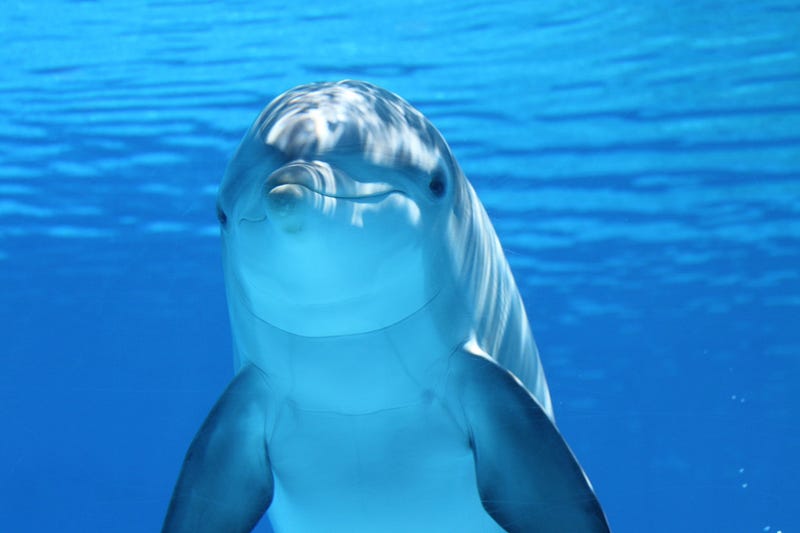
Empathy versus exploiting
Empathy makes humans humane. To imagine ourselves in the skin of another and understand their emotions from their perspective. But in our struggle for the safety, health, and rights of other humans and other species, is empathy enough? Is it even possible?
I just read Walter Veit’s fascinating essay on understanding sickness in animals, based on a paper he and Heather Browning co-wrote. The key point is in their conclusion:
“Animal experience is real and needs to be taken seriously — both for ethical and scientific purposes. While we cannot literally hear their voices, there are good phenomenological, yet nevertheless qualitative empirical methods, that can help us to, at least indirectly, make them heard.”
I agree.
The issue is personal for me. I am a research scientist, studying yeast in an academic lab. Previously, I was an engineer working in the medical device industry. From high school through my 20-year engineering career, I used a range of animals from mice to dogs to pigs, for research and product development. For some animals like the mice, I did everything from surgery to killing them by cervical dislocation (I broke their necks). This was my high school summer job at a research hospital. Later as an engineer I supervised or commissioned animal studies which others executed. Whether hands-on or hands-off, my actions still haunt me today. And these are my thoughts on the issue…
I believe the question of animal minds (and the associated policy issue of animal rights) remains stuck between the extremes of empathy versus exploitation.
One camp (call them the empathizers) identifies with the sufferings of animals and works to protect them, like in this recent petition to add protections for octopuses.
Another camp (call them the exploiters), defending their unfettered right to exploit animals, denigrates empathy as anthropomorphizing, as incorrectly projecting our feelings onto an unfeeling lower life form. The exploiters have the advantage and the benefit of the doubt in society today. They are the deeply entrenched status quo from our prehistoric days as hunters and domesticators of animals. Animals have always served humans in life and in death, and even if celebrated and thanked in some cultures, always at our will.
Then there is a vast middle ground of people who are not committed to either camp, but whose opinions, biases, and lack of action has distinct social consequences.
I found myself split, straddling the extremes, empathetic by nature, exploitative by profession.
Since we lack clear evidence of an animal’s state of mind, the empathizers can’t marshal anything convincing to rally the silent majority. And here’s the thing. The majority of people agree with the empathizers that animals have a mind filled with emotions. But to rally the public, opinion must become decisive action.
Meanwhile, the exploiters only need to raise a minimally reasonable doubt coupled to the promises of miracle drugs or profits wrung from the carcasses of animals, to defend their turf and keep the amber waves of people quiescent, inactive. A strategy much like the cigarette makers deployed against health advocates.
Hardwired automatons or perceiving consciousness
From an evolutionary perspective, I agree with Darwin that our human mind must have evolved from a perhaps less specialized mind that existed in the common ancestor to us and our great ape siblings. And the common ancestor to apes and humans derived their mind from an even more rudimentary mind further back in time. As we chase our evolutionary history, somewhere prior to a conscious mind was an autonomous system of hardwired responses.
I believe many of the charismatic megafauna we are drawn to are intelligent and have emotions recognizable to us. As an observer, however, I doubt my own ability to discern an automated response from a truly conscious and emotional creature.
I recently wrote an article about the eye-like structure in a single-celled dinoflagellate, a photosynthetic and predatory algae. The fundamental question is, does this alga see? Does a dinoflagellate with a complex eye, or a box jellyfish with a few thousand scattered neurons and complex lensed eyes, actually perceive? Or are the movements of these organisms hardwired in response to light, like a mousetrap triggered to snap shut when a mouse steps on the pressure sensor. The mousetrap does not perceive touch. The dinoflagellate does not experience vision. Or does it?
We have our own mousetraps as well, like when we touch a hot stove. But we believe we have higher level neural functions, which we call perception, memory, emotion, etc. Or, are these merely more complex mousetraps?
Is there a threshold of complexity before a mousetrap becomes conscious?
Emergent properties, a mind rising from the fog

The emergent property of Mind from an increasing complexity of networked neurons is analogous to the emergent property of Life from an increasing complexity of networked biochemicals.
We long ago discarded the idea that life requires some animating force other than the biochemicals within the cell. However, we do not know enough cell biology at this time to precisely define the minimum requirements of life. But! We believe it is only a matter of time, as we learn more about biochemistry and their networks, before we learn where the threshold of complexity lies between life and non-life. The search for the origin of life which I wrote about here is intimately focused on this very question.
The sub-disciplines and the associated tools of biology are powerful: biochemistry, molecular genetics, cell biology, etc. The ability to isolate and characterize proteins and genes and their interactions, to learn which molecule turns which switch on, what signals another to make more protein, etc. And from that reductionist understanding of the components, we are slowly, painfully building up our knowledge of how the whole cell, how life works.
What are the analogous sub-disciplines in studies of the mind? What are the tools?
Although science is rightly criticized for its reductive methods, those methods are incredibly powerful when coupled with the appropriate technology for addressing a discrete question. There was no way to directly test the presence of microbial life without a microscope. But we can infer the presence of something we can’t directly observe with careful experiments, so even without a microscope we can infer the presence of microbes.
Today, we can only infer the presence of a mind since we lack the sub-disciplines or technological tools to directly observe and measure it. Without the right tools and methods, we cannot tell at what level of complexity an animal has a mind: a single-celled dinoflagellate, a jellyfish, a worm, an insect, a fish, a mouse, a monkey, or a man?
That problem will fade with the further development of disciplines such as neurobiology, and tools like functional magnetic resonance imaging or Elon Musk’s Neuralink electrode implant technologies, and whole brain maps detailing each neural connection, and many others. But for now we are limited to the crude tools of observational data, and of empathy.
A convincing and scientific understanding of an animal’s mind is a long, hard road with no predictable date of achievement. Anything less than a scientific understanding will be an easy target for charges of anthropomorphizing and reasonable doubt. So the scientific road to the animal mind is an essential one to travel.
Communication with animals isn’t the problem
The central problem is our inability to quantitatively and scientifically understand an animal’s state of mind.
We tend to interject our inability to communicate with animals as the central problem, as if a dolphin saying “I feel sad” would clarify their mental state. Scientifically, we know a talking dolphin would not clarify its mental state. But could animal communication help to influence the public in support of animal welfare policies?
Scientifically, think of our studies of fellow humans with whom we have direct communication, and yet we still struggle to understand their true mental state. Language only imposes another screen between the observer and the observed. Think of how often we misunderstand a friend, a spouse, a child, a coworker, despite often intense and frequent communication. We can’t accurately or precisely model and predict the inner mental state of another human, however close they are to us. This problem magnifies with relational distance: we are even less able to understand or empathize with someone of a different sex, religion, social status, race, etc. By extension, the problem becomes intractable by the time we add “different species” to the relational distance, even if we could communicate.
Our inability to empathize with distantly related humans, of another religion or race or nationality, is enough to trigger discrimination, apartheid, war, and genocide. Our lack of understanding is enough for us to close the windows and turn up the music when we hear a woman screaming for help.
In fact, we are even unable to truly understand our own state of mind — ourselves with whom by definition we have no communication barrier. The emotions we readily perceive in ourselves, and which are observable to others, is multi-layered, underlain by a complex network of other often hidden emotions, memories, perceptions, experiences, etc. The fact that many of us need therapy to unravel our layered emotional state to even remain minimally functional, reflects our inability to truly understand our own or any mental state.
The dubious record of mental health treatments attests to our still primitive understanding of the mind.
Communication with animals would no better enable our scientific understanding of their inner lives, their minds, feelings, and sufferings than it does for humans. We would have at best a superficial reporting of animal feelings (which we can just as easily gain by simply observing), but no deeper understanding of what makes their mind tick.
There is a gulf between the public’s professed belief in the mind of animals, and their willingness to support animal welfare. The public won’t back policies to protect animals to the same degree as their belief in animal’s feelings of pain and suffering. Why? Perhaps the average person believes animal feelings are not similar enough to human feelings to warrant similar rights and protections.
You can imagine a prioritization in the mind of the public: at the top, family, then friends, community, nation, other nations and races and religions… and at the bottom, animals.
We have a deep scientific understanding that humans across the world are genetically very similar — that the variation in genetics is larger within a racial group, than between any races. We are truly all one. Yet we don’t treat each other as such.
We know that there is a tremendous gulf separating us from other animals. Genetically, behaviorally, and possibly mentally. Is it reasonable to expect us to empathize and treat animals better than we treat ourselves?
Perhaps.
What to do when we don’t know

We humans kill our neighbors on a horrendous scale. We see our handiwork in Auschwitz, in Hiroshima, in Dresden, in Rwanda… We kill our black and brown neighbors on American streets, through our police and through our inaction. Significantly because we lack an ability to assign others emotions and minds just like our own. We won’t empathize with those we fear or hate.
Despite our inability to understand another’s mind, we do know how to treat others: as we wish to be treated ourselves.
We act compassionately by assuming we understand another’s mind, by mapping our own feelings onto them, by anthropomorphizing if it is another species, and treating them as we wish to be treated. When we empathize, we don’t actually know their mind. But we don’t need to.
But we do need a reason to empathize. A dog gives us unconditional love (we think — it could just be the treats). So, we find it easy to empathize, or at least to project our emotions and thoughts onto our dog. We find empathizing much harder to do for a sea cucumber. Some can. But most can’t. Same with an octopus. It is much easier for us to empathize with a dolphin because they give us such direct pleasure, they are a joy to watch as they play and chatter.
When we feel fear or anger (“they” are coming for my job, my home, my wife…), we will no longer empathize, even for our fellow human.
A key to convincing the vast middle ground of the minds and rights of animals, is to make sure the public finds attachment, pleasure, fascination, or even love for them. For that, we need the sophistication and technology and scale of a modern political campaign. I think that is a fundamentally hard problem, like convincing a racist to love another race, or a carnivore to love a cow.
Nonetheless, we can and should act to protect the minds and rights of animals, even though we don’t know if they have minds, because it is the right thing to do. And it may teach us how to treat each other, better.
Thank you for reading, and please share!
If you liked this, you may like my clarification of Darwin’s doubts here:
Or my story on the genomic sequence of the tuatara, the last survivor of a once dominant reptile order from before the age of dinosaurs, here:


