
Don Knotts and Tim Conway, side-splitting second bananas
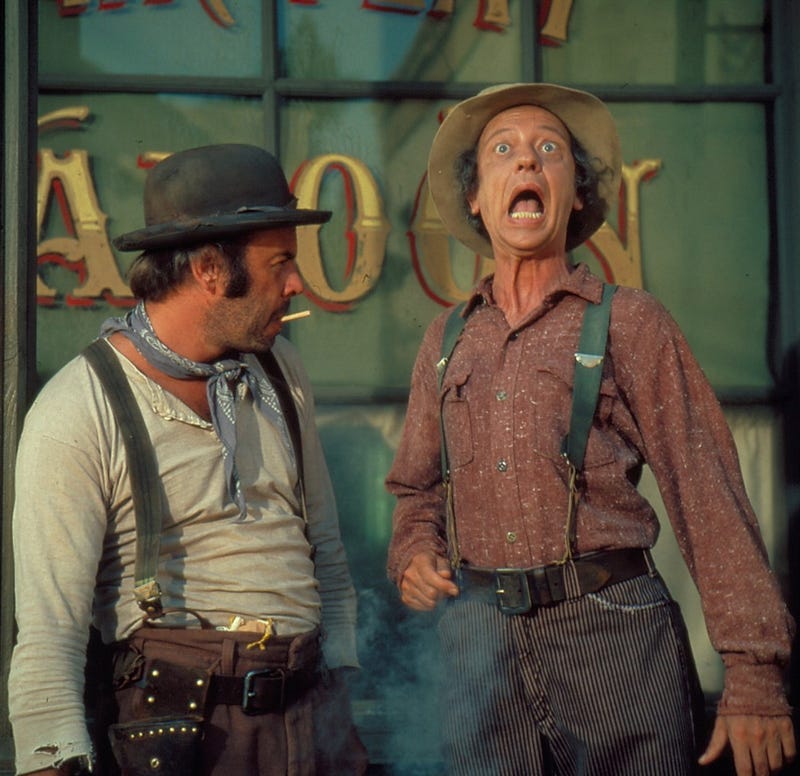
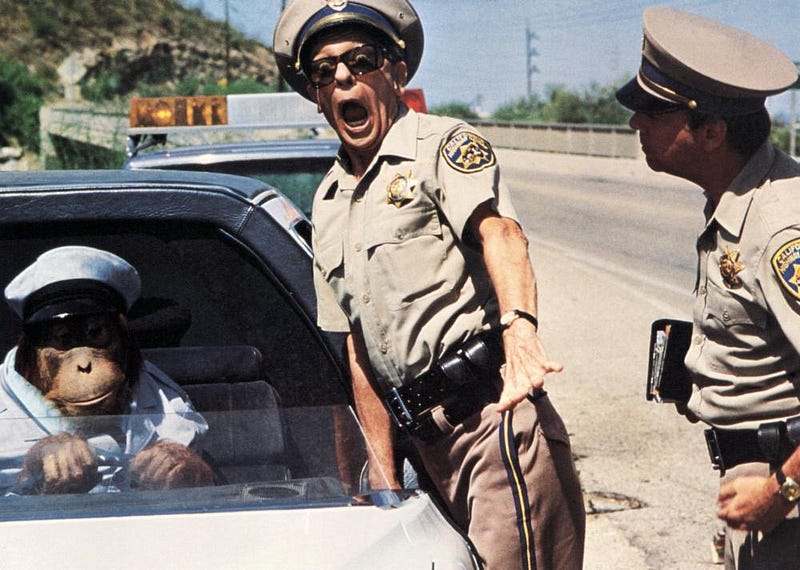
Tim Conway is forever enshrined as a vital element of Carol Burnett’s comedy-variety troupe, but his five late ’70s motion picture pairings with Don Knotts are hysterically funny and have been more widely reissued on home video. Over a five-year stretch — a Knotts idiosyncrasy going back to his Andy Griffith Show, Universal Films, and soon-to-be Three’s Company tenure— the bossy, bug-eyed Mayberry deputy and the decidedly silly McHale’s Navy ensign made three Disney features — The Apple Dumpling Gang, Gus [regrettably no scenes together], The Apple Dumpling Gang Rides Again — and two indies scripted by Conway for B-movie innovator Roger Corman’s New World Pictures — The Prize Fighter and The Private Eyes. Fast forward to 1984, and their orangutan-assisted cameo as highway patrolmen in the all-star Cannonball Run II proved to be one of the sole bright spots in the asinine road movie that killed Burt Reynolds’ 11-year reign in the Top Ten Money Making Stars Poll. Instead of vignettes embracing cheap laughs, their humor was character-driven.
In his 2014 memoir, What’s So Funny? My Hilarious Life, Conway shed light on how he initially glimpsed Knotts on television. “I’d watched Don do his ‘Man in the Street’ interviews on The Steve Allen Show [1957–1960], and he had me doubled over with laughter,” wrote the nearly decade-younger funnyman. “Don would come out as this quivering bundle of nerves, his head jerking, his hands trembling, and Steve would stop him and ask him questions. He’d ask his name, and then say, ‘What is your occupation?’ His voice shaky, Don would answer, ‘I’m a ne-ne-neurosurgeon,’ or ‘I make d-d-d-dynamite.’ It wasn’t just the material, it was the way he portrayed these people. You’d be laughing before he said a word. And it was all so gentle.
“There wasn’t a phony motion in Don…and what characters he created! I think Barney Fife is one of the greatest, funniest, and truest personalities ever seen on the screen. When you watched his antics as Andy Griffith’s deputy, you were watching Don Knotts. He was Barney Fife, a kind, gentle, fun-loving person who dedicated his life to making people smile.” Knotts won his third Emmy in 1963 as the overzealous lawman for “Outstanding Performance in a Supporting Role” in direct competition against Conway on McHale’s Navy, so no lingering hard feelings existed. In fact, three years later “Little Red Riding Doctor,” one of the final episodes of the Ernest Borgnine starrer, inauspiciously launched the buddies’ small screen debut with Knotts emblazoning a psychiatrist sent to identify battle weary soldiers.
Knotts preferred not to tear down scene partners to get a laugh and keenly analyzed his comedic approach as quoted in eldest child Karen Knotts’ 2021 autobiography, Tied Up in Knotts: My Dad and Me [pages 192–193]. “There are two classifications of humor that are frequently used,” according to the elder Knotts. “One that isn’t my type of comedy is insult humor. It’s usually effective if the right kind of person does it, like Don Rickles. It appeals to the bully in us, I think, to see Rickles tear into somebody, and there’s a certain sort of sadistic side. Everybody loves to see somebody take somebody else apart verbally. Jack Benny, on the other hand, turns the humor against himself, which is more or less what I’ve tried to do. He makes himself the butt of the joke. It makes the audience feel superior to this poor schmuck who’s in whatever situation he’s in.”
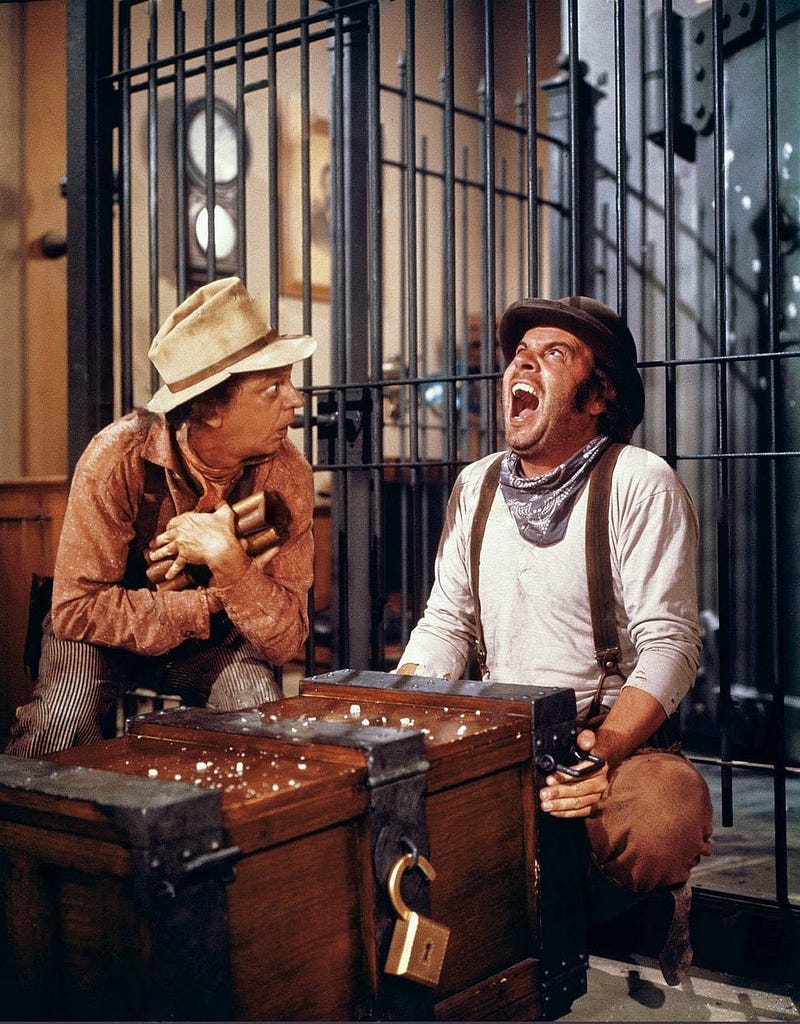
Of course, Griffith had been Knotts’ straight man, while Harvey Korman helped make Conway look good on The Carol Burnett Show. Knotts credited the helmer behind Savage Sam and The Ugly Dachshund for scheming to couple him up with Conway in his too-concise 1999 Barney Fife and Other Characters I Have Known tome. “I was doing a play in Chicago when I got word that Disney wanted me for a picture,” recalled Knotts. “Well finally, I thought to myself! I had always thought I was Disney material. It wasn’t Disney per se that wanted me, it turned out. It was a director named Norman Tokar…I thought teaming us up was a stroke of genius on Norman’s part…nobody gets rich working for Disney, but I had a lot of fun and some great experiences…”
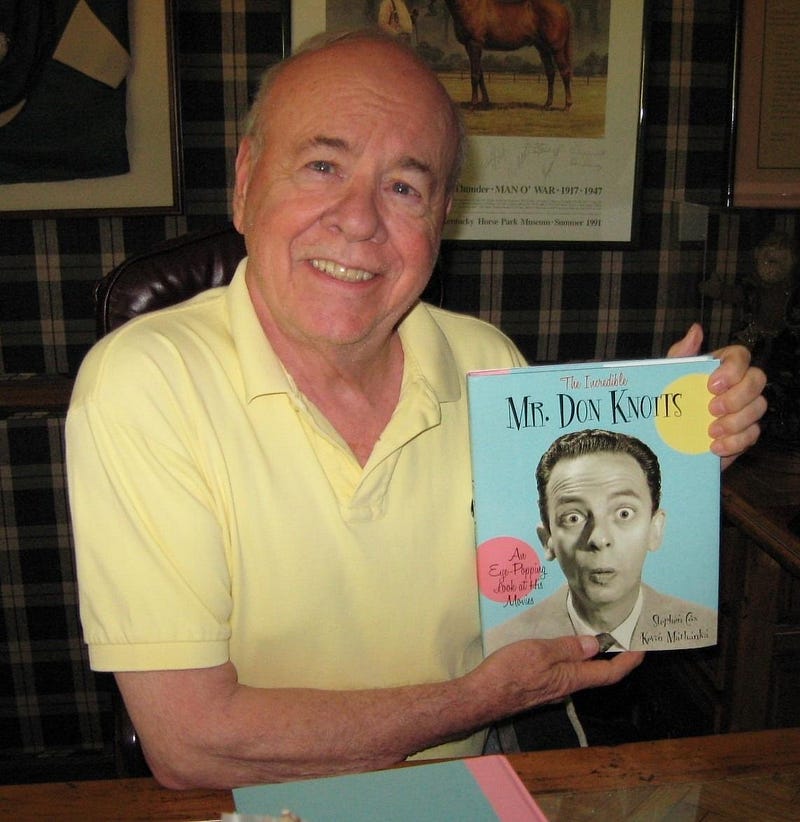
In The Incredible Mr. Don Knotts: An Eye-Popping Look at His Movies, authors Steve Cox and Kevin Marhanka examine the moribund status of Knotts’ then-celluloid career, four years after his final Universal effort, How to Frame a Figg, fizzled at the box office. Knotts had grown exhausted rendering the “nervous little guy” and “got the feeling of being boxed in, stuck with the same character.” As inept, annoyed bank robber Theodore Ogelvie in The Apple Dumpling Gang, Knotts “reinvented his performance into a much bolder, riskier type. Taking on the numskull role was Conway, who played it stupid most of the time…
“We walked down the street for our first shot,” reported Conway while filming the family western that they literally stole out from under the top-billed Bill Bixby and Susan Clark. “Norman stopped us and said, ‘You boys are doing the same kind of comedy walk. One of you has to change it.’ Don and I know each other’s work so well that all I had to say was, ‘You use the No. 6 walk with the three face, and I’ll do the No. 4 walk with the two face.’” Knotts concurred. “I had to change my style a little when I worked with Tim,” Knotts admitted to ghostwriter Robert Metz. “It was clear that Tim’s character was the more ridiculous of the two, so I had to be the guy who at least thought he knew what he was doing — the take-charge guy.” Their chemistry soon fell into place.
Karen Knotts inherited her father’s hysterical streak and observed how his style initially veered away from Conway. “Dad would rehearse diligently, but Tim thrived on improvisation. Dad used to improvise with Andy, and it started coming back to him. He began to enjoy improvising scenes with Tim, who was a master at it.” Her dad picks up the tale in his book. “As in the case of Howard McNear [Floyd the Barber on TAGS], you were never quite sure what Tim was going to do when the camera turned on…much to his credit, Norman did not pin us down with a lot of staging in our camera rehearsals. Most of the time he just turned us loose.
“We did a scene in which we sneaked a ladder out of the firehouse while the chief [Owen Bush] was sleeping and wound up breaking a window in the building next door, which I hold to be as funny a piece of film as you will ever see. Norman gave us free rein and we ran with it. It was great fun!” Conway chimed in and disclosed to Cox and Marhanka, “Don and I walked around with this stupid ladder, and Don knew enough that when I pulled on the ladder to stop or to go. All of that business of crawling over the guy and running into bells was adlibbed. Don knew exactly what to do to make it funny and never to stop and question, ‘Hey, what are we doing here?’”
Cox and Marhanka turned up another vintage Knotts interview where he expounded, “It’s difficult to explain why we work so well together. Even the fact that we have a mutual admiration society doesn’t entirely explain it. Maybe it’s because he makes me laugh when I work with him. I put myself in the straight man position when we’re in a scene together. I consider him the zany one. I’m like Hardy to his Laurel.”
Knotts avoided stunts at all costs, and his neuroses were legendary. “If there is anything falling or blowing up, Don is not there,” his partner endearingly informed Cox and Marhanka. “Don was kind of a chicken that way. He always saw the danger in scenes and avoided it. He’d had a blood clot in his leg at one time, which is obviously very dangerous, and he assumed that if he had one, there must be others…” Knotts claimed, “I have never done a stunt in my life, you might say, which gets to be kinda funny because if I had to jump off the top step, if it’s two steps down, I got a stunt double in there.”
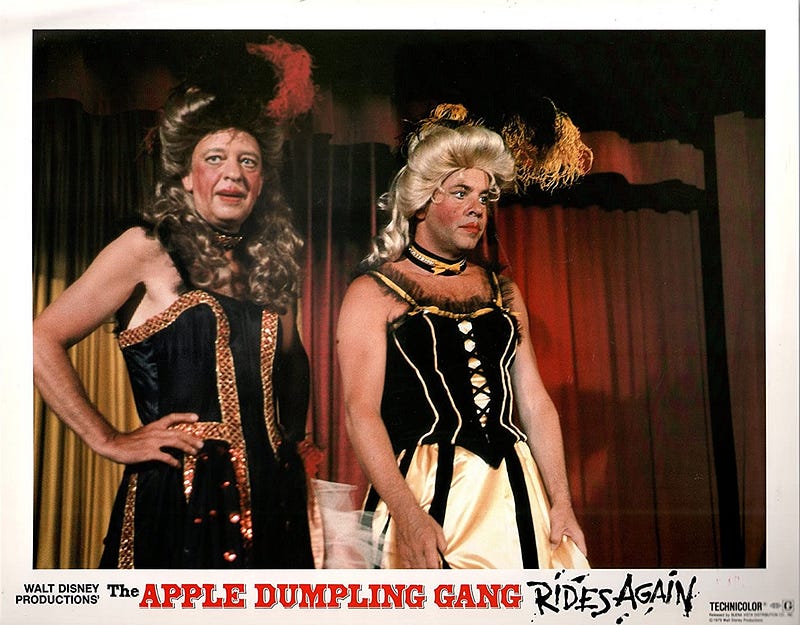
Conway recollected one of the goofiest behind the scenes antics in his What’s So Funny? manuscript. “During the filming of The Apple Dumpling Gang Rides Again [the original’s hefty profits kept Disney in the black] we were on location in Stockton, some 300 miles from Los Angeles,” stated Conway. “For one scene in the movie, Don and I were disguised as two dance hall girls working in a western saloon.
“We wore low-cut frilly, black dresses, black stockings, high heels, and wigs. My wig was in an upsweep; Don’s was a mass of flowing locks with a big feather sticking up in the back. We made a pair of pretty hot chicks. We stayed at a nearby motel and every morning we’d get in my rented car and I’d drive us to the train station where we were filming. During the week or so that we worked on the dance hall sequence, Don, who never bellyached, constantly complained that he was freezing to death during his costume change. The wardrobe trailer was unheated; really it was like being inside a refrigerator. I wasn’t bothered by the cold but I sympathized with him.
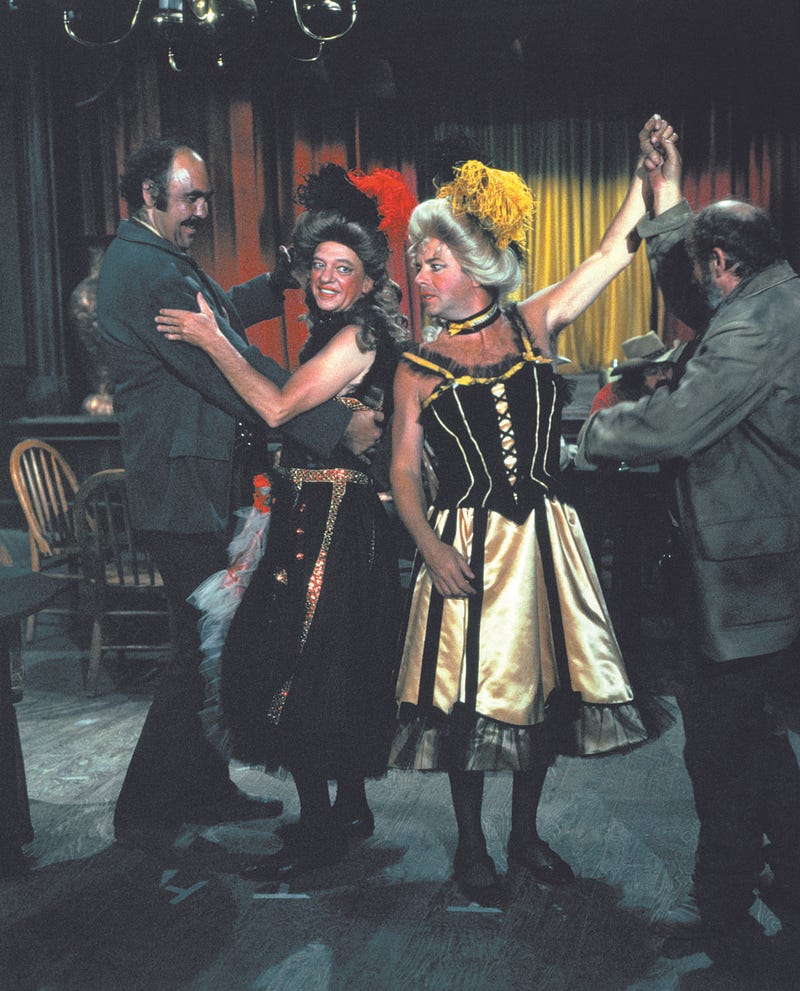
“‘Look,’ I said, ‘Just get the wardrobe guy to give you the clothes. Get dressed in the motel in the morning then you won’t have to change in the trailer.’ ‘Y’know, you got a good idea there, buddy,’ said Don.
“That day when we got to the set we arranged for Don to bring his costume back to the motel. He was a happy man. The next morning he emerged from his motel room in all his feminine finery and got in the car. I’ll admit he did look a little strange sitting there next to me, but it was what it was. As we drove along, Don couldn’t resist grabbing the opportunity to have some fun. He kept preening in his seat and giving friendly little waves to other drivers when we stopped at traffic lights. A day later the scene became even weirder.
“We were shooting the dance hall sequence when the director [Vincent McEveety] called a halt and announced that we’d finish the next day. I got into my regular clothes, but Don stayed in his costume. He kept on his makeup, too. Dance hall girls tend to pile it on a little thick, and his face glowed with pancake powder. Not to mention the bright red lipstick, the false eyelashes, and the wig with the plume in it. I drove back to the motel and dropped Don off at his room to change. I told him I was going to get a beer at the bar across the street before we went for dinner. He said he’d change into his civvies and join me.
“I went into the saloon, got my beer, and sat at the bar. Did I mention that this bar was rather a rough place to spend time? The locals didn’t much care for Hollywood types. I passed because I didn’t look like a movie person; ordinarily Don passed, too. I was sipping my beer and looking into the big mirror on the wall behind the bar when I saw Don enter. He was still in his dance hall outfit, the black stockings, the high heels, and the wig with a plume in it, the whole works. Everyone stopped talking, and all eyes were on him as he crossed the room and came over to me. He put his hand on my shoulder and said, loud enough for all to hear, ‘Have you got the keys to that room, big boy?’
“Every cowboy in that bar was looking at us. I pulled my head back, slowly looked Don up and down, and then drawled, ‘Well ma’am, don’t you think we ought to talk price first?” I can still hear the sound of Don’s laughter. We were just plain lucky that the cowboys found it amusing, too.”
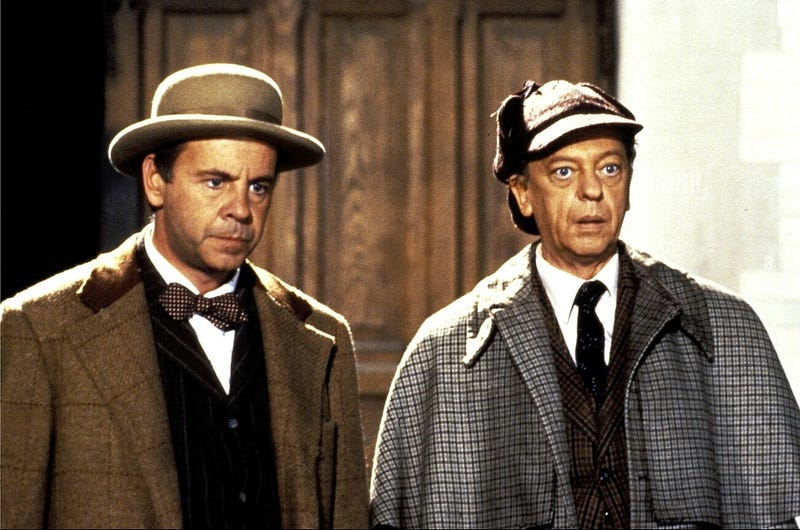
The Private Eyes inadvertently stands as the final full-length theatrical mash-up for Conway and Knotts. Written by Conway and John Myhers, the Sherlock Holmes spoof was a sleeper hit that audiences flocked to see. Daniel de Visé’s masterful Andy and Don: The Making of a Friendship and a Classic American TV Show paints a bird’s eye portrait of how a typical day transpired. “The Private Eyes was shot at the historic Biltmore House in North Carolina,” writes de Visé, incidentally Knotts’ brother-in-law through third wife Francey Yarborough.
“Tim would pick Don up for the 20-minute drive from town. His passenger was a tireless complainer. ‘Don would get in the car in the morning and he would say, ‘You know, that damn air-conditioning last night, that was blowin’ all over me. I’m gonna tell those people to put some cardboard over it or something. I can’t take that much longer,’’ Tim recalled. ‘Then we’d go by some houses, and he’d say, ‘Look at that. Brick houses. I hate brick houses.’ And we’d get almost out to the house in the country. And he’d say, ‘Look at those cows out there. What the hell do cows do all day?’
“One morning, Tim surreptitiously recorded Don’s rants. ‘So, next day, we got in the car, and Don goes, ‘I’ll tell you, that meat loaf kind of got to me last night. Boy, that backed up on me.’ And I said, ‘Don, would you mind very much if we don’t talk this morning? Just listen to the radio?’’ Tim put on the tape, and Don heard his complaints of the previous day issue forth from the speakers. After that, ‘we played that thing every morning when we went to work.’”
Conway’s mischievous streak engendered an unscripted Private Eyes scene. “Don [Inspector Winship] and myself [Doctor Tart, his sidekick] were standing in front of a large window,” reads a delicious passage in What’s So Funny? “I was supposed to send a message to Scotland Yard via a carrier pigeon with a little note attached to his leg. Don was to hand me the pigeon and then tell me to throw the bird out the window. During the shoot, I took the pigeon but, instead of opening the window and flinging him out, I threw the bird at the pane.
“The pigeon smashed through the glass, adjusted a few feathers, and went sailing off. [Wait, don’t call the ASPCA — the glass in the window was the breakaway kind]. Now if Don had laughed we’d have lost the whole scene. He didn’t, though, he just gave one of his ‘sniff’ takes, a quick drawing of air up into his nostrils, and a couple of head bobs, and walked away. Thanks to him, we were able to keep the bit in the film.” More comedy gold ensues when a forgotten cigar misplaced by Knotts on their station wagon’s roof accidentally decimates a gas station.
Besides the 1984 cameo in Cannonball Run II, coincidentally the same time that Knotts’ flashy streak as wannabe Lothario Ralph Furley wound down on Three’s Company, the duo supposedly went their separate ways. Not so, according to Conway. “After I started doing Vegas and different theaters around the country with Harvey Korman, a lot of times Harvey wouldn’t be able to make the trip or he would be ill,” Conway documented in What’s So Funny? “Don would step in, so we worked a lot in clubs, too. Don was one of those reliable guys.”
Knotts succinctly lamented the cessation of their Tinseltown partnership. “Each of us became busy with our separate careers, and Tim and I never made another picture together. It’s really kind of a shame. I thought we made a good team…”
“Had I come up with another film, I’m sure we would’ve been able to work it out,” elaborated Conway in The Incredible Mr. Don Knotts. “We had a lot of success with those movies, and we should have done more. Later on Don and I voiced some characters together on the Hermie cartoon series that came out on videotape [from 2003 until Knotts’ death at age 81 from lung cancer in 2006]. Once Don had the problem with his eyes [severe macular degeneration], it became very difficult for him to work. He really couldn’t stand being under lights. That really bothered him, even if he was in natural daylight…I learned a lot just watching Don at work. I’m so thankful I had the opportunity to know and to work with him.”
© Jeremy Roberts, 2023. All rights reserved. To touch base, email [email protected] and mention which story led you my way. I appreciate it sincerely.


