
Does The iPhone Make Cameras Obsolete?
For most people, including myself, the answer is now abundantly clear…
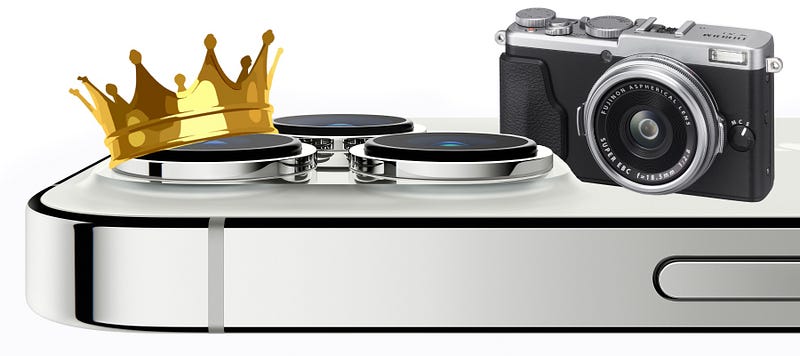
I sold my last ever camera that I owned, a Fujifilm X70, and I felt no regret whatsoever. In fact, I wish I knew why I waited so long. Since the iPhone XS, I have barely turned it on and the difference in photo quality often was indistinguishable. Don’t get me wrong, in some ways it would still outperform every phone out there, it was after all a fantastically capable camera for its size and price-point. But it was time to say goodbye to it for good, and it wasn’t the camera’s fault. Nor was it mine. I blame Apple.
When the iPhone 6S was launched, which was officially my first-ever iPhone, I bought it on release day, just days before a holiday back home to Romania. The reasons for getting an iPhone were the usual ones. All the Android phones I had kept crapping out on me, software updates dried up after a year or so, and their resale value dropped to practically zero merely months after purchase. Owning an Android phone felt like a technologically and financially irresponsible strategy. The iPhone 6S was meant to change that. But there was still one aspect of tech I wasn’t quite convinced about when I bought the 6S — photography, and I needed to test it out.
Whenever I would go on holiday, I would always take a camera with me. I owned many cameras. Small point-and-shoots, hybrids, APS-C, micro four-thirds, DSLR, fixed lens, removable lens, I had them all at one point or another. They all shared a common flaw — they were all an additional device to carry around.
The “one more thing” problem
Many photographers will tell you, “the best camera is the one you have with you.” And that’s no joke. Many of the famous shots in history have been taken with cameras that people had with them then and there, rather than the ideal camera, the top gear with all the bells and whistles. For most folks, myself included, this holds true even more. If I had a penny for every time I or someone I know said the camera is “just another thing to carry”, I wouldn’t be a millionaire, but I’d definitely have a few hundred extra bucks in the bank.
The truth is, whether we like to admit it or not, is that most folks simply don’t like to carry stuff, especially when its purpose is singular, and unfortunately for dedicated cameras their purpose is exactly that. That’s all they do — take pictures and perhaps videos, but typically, it’s the former. This essentially means that every time you want to take a picture, you have to grab that specific device, set it to the right scene or even go as far as set the F-stops, exposure, etc, and take that picture.
If that wasn’t enough, there’s actually more to it because you’re not really carrying just “one more thing”. What I noticed over the years is that cameras’ batteries tend to last less than they used to in the past, and most definitely less than many smartphones, iPhones in my case. So, you’re likely carrying an extra battery for your camera as well. If it’s not a fixed-lens device, then you’re looking at at least another lens, at which point you’re inevitably carrying everything in a camera bag. At this point, it’s a genuine hassle. I had a Canon EOS 600D, an otherwise fantastic DSLR, but lugging around that, an extra battery, three lenses, UV filters quickly became a chore rather than pleasure.
I’m not a photographer, but I love photography
This is a crucial distinction to make, and it’s the one Apple has bet their camera systems on since probably the iPhone 4S. What many photographers arrogantly dismiss is the rest of the world’s interest in light, casual, but quality photography. At times people have suggested that Apple make a camera as well, and in fact Apple did just that with the QuickTake series, a line of devices which thankfully flopped in just four years between ’94 and ’97. What Apple decided to do after, was a lot smarter (QuickTake is now also back as a camera software feature).
Everyone wants to take good photographs; photographers just want to make a living from it.
Admitting to myself that I wasn’t a photographer, but that didn’t mean I couldn’t aspire to quality photography, changed everything. Suddenly, I didn’t feel like I needed to live up to a certain camera gear standard to somehow justify the resulting photograph. So, I went on my cross-Romanian holiday and used the iPhone 6S exclusively. Going through some of those shots even many years later, I find them to be spectacular photos from a device that wasn’t a dedicated camera, just a phone always with me, that happened to be able to take pictures and videos.

Suddenly, my creativity was unleashed because I wasn’t bound by the limitations of lugging around an extra device.
Meet computational photography
Having said the above, that didn’t stop me from purchasing two more cameras after my positive iPhone 6S experiment. While the photos were great, bokeh was practically non-existent, playing with exposure, F-stops and fine settings were not an option, so ended up getting a Fujifilm X70 and a Panasonic Lumix DMC-LX10. Both fine cameras, both fixed lens. The intent was to recreate the pocketable aspect of the iPhone. To some extent, both managed to achieve that, though the Lumix definitely couldn’t cope with anything less than a jacket pocket. The Fujifilm was easier on the jeans, but you definitely looked like you were really happy to see people. But my excitement didn’t last long. Not for the cameras. It pivoted to the iPhone XS.
The iPhone X was already impressive, but having learnt from the 6S to wait for the S iteration a year later was a good lesson, so I waited it out, and as soon as it was in stock, I was the proud owner of one. Taking just a few photos with the XS was already proof enough for me, and a photographer/videographer friend of mine confirmed my feeling when he stated, “computational photography just screwed the photography industry”. And indeed it did.
At this point, most point-and-shoot and fixed-lens cameras are a waste of money.
Now, I would like to make something abundantly clear. Apple did not invent computational imaging or photography, but they did contribute to making it extremely popular and effectively the norm by 2022. While the likes of Samsung and Google are doing remarkable things as well, Apple has maintained its position in the forefront of this technology going as far as applying it to video too and that is no small feat!
What computational photography does is in many ways magic, but from a software engineer’s perspective makes all the sense in the world. When you have processors fast and efficient enough to understand the photo you are taking, they can remove barriers posed by mere lens physics and recreate reality through emulation. This doesn’t only allow someone, heck, anyone to take the best shot without trying twice — which professional photographers do all the time — but also to change the initial parameters of said shot and return a different output.
One could argue, this is not necessarily true to life, but as someone who owned plenty of cameras, I’ll tell you there is no true-to-life photography. Sensors between camera brands are different, so is the software interpreting the colours and light, the settings the photographer uses will vary, and the lenses they use will have different characteristics.
Computational photography renders half the cameras out there expensive paperweights. Sell them while you can!
While my iPhone 13 Pro might not yet rival a $20K camera, it’s definitely all the camera I need to take truly memorable shots, and for most of us, that’s all we need — great photos without a dedicated camera.
Attila Vago — Software Engineer improving the world one line of code at a time. Cool nerd since forever, writer of codes and blogs. Web accessibility advocate, Lego fan, vinyl record collector. Loves craft beer!