Does Flexibility Pose A Threat to Career Progression?
There’s been a lot of noise about getting people back into the office. More and more companies are using different approaches to get people back in. However, we need another conversation about having everyone back full-time. I don’t see the hybrid model being made redundant, nor should it be. I’m thrilled that people are being offered a choice in their organisation.
According to Jamie Dijon, CEO of JP Morgan, the world of work will look different anyway.
The Hard Hitting Titan
JPMorgan’s Dimon Predicts 3.5-Day Work Week for Next Generation Thanks to AI. Wow, that’s sensational. Imagine having 3.5 days off from work. According to Jamie Dimon, CEO of JP Morgan, this could be a reality for the next generation.
He says AI is already widely used in the company and expects its influence to continue. If AI is so effective, does he see any job losses? He says it’s inevitable that jobs will be lost. However, he’s confident that those affected will be redeployed within the firm.
Before transformational changes start sweeping through organisations, I believe there’s an excellent opportunity for hybrid job holders to make the arrangement work for them without jeopardising their career trajectory.
Jump Into The Driving Seat Of Your Career
In today’s world, YOU must be responsible for your career. Ouch, I might hear you say. Yes, you heard right. You can’t be in the passenger seat of your career in the 21st Century. Instead, learn to jump into the driving seat. It might feel overwhelming, but you’ll thrive if you job-craft your way to your next best stretch.
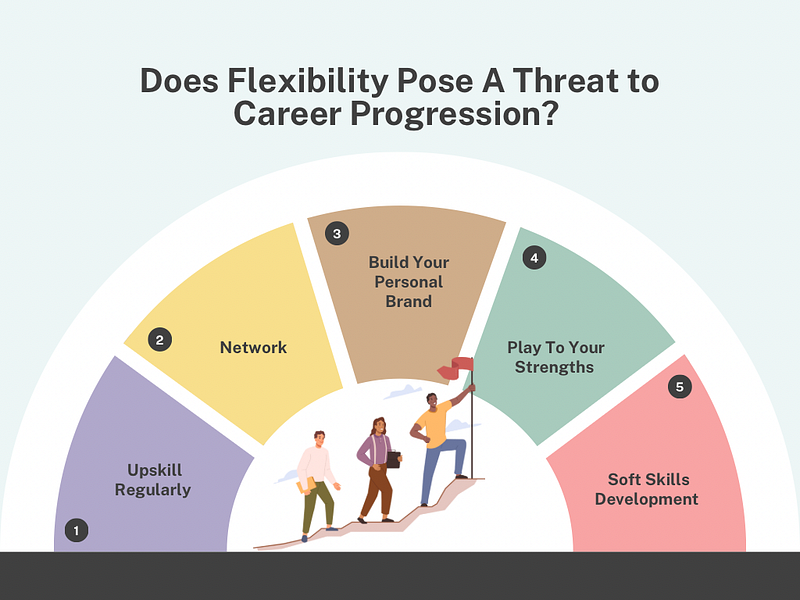
Here are six ways you can take control of your career:
- Upskill Regularly
- Networking
- Personal Brand
- Soft Skill Development
- Play to Your Strengths
- Passion Project
- Upskill Continuously
As an Executive Coach, upskilling goes within my scope, but I appreciate that it might not be for others.
I see so many talented and competent people struggling to manage their careers. Why? They’re feeling the heat under the collar because the only constant in today’s fast-paced world of work is change and uncertainty. The fear associated with uncertainty is holding many back because they’re still using the old formula to excel. It doesn’t work anymore.
The old formula of getting excellent grades at good schools and attending a top university has been turned on. It’s no wonder that many feel overwhelmed and unsure of how to navigate these uncertain times.
2. Networking
Do you dread networking? I know many who do. Why? They’re going to dull and dreary events, forcing them to speak to a few people and then come away with a bunch of business cards. They’ll collect dust if you do nothing with those business cards.
Networking is one of these activities that many want to do, but it ends up being on a sideline for maybe tomorrow. I hear a lot, ‘I know I should, but…..’
Networking becomes fun if you do it regularly versus ‘doing two hours networking’ one afternoon.
Instead, tear the rule book up, start building relationships online, and continue developing offline relationships. Building and maintaining relationships is an essential skill that AI cannot replace. How? Humans can empathise, understand nuances, and make connections that AI cannot replicate.
Enhance your active listening, communication, and negotiation skills to foster stronger relationships with colleagues, clients, and stakeholders. Remember, the networks you build today can be your greatest asset moving forward.
3. Personal Brand
Your career story is also your brand, and branding counts in the 21st Century. What do I mean by that? How many know your story? 50–100, maybe 500? Did you know you could reach millions of people with the right online platform?
People buy people based on trust. An online presence, especially on LinkedIn, will enhance your brand and help you build trust with an audience who doesn’t know you.
Be Proud Of Your Online Brand. You don’t need to be an influencer or showbiz icon to think about your online presence. Anyone and everyone who has access to the internet can build a personal or professional brand. I believe it’s a great way to document your journey, especially if you’re aspiring for more visibility.
However, creating your online brand doesn’t happen by magic. Instead, you have to do your bit to craft your legacy because no one has a vested interest in your career than you. It is easy to get complacent, but in today’s world, you can be anything except complacent.
4. Soft Skill Development
Which Soft Skills Matter? Problem Solving. In an AI-driven world, problem-solving skills will be more crucial than ever. You benefit from your ability to analyse complex situations and find feasible solutions. This includes being able to think critically and make data-driven decisions, as well as skills. Learn how to apply this knowledge in a real-world context to stay a step ahead in your career.
Emotional Intelligence is another one. Understanding and managing one’s own emotions and the feelings of others will be highly sought after in the AI-dominated workforce.
Cultivate your skills in empathy, self-awareness, and emotional regulation. Being adept at navigating complex human emotions will set you apart in a world where technical tasks are delegated to machines.
5. Play To Your Strengths
When each day falls into a pattern or a routine, it’s easy to slip into the status quo and start drifting. It’s straightforward to do when you don’t set stretch goals. Change can be too much to handle when it feels cosy or comfortable.
Discover Your True Strengths… We all know our strengths, but do we truly understand them? You can navigate challenges more effectively when you are deeply aware of your strengths. You’ll learn how to transition from one strength to another seamlessly.
Here’s a little exercise for you:
- Strength 1:
- Strength 2:
- Strength 3:
- Strength 4:
- Strength 5:
6. Passion Project
Do you have a passion project? Take a leaf from Google’s book and spend 20% of your time on innovation. You don’t need to be working on Google-type projects; it could be something you’re very passionate about.
Sitting in on projects which interest you may also be an excellent way to job craft. You may not be directly involved with the responsibilities, but it will give you a taste of what’s on offer. I’ve done it a few times and found ‘sitting in’ insightful.
What happens if the boss says no to your passion project? If your boss won’t let you do it on your own time. Really? Yes, maybe you have a hobby or volunteering gig. If yes, learn new skills through it. You will learn and apply the transferable skills to your day job, thus helping you excel and shift gears when needed.
Other Tips
❇️Make an Effort to Stay Connected. Actively engage in virtual meetings and events. Use messaging platforms and video calls to maintain regular contact with colleagues. Schedule virtual coffee or lunch breaks with colleagues to replicate the informal bonding in the office.
❇️Keep Communicating Clearly and Often. Share your thoughts, concerns, and ideas with your team and superiors. Good communication helps in forming solid relationships and reduces feelings of isolation.
❇️Set Boundaries between balance work and personal life. Allow breaks to recharge and maintain mental and emotional health.
❇️Engage in Virtual Team Activities. Participate in online team-building activities. These can be fun, interactive sessions to bond with colleagues.
Sue’s Story
Sue, a marketing specialist at a leading tech firm, found herself at a crossroads moment in her career when her employer announced a permanent move to a hybrid working model. Initially, Sue was very excited by the prospect of greater flexibility and a better balance between working from the office and remotely. However, as the initial excitement wore off, a persistent worry emerged: What impact would this new working mode have on her career advancement?
The world was buzzing with discussions about AI transforming the workplace, and CEOs like Jamie Dimon of JP Morgan were forecasting a future with substantially fewer office hours.
The transformation was simultaneously exhilarating and disconcerting for Sue. She was excited to have a better work/life balance, yet the uncertainty around job security and her career trajectory in this shifting landscape was troubling.
Determined not to allow these transformations to sidetrack her career aspirations, Sue embarked on a personal and professional growth journey. She realised she had to take responsibility for her career development in this evolving work environment. She’d not had to worry about her career before, but she’d have to start focusing on it.
Inspired by the concept of “20% time” for innovation, Sue initiated a passion project to improve the company’s internal communication. This project fueled her creative energy and demonstrated her initiative and ability to drive positive change.
Sue’s proactive approach turned the challenge of a hybrid work model into an opportunity for growth and advancement. By focusing on continuous learning, networking, personal branding, soft skill development, playing to her strengths, and pursuing passion projects, Sue secured her place in her current company. She positioned herself as a forward-thinking leader ready for the future of work.
Parting Comments
Instead of feeling despondent or left behind, use your existing working arrangements to thrive, grow and develop. If you focus on the above 6 Points, you will future-proof your career and thrive in the next chapter of the global workforce, just like Sue, the fictional character above. Remember, the future is not something to fear but a landscape of potential to shape and seize.
For employers and some employees who believe being in the office is way better than #wfh or flexible working arrangements, the grass isn’t necessarily greener in the office. Instead, you may find that watering your patch. However, your work may lead to better and bigger opportunities.
Thank you for your attention.
Follow me for more valuable tips.
Pervin
linktr.ee/AimHighLtd