
Does Casual Sex Make You Depressed? This is What Science Has to Say.
Does casual sex make us unhappy? Some science suggests it might, but there’s a lot more to the story

Casual sex can make you feel rotten inside.
Take it from me. I know from experience.
There’s not much in this world that can crush your feelings like the aftermath of a casual sex experiment that didn’t turn out like you wanted. More than once, I’ve dived into casual sex excursions that didn’t pan out the way I was thinking it would in my head. I had this idea of closeness and comfort. I wanted connection and love, even if it was from a no-strings-attached friend with benefits.
Sometimes, all I got for my efforts was the sinking feeling of worthlessness and a cacophonic ensemble of depressive symptoms to boot. Make no mistake, this didn’t happen every single time. There were plenty of encounters that made me scream silently with joy on the inside.
When casual sex is good, it’s really good, and when it’s bad, it can leave you scratching your head and wondering, “Is this it? Is this all I’m good for? I feel like a piece of meat!”
Casual sex puts us back in our place.
It reminds us that we’re yet to find someone to settle down with, and it sometimes brings us back to the cold, harsh feeling of complete unlovability. It’s like an anesthetic that covers up the pain momentarily, only to wear off and leave us feeling more agony than before.
In casual sex, we get a fleeting ceasefire from the bombardment of self-doubt and that nagging voice that reminds us that we’re still single — and likely to stay that way — and from our sexual-physical disconnect with the world, but when the drug wears off, the pain usually hurts worse.
One-night stands are a bit like stale corn chips. On the outside, everything appears just right. But the moment you take a bite out of it, you quickly realize that something is a bit off.
It might have all the usual delicious flavors of a regular corn chip, but you come to find out the texture is different the moment it crumbles in your mouth.
Conversely, casual sex can be mesmerizing, especially if we have it with friends or people we genuinely care about — and we know and respect our emotional boundaries.
Research Finds Mixed Results
Studies over the past decade or so have tried to clarify the relationship between casual sex and personal wellbeing.
A 2009 study called Casual Sex and Psychological Health Among Young Adults: Is Having “Friends with Benefits” Emotionally Damaging? examined casual sex and its effects on college-aged adults.
The study asked a diverse group of 1,311 sexually active young adults about their sex lives. 20% of them reported that their latest sexual encounters had been of the casual variety. 29% of men and 14% of women reported having had casual sex in their most recent encounters.
The study found no relationship between casual sex and mental health, with the study authors saying:
Young adults who engage in casual sexual encounters do not appear to be at greater risk for harmful psychological outcomes than sexually active young adults in more committed relationships.
A 2014 study found a link between mental health outcomes and causal sex habits.
This study asked 3,907 diverse young people aged 18–25 about their sex habits to discover the psychological impact of casual sex. The study asked them other questions to measure their self-esteem, life satisfaction, psychological wellbeing, eudaemonic wellbeing, depression, general anxiety, and social anxiety.
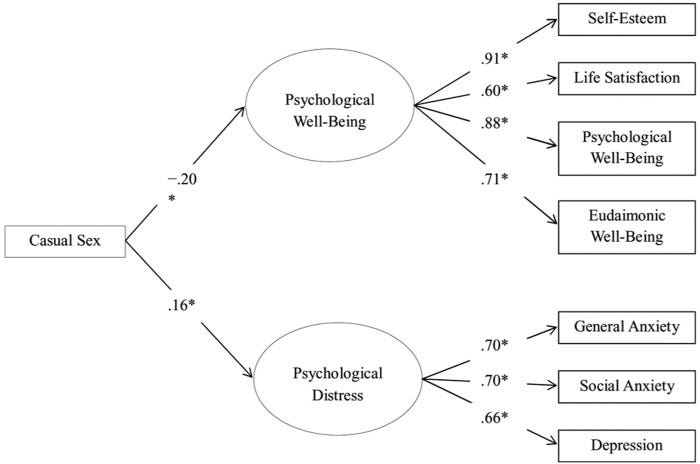
Participants who reported having more casual sex also reported more psychological distress and worse psychological well-being.
The study authors declared:
Mean comparisons conducted using the sandwich estimator indicated that college students who had recently engaged in casual sex reported lower levels of self-esteem, life satisfaction, and happiness compared to those students who had not had casual sex in the past 30 days. Casual sex was also positively associated with a psychological distress latent variable (ß = .16, p < .001). College students who had recently engaged in casual sex reported higher levels of general anxiety, social anxiety, and depression compared to college students who had not had recent casual sex.
How Do We Make Sense of This?
I could go on, listing a ton of studies that support both conclusions, but I’ll spare you the monotony. These are the two lines of thought that you can use to confirm whether you believe casual sex is the greatest thing since sliced bread or the worst thing since the burning of the Library of Alexandria.
But additional studies have clarified the disparity in outcomes. These studies got more into detail with their questions, and they’ve highlighted what makes casual sex either glorious or lousy.
A 2014 study by Zhana Vrangalova and Anthony D. Ong sought to explore the relationship between sociosexuality, casual sex, and well-being. They inquired about the same things, but took it an important step further — they queried participants about their sociosexual orientation.
Sociosexual orientation measures how open to having multiple partners a person is compared to how much they want to tie down for life with just one partner.
People who scored higher on sociosexual orientation were positively correlated with feelings of happiness, wellbeing, and satisfaction from casual sex. This is the group who feel that casual sex and multiple partners are a-okay, and they enjoy it accordingly.
Conversely, people who scored lower on sociosexual orientation were more likely to experience problems with casual sex. This is a group of people who might not be inclined to have more than one partner, the people who are really looking for a relationship while having casual sex, and people who might not want casual sex but feel peer pressured into it.
These two groups are very different people.
While this may seem obvious, there’s a bit more to it than just saying, “The people who want to have casual sex end up having better experiences with casual sex than the people who don’t want to have casual sex.”
This is so obvious, it should go without saying.
But how many people have you known in a weird state of erotic limbo? Have you ever seen someone who desired something resembling love, sex, affection, closeness, security, passion, carnal desire, and more, but they didn’t know what?
I can’t tell you how many people I know who’ve gone around telling themselves they wanted to have wild, raging hook-ups and sex flings, but really, they were covering up the pain of unrequited love — or being dumped.
I can’t tell you how many people I know who’ve gone around like Don Juan, claiming to look for the deepest, profound love, when really, they were in search of brief, sensual, sexual encounters and nothing more.
The truth is, a ton of us are strolling around befuddled about what we need. What’s more, to exacerbate the situation, we’re immersed in a bombardment of messages about how sex and connections should be, which just further adds to the disarray of being human and frequently having conflicting drives.
We crave the flames of passion, but we also know we need security and comfort at the end of the day. These desires clash within us often.
I can’t help suspecting, that in attempts of both love and sex, individuals who end up having the best encounters are the people whose encounters align with their motives.
Pursuing love while employing sex as a tool to get it isn’t a recipe for happiness. Neither is pursuing sex by using love as an apparatus to get it.
So ask yourself, what is it that you truly want out of your relationships? If you were able to ask for everything you wanted out of a romantic or erotic relationship, what would you ask for?
Science suggests reflecting long and hard about this might make you happier with your sex life.

Thanks for reading. Sign up to my Medium email list so you don’t miss a beat, and check out my new Substack publication, The Science of Sex.
Three books I recommend checking out:
- Tell Me What You Want: The Science of Sexual Desire and How It Can Help You Improve Your Sex Life
- Mating in Captivity: Unlocking Erotic Intelligence
- The Red Queen: Sex and the Evolution of Human Nature.
These are also available as an audiobook on Audible. If you use this link, you can try Audible for free, and you’ll get up to two free audiobooks.
Full disclosure: these are affiliate links, and as an Amazon Associate, I make a commission from them.


