avatarWendy Scott

Free AI web copilot to create summaries, insights and extended knowledge, download it at here

4146

Abstract

e for the business?</p><p id="b4dc">Teams were plonked down according to numbers and pods of desks available. If there was a team of four, they got put in a pod of four. Things were decided by logic and fit.</p><p id="a8a8">There was no requirement to communicate anything to the staff until necessary. The thinking types’ stance was that people don’t need to know anything until they have to do something.</p><h2 id="2929">The office move according to the feeling types</h2><p id="3800">My group approached things very differently. Our main concern was the effect of the office move on the staff. How could we make it easier for them? What dates would be least disruptive, taking into account school holidays? We thought there should be lots of communication upfront, so people didn’t get stressed.</p><p id="de88">We feelers spent a long time worrying about where people would sit. Would the single admin person be lonely? Would finance be disturbed by the noisy operations people if we put them side-by-side? Who had access to windows? Was anyone crammed in by the toilet? Would people near the kitchen be disturbed by the noise of chatter and the smell of food?</p><p id="0927">We spent hardly any time talking about a budget. I think we may have even missed it off.</p><h2 id="341e">How the de-brief went</h2><p id="b20b">I’ve worked with some wonderful people, so the de-brief between the two types was hilarious. We found each other’s point of view so different as to be ludicrous.</p><p id="8661">We felt the thinkers were heartless monsters, and I seem to remember they called us tree-hugging hippies.</p><p id="9261">Indeed, there were robust responses to our pleas to think about how changes would affect the people. For example, “They’ll put up with where we’ve put them — they are here to work, not look out the window.”</p><p id="da3e">These are two very different approaches. It’s confusing working with your opposite if you don’t know about decision-making types.</p><figure id="1f23"><img src="https://cdn-images-1.readmedium.com/v2/resize:fit:800/0*ZyLJsVGR5cmplIuu"><figcaption>Photo by <a href="https://unsplash.com/@brookecagle?utm_source=medium&amp;utm_medium=referral">Brooke Cagle</a> on <a href="https://unsplash.com?utm_source=medium&amp;utm_medium=referral">Unsplash</a></figcaption></figure><h1 id="1357">How to use this knowledge</h1><blockquote id="a895"><p>“Half our mistakes in life arise from feeling where we ought to think, and thinking where we ought to feel.” — John Churton Collins</p></blockquote><p id="24f6">The thinking/feeling continuum is to help us understand ourselves and others rather than label us. Everyone can change if we need to and practice a different way of being.</p><p id="a0df">For example, in my various leadership roles, I had to consider budgets, costs, and logistics of releasing staff. I had to grow this skill because it was needed in my job.</p><p id="a2a2" type="7">We spent hardly any time talking about a budget. I think we may have even missed it off.</p><p id="3210">Similarly, thinking types in leadership roles may have to consider more personal considerations when leading their teams.</p><p id="e379">Firstly, know what decision-making type you are and then find out what type other people are. Use this information for discussion and mutual understanding.</p><p id="f7ab">In this YouTube clip, the presenter explains that thinking and feeling types are spread equally between males and females. Societal norms may lead us to expect females to be feelers and males to be thinkers, however, this is not correct.</p> <figure id="e0c3"> <div> <div> <img class="ratio" src="http://placehold.it/16x9"> <iframe class="" src="https://cdn.embedly.com/widgets/media.html?src=https%3A%2F%2Fwww.youtube.com%2Fembed%2FeXMzcEtb1WA%3Ffeature%3Doembed&amp;display_name=YouTube&amp;url=https%3A%2F%2Fwww.youtube.com%2Fwatch%3Fv%3DeXMzcEtb1WA&amp;image=https%3A%2F%2Fi.ytimg.com%2Fvi%2FeXMzcEtb1WA%2Fhqdefault.jpg&amp;key=a19fcc184b9711e1b4764040d3dc5c07&amp;type=text%2Fhtml&amp;schema=youtube" allowfullscreen="" framebo

Options

rder="0" height="480" width="854"> </div> </div> </figure></iframe></div></div></figure><h1 id="0bfd">What type are you?</h1><blockquote id="7325"><p>“There is no good reason we can not develop and change until the last day we live.” — Karen Horney.</p></blockquote><p id="8174">None of us are pure thinkers or feelers. We are on a continuum.</p><p id="149c">Have a look at the image below and think about where you are. Where are your colleagues and family? Knowing how people approach decision-making can help you get along with them better.</p><p id="233c">Neither type is better than the other. They both have value.</p><figure id="916f"><img src="https://cdn-images-1.readmedium.com/v2/resize:fit:800/1*ntbpDoCOzDA6EBIpuXXlIQ.png"><figcaption></figcaption></figure><h1 id="9200">Takeaways</h1><blockquote id="71be"><p>“I am not what happened to me, I am what I choose to become.” — Carl Jung.</p></blockquote><p id="53ec">The main points to remember are:</p><ul><li>There are two different extremes of how we make decisions</li><li>You could be a thinking type, a feeling type, or somewhere in between on the continuum</li><li>You can change how you make decisions if you have the knowledge and desire to do</li><li>Knowing where you and other people sit on the thinking/feeling continuum will help you understand and get along with them.</li></ul><p id="1829">I hope this has helped you in some way. If you haven’t already looked at my <a href="https://readmedium.com/introverts-and-extroverts-whats-the-difference-3c041dcc3063">introvert/extrovert article</a>, it may be of interest to you. In the next article I will be combining introvert/extrovert and thinking/feeling to talk about four personality types.</p><p id="95eb">And sorry, yes, you will be allocated a color!</p><p id="951e">I write about leadership & training, and I’ve designed The New Leader’s Starter Kit to help leaders better communicate with their teams. Get your free copy <a href="https://artisanal-inventor-759.ck.page/74f7d108ff">here</a> — The New Leader’s Starter Kit takes you through how to run One-to-Ones and Constructive Feedback sessions & develop effective listening skills — a printable one-to-one form, feedback form and listening skills checklist included.</p><div id="5a14" class="link-block"> <a href="https://readmedium.com/how-to-spot-a-toxic-boss-who-could-ruin-your-career-a0641d91e4ae"> <div> <div> <h2>How to Spot a Toxic Boss Who Could Ruin Your Career</h2> <div><h3>And three ways you can deal with it</h3></div> <div><p>medium.com</p></div> </div> <div> <div style="background-image: url(https://miro.readmedium.com/v2/resize:fit:320/0*GlDk-VCgIP1tTrSk)"></div> </div> </div> </a> </div><div id="0002" class="link-block"> <a href="https://readmedium.com/never-mind-the-bollocks-why-cant-we-just-talk-english-fa76a49b015b"> <div> <div> <h2>Never Mind the Bollocks: Why Can’t We Just Talk English?</h2> <div><h3>Let’s dump the pretentious business speak and get real</h3></div> <div><p>medium.com</p></div> </div> <div> <div style="background-image: url(https://miro.readmedium.com/v2/resize:fit:320/0*t0piFAc9Podf6x-x)"></div> </div> </div> </a> </div><div id="cd75" class="link-block"> <a href="https://readmedium.com/how-to-prepare-for-a-job-interview-6b190157c2c5"> <div> <div> <h2>How to Prepare for a Job Interview</h2> <div><h3>Impress the Interviewers with Relevant Answers</h3></div> <div><p>medium.com</p></div> </div> <div> <div style="background-image: url(https://miro.readmedium.com/v2/resize:fit:320/0*lSVWEjSDOZiFCw1K)"></div> </div> </div> </a> </div></article></body>

Do You Make Decisions by Thinking or Feeling?

Carl Jung’s theory of thinking vs feeling
Authors image created on subscription Canva account

I’ve written about introverts and extroverts in my article Introverts and Extroverts: What’s the Difference?, which talks about where you get your energy from.

The next step in understanding yourself and others is to work out how you make decisions. Do you use primarily cold hard logic, or are you guided by your feelings and how they affect people?

According to Carl Jung, a psychoanalyst from the 1900s, people are either thinking types or feeling types. We are spread evenly over the population, fifty percent thinking types and fifty percent feeling types.

“Where wisdom reigns there is not conflict between thinking and feeling.” — Carl Jung.

The thinking/feeling dichotomy is one of the constituents of the well known Myers Briggs Type Indicator test (MBTI). Isabel Briggs Myers developed the test based on Jung’s work.

So what does it all mean?

Thinking types

Thinkers use facts, concepts, and ideas to make decisions. They shut down any connection to feelings or values.

If you are a thinking type, you will make decisions objectively using:

  • Logic
  • Truth
  • Justice
  • Evidence
  • Consistency
  • Accepted standards
  • Facts
Photo by Mathew Schwartz on Unsplash

Feeling types

Feelers are concerned with emotions and how a decision fits in with values and affects people.

If you are a feeling type, you make decisions subjectively using:

  • Values
  • Love
  • Mercy
  • Harmony
  • Praise
  • Personal situations
  • How things affect individuals
Photo by Fernando Brasil on Unsplash

How thinking and feeling types approach tasks

“We cannot safely assume that other people’s minds work on the same principles as our own. All too often, others with whom we come in contact do not reason as we reason or do not value the things we value, or are not interested in what interests us.” — Isabel Briggs Myers.

A few years ago, I was on a course studying thinking and feeling types. After being split into our respective groups of thinkers and feelers, we were given a task.

Task: The office will be relocated to another building. Plan the move.

Off we went with the others of our type and had twenty minutes to work it all out.

Then, of course, we reported back to the room.

The office move according to the thinking types

This was an eye-opener to me as a feeling type. It was all about facts, logic, and numbers. What’s the budget? How much money can we save? How many desks? When is the best time for a move for the business?

Teams were plonked down according to numbers and pods of desks available. If there was a team of four, they got put in a pod of four. Things were decided by logic and fit.

There was no requirement to communicate anything to the staff until necessary. The thinking types’ stance was that people don’t need to know anything until they have to do something.

The office move according to the feeling types

My group approached things very differently. Our main concern was the effect of the office move on the staff. How could we make it easier for them? What dates would be least disruptive, taking into account school holidays? We thought there should be lots of communication upfront, so people didn’t get stressed.

We feelers spent a long time worrying about where people would sit. Would the single admin person be lonely? Would finance be disturbed by the noisy operations people if we put them side-by-side? Who had access to windows? Was anyone crammed in by the toilet? Would people near the kitchen be disturbed by the noise of chatter and the smell of food?

We spent hardly any time talking about a budget. I think we may have even missed it off.

How the de-brief went

I’ve worked with some wonderful people, so the de-brief between the two types was hilarious. We found each other’s point of view so different as to be ludicrous.

We felt the thinkers were heartless monsters, and I seem to remember they called us tree-hugging hippies.

Indeed, there were robust responses to our pleas to think about how changes would affect the people. For example, “They’ll put up with where we’ve put them — they are here to work, not look out the window.”

These are two very different approaches. It’s confusing working with your opposite if you don’t know about decision-making types.

Photo by Brooke Cagle on Unsplash

How to use this knowledge

“Half our mistakes in life arise from feeling where we ought to think, and thinking where we ought to feel.” — John Churton Collins

The thinking/feeling continuum is to help us understand ourselves and others rather than label us. Everyone can change if we need to and practice a different way of being.

For example, in my various leadership roles, I had to consider budgets, costs, and logistics of releasing staff. I had to grow this skill because it was needed in my job.

We spent hardly any time talking about a budget. I think we may have even missed it off.

Similarly, thinking types in leadership roles may have to consider more personal considerations when leading their teams.

Firstly, know what decision-making type you are and then find out what type other people are. Use this information for discussion and mutual understanding.

In this YouTube clip, the presenter explains that thinking and feeling types are spread equally between males and females. Societal norms may lead us to expect females to be feelers and males to be thinkers, however, this is not correct.

What type are you?

“There is no good reason we can not develop and change until the last day we live.” — Karen Horney.

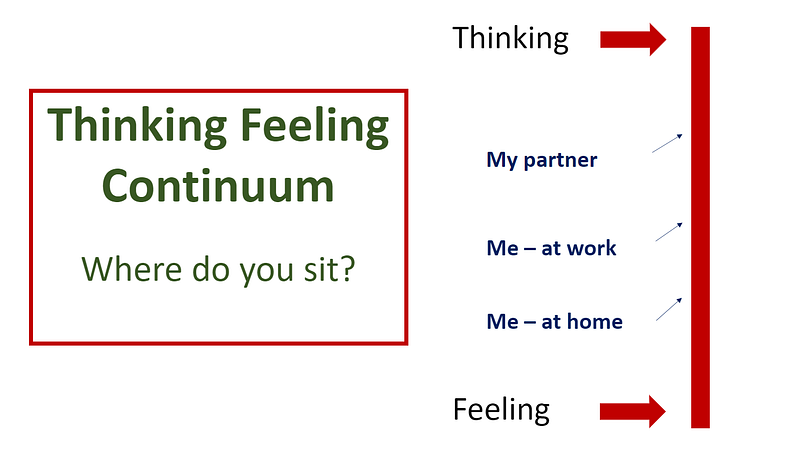
None of us are pure thinkers or feelers. We are on a continuum.

Have a look at the image below and think about where you are. Where are your colleagues and family? Knowing how people approach decision-making can help you get along with them better.

Neither type is better than the other. They both have value.
Takeaways

“I am not what happened to me, I am what I choose to become.” — Carl Jung.

The main points to remember are:

  • There are two different extremes of how we make decisions
  • You could be a thinking type, a feeling type, or somewhere in between on the continuum
  • You can change how you make decisions if you have the knowledge and desire to do
  • Knowing where you and other people sit on the thinking/feeling continuum will help you understand and get along with them.

I hope this has helped you in some way. If you haven’t already looked at my introvert/extrovert article, it may be of interest to you. In the next article I will be combining introvert/extrovert and thinking/feeling to talk about four personality types.

And sorry, yes, you will be allocated a color!

I write about leadership & training, and I’ve designed The New Leader’s Starter Kit to help leaders better communicate with their teams. Get your free copy here — The New Leader’s Starter Kit takes you through how to run One-to-Ones and Constructive Feedback sessions & develop effective listening skills — a printable one-to-one form, feedback form and listening skills checklist included.

Work
Psychology
Self Improvement
Self-awareness
Business
Recommended from ReadMedium