
Do You Know the Best Way to Get and Keep a Reader’s Attention?
It begins with the title but ends somewhere else

Any writer with any kind of old school training or background is familiar with certain words that are known to benefit not just the title, but the structure of your story.
Those words are responsible for helping you get and keep a reader’s attention, and yes, it begins with your title.
But that’s not where it ends.
The real answer to how to “..get and keep a reader’s attention” is:

Just ask a question!
Asking a question in your title — or at the very least, in your subtitle — will gain you a lot more glances, views, and potentially reads.
Using the very specific words that I’ll mention in a moment, can be of extreme benefit to you, but only if you use them correctly, both in your title (and/or subtitle), but also throughout your story.
Feel free to jump to the section of this story, where I simply list the words I want to share with you.
If you do, I WARN YOU — you’ll miss some pretty good stuff that I share in the next paragraph, so you might want to stick around…
Recent writing advice about getting story views
There’s a lot of writing advice in the Medium community, about different ways to get more story views, thus increasing your earnings.
I enjoy reading most of these type of stories and getting different perspectives from other writers. Some are not only good for providing reminders to old timers like me, but many of the suggestions and writing tips are brand new to newer online writers.
That’s great, because unlike the old school training I mentioned in the first paragraph, some newer, self taught content creators aren’t familiar with many of the concepts that more seasoned writers take for granted.
For instance:
I read a story by a Medium writer named Lori Ballen and it contained a few of those oh so important words that I’m about to tell you about. Her story titled: 25 Little Known Ways to Get More Views was super detailed, and I recommend everyone give it a read when you’re done here.
Lori mentioned using what she stated were known as: “W” Words, so I’m guessing we’re both writers from the same school of thought. She wrote:
“The words when, where, why, and how are considered “w” words because they can create a sense of curiosity when used correctly in titles.”
Of course, she was absolutely right, just like she was about some of the other highly effective tips she offers. However, I suspect that I’m a bit older than her, so my training goes back a little further.
So I’m adding the other two words: “who” and “what”, that traditionally belong to that same family of “w’s”.
And since we’re on the subject of the kind of words that help capture and keep your reader’s attention, especially in a title, we could even include the following:
- “which” — Yay, another “w” word
- “have” — ooh, another “h” word too
- “do” — Don’t know where that came from, but it works as a question
Don’t just ask a reader questions without providing the answers
Not every writer on Medium is interested in trying to provide details, facts, and figures about what they write. Many writers, myself included, will write tons of stories, before writing a piece they have to spend all day researching.
Both researched and non-researched stories still have some basic expectations, regardless of what your preferences are as a writer.
If you resolve to use questions in your titles and stories, don’t do it without providing some kind of answers; factual or speculative, but give them something (but be sure to let them know you’re guessing or it’s just your personal views). Your readers expect at least that much. This is true, whether:
You’re writing a story about global warming:
Or you’re simply giving advice or an opinion on candy bars:
Did you notice that I used a “w” and “h” question in both titles?
Structure stories with words that grab the reader’s attention
As was mentioned, besides using these attention grabbing words to ask a question in your titles and subtitles, allow them to help benefit your entire story.
Some writers get stuck when it comes to what they want to say, and often require a bit of guidance or structure to help keep their story on track.
If you find this happening to you when you write, use these helpful words in the following order. They can help your story stay on a logical path and prevent unnecessary and unrelated rambling.
Who, what, when, where, how, why
Here’s a great example of what I mean. My recent story about a prominent billionaire in the news is a perfect way for me to demonstrate this “W” story structure.
Notice the following example:
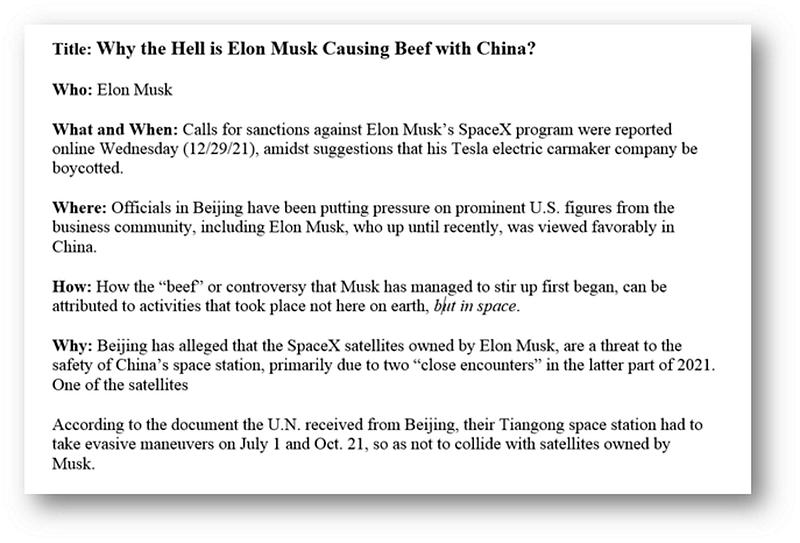
As you can see, all the elements are provided, so by now your appetite should be wet enough to go read the complete story when you get a chance.
Now, you try it. Simply think about a story you might want to write about — regardless of the topic or category. Now, as you start writing the story, insert details, based on all six words, in a logical order.
By the time you’re done answering those questions, your story is basically finished. Now, just wrap it up with a conclusion. Bada bing, bada bang!😄
Final Thoughts
All of us writers can relate to how difficult it is to hold onto a reader’s attention on this platform. There’s a lot of great stories, all vying for the same visibility and exposure.
But there’s also a huge community of readers who have a lot of diverse likes and interests. If we do what we can to capture their attention, hopefully, we can gain more and more readers who actually stick around and read our stories all the way to the end.
I invite new members who are just getting started, to read my helpful stories and take my writing advice about how to make money on Medium.

Get Canva Pro | Sign Up for Medium | Join Fiverr



