
Society — all aspects
Recording the DNA of Every Baby Immediately Upon Birth
How will society change? Dramatically!
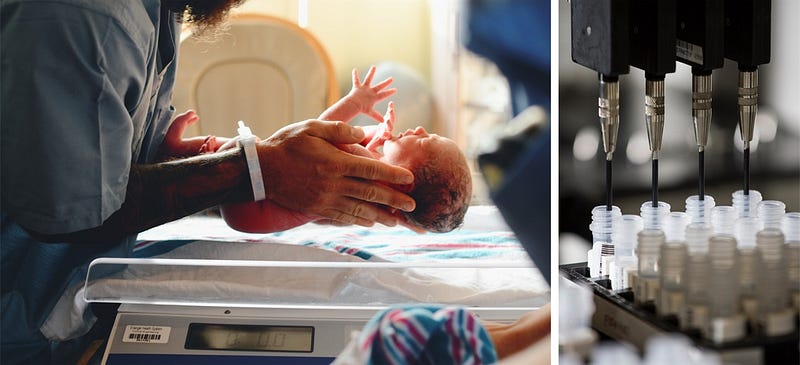
Synopsis Currently, women take all the risks with sex. Men take none. DNA at birth immediately identifies the sperm provider. Other things, like the voting process, criminals and law enforcement, insurance, medicine, international travel, child support, credit verification, and who knows what else will change too. Physical credit cards may disappear and cash could become almost obsolete.
Get Ready
Time to start thinking about it, discussing it, writing about the possibilities. It’s going to happen.
Technology moves from magic to science fiction to reality. For example, long-distance personal communication used to be mirrors and semaphores. Then it moved to Dick Tracy and wrist radios, but only the police and criminals had them. Now, that technology is called a cell phone. Technology, once conceived, eventually becomes reality.
A universal personal identification system has always been a dream
E.E.“Doc” Smith described the perfect one in his 1930s sci-fi Lensman series, but only a few of the police had it. With the discovery of DNA, science fiction is now reality and we didn’t need space aliens to supply it.
The idea of collecting DNA in the delivery room at birth, in addition to footprints, sounds radical, but something is radical only when it first appears. Once it is ingrained in society, it is no longer radical.
We don’t have the technology for DNA to have much impact today, even though it seems to, based on watching the daily Forensic Files on TV. Recording DNA may impact a few people now, but everyone will notice once the instant DNA readers and verification technology is perfected.
How would recording DNA universally change society?
Dramatically!
First, the obvious. It will be easier to tie criminals to crimes. But wait, we have that today in the CODIS database for anybody who already is a felon or has been arrested.
Currently, that database does not contain personal information. The record must be linked back to the source. Hackers must go to two different databases to get meaningful data.
Identification. Two pieces of technology need to be invented and developed for DNA to be used as identification:
- DNA reader. Machines exist today that can read fingerprints. However, they are not in widespread use. Eventually, DNA readers will be able to do the same thing, without sending samples off to a lab. No business or government will be able to function without them.
- Verification method. The DNA reader sends the codes to the central computer for instant ID verification.
Similar verification exists now with fingerprints. We lived in Peru for a few months. You go to withdraw money from a bank in Peru. You give them your card, enter your pin number, and put your finger in the fingerprint reader. In the future, the same fingerprint reader will pick up your DNA for verification.
Today, we have a delayed DNA verification system. Samples need to be taken, sent off to the lab, and everybody waits for the results. That works for law enforcement, but has little overall impact on society in general except for ancestry searches.
Once Instant ID Verification exists, many institutions in society will change. Such as the voting process, criminals and law enforcement, insurance, medicine, international travel, paternity and child support, credit verification, and who knows what else. Physical credit cards may disappear and cash could become almost obsolete.
This idea was triggered by a proposal in my abortion article:
“Paternity — require the sperm provider to pay child support until the child is 21 years old. Record the DNA profile of every baby immediately upon birth, so that there are no questions.”
A Central Child Support Institution (CCSI) replacing the current hodge-podge of courts and methods would need to be set up to collect and disburse child support payments.
We will look at the idea of collecting child-support fees first, starting with the definitions of the people involved. It is not nearly as simple as first thought.
Child support when DNA registration becomes law
The hospital now takes a footprint of the baby for the birth certificate when it is born. In addition, the hospital would also take a DNA sample at the same time and log it into a national database. Logically, there is no difference between taking a footprint and the DNA sample.
The argument about self-incrimination does not apply since a newborn baby has not committed any crimes yet.
First, some definitions for this article. - Mother: we know who that is. - Sperm Provider: the man that provided the sperm to conceive the child. He has no automatic right of access or even knowledge about the child. - Sperm Donor: a man who, after signing a form filed in advance with the state releasing him of all rights and responsibilities, voluntarily provides sperm used for artificial insemination or other methods of impregnating a woman. - Father: the first man that raises the child, with all current rights unless revoked by a court. Divorce and remarriage may add step-father.
Three of these people, and the institution of marriage, generate numerous scenarios at the time of birth. The sperm donor, by definition, has no impact.
Typical, Successful Marriage. The sperm provider and father are the same person. Nothing would change, unless there was a divorce. Then the person without the children would pay child support through the CCSI to the person with the children. That would reduce personal confrontations and add clout on the collection side.
Married, outside sperm provider. Whether due to an affair or that the woman was pregnant at the time of marriage is not relevant. The husband is the father. The sperm provider would pay the CCSI. However, the details aren’t so simple.
- Do you list the Sperm Provider on the birth certificate? If so, and the husband does not know, will it cause a divorce. Will it cause the husband to treat the child differently. After all, legally, the husband is the father by being married to the mother at the time of birth. Will it cause any later problems?
- Should the mother accept child support payments? The money will be paid and distributed, either to the mother or somewhere else. That money would be taxable if the mother accepts it. The husband would be reminded every month when the payment arrived and every year when filing taxes. If the husband was not aware, he would be alerted when the 1099 forms arrived.
Single, married sperm provider. The mother would have financial support for her child, but life could change dramatically for the sperm provider. Now, a man can get a woman pregnant and ignore the whole thing, if he knows at all.
With Instant ID Verification via DNA, he would start paying child support immediately. Unless he is a high-income person, his wife might notice the drop in income or statements in the mail, especially if he is paying for 3 or 4 extra children.
Then it would become even more sticky at tax time. Since the recipient would pay taxes on the income, the payor would be able to deduct it from his gross via a special line on the tax form. If they filed jointly, the wife would see that entry when she signed the form. Of course, if he was just adding one more child, she might not notice the difference.
Single woman, unmarried sperm provider. This is by far the simplest. The man would pay support, with no rights concerning the child. He could be granted the rights of a father only if he married the woman later. We’ll leave the details up to the legislature and the courts.
One-night stand. Suppose a man was driving across the country, had a one-night stand in the Midwest, and continued on to California. If a pregnancy resulted, he would pay support for years even if he couldn’t remember the woman’s name. That certainly levels the risk of having sex.
Other scenarios. There may be other options, but these cover the most common.
How payments would work
Congress would pass laws to set up the Central Child Support Institution (CCSI), rules for calculating the support amount, and ways to determine where the money would be sent if the mother rejects it or the payment exceeded the legal maximum. Most likely, the money would be diverted to orphanages or similar institutions.
This is what the sperm provider would pay:
- Payment = 10% of gross income per child
- All payments total no more than 50% of gross income
- Total payments split equally if more than 5 recipients
- If recipient child-count drops below 5, payments revert to 10%
- Payments end at age 21 of the child
- Payments are garnisheed or withdrawn automatically from bank accounts
- Payments based on the current paycheck, commissions when paid, or prior year’s tax return as a last resort
The mother should not be allowed to make collecting these payments a business. Congress would need to set a maximum number of children, probably 5, and a maximum amount per child, adjusted for inflation. CCSI would distribute any overpayments to alternative institutions or a reserve to cover deficiencies.
The CCSI should be self-supporting, so the maximum amount per child would be the amount collected the prior year less expenses divided by the number of children, or the maximum set by Congress, whichever is less.
Then, the mother would not gain if the sperm provider was a pro athlete making $400,000 per month. His payment would still be $40,000 per month per child, but the mother would not gain from that high amount.
Congress would have to add the hundreds of other details.
Of course, if the sperm providers don’t want to pass the laws concerning DNA, they can pass this one instead:
It might be even more effective in solving the problem.
Concerns
Everything would be great when the system works smoothly, but what happens when it doesn’t? How would it handle errors and computer bugs?
Suppose it identified a sperm provider from Los Angeles tied to a woman in Chicago and neither had left their home town, assuming the man was not a sperm donor.
That could happen if crooks found a way to collect the sperm from a female prostitute, shipped it across the country, and artificially inseminated the woman in Chicago. I don’t see how that would pay off, but someone else might.
Other Impacts on Society
Every change has unforeseen benefits and downsides. Child support and distribution of pregnancy's costs triggered the idea, but many other institutions and customs will change. It makes some valid proposals viable and existing practices more, or less, effective.
Voting Process (HR1 becomes viable). The first bill introduced when the Democrats gained control of the House in 2018 was a voting rights act. As written, it promoted voter fraud.
Instant ID Verification using DNA eliminates the technology problem that helped to promote fraud.
It would catch people trying to vote twice, provide the proper ballot for that voter at any polling place in the country, prevent underage voting, and block non-citizens. It might even allow people to vote from home using their own computers. However:
- The government could track a voting choice back to the individual if they vote from home. You can imagine what they would do with that data.
- The government might take constant polls and make decisions based on public opinion, instead of using logic and carefully debated conclusions like they do now.
Child support. Suppose a marriage ended in divorce and the court rules the father pay additional child support to maintain the child’s current living standards, which may be more or less than 10% of his income. The CCSI would handle payments and the minimum limit would still apply, automatically overruling the court’s order.
The real question: would the father still be liable if he was not the sperm provider and the mother was already receiving payments. Maybe, if the support was to maintain the child’s current living standards, but the limits on payments and receipts would still apply.
Marriage customs. Matt Sweetwood has proposed that “Marriage should have a 2-year expiration date with automatic renewal, if both parties agree to continue, within 60 days of the end of the 2 years.” Automatic child support would make this proposal more viable.
People will argue that recording DNA will destroy marriages, but the odds of a marriage’s survival are now 50:50.
Abortion. One aspect in my A Comprehensive Solution on Abortion vs the Current One-sided Scheme article suggested that men be required to pay half of the cost of an abortion.
A reader pointed out that a pro-life guy would be forced to pay for something he was opposed to, just like he wants a woman to deliver a baby she doesn’t want. The concepts are no different. The reader suggested that if he could prove he has been part of a pro-life group for a year, he would not have to pay for half an abortion.
Let’s take that a step further. Assume the woman has the abortion. She has no more responsibilities. After the abortion, identify the sperm provider with a DNA test. Give the sperm provider the choice of paying half of the abortion cost at 10% of his income until paid, or 10% of his income for 18 years to support orphans and help balance the CCSI pay-out fund. The woman would receive no payment in either case.
Of course, laws would need to be in place to prevent price-gouging by abortion doctors.
Criminals and Law Enforcement. They already use DNA to track criminals and to solve crimes. Just watch The Forensic Files on TV. It’s just not as easy as it would be with DNA scanners and automatic registration at birth. The only DNA not on file would belong to people in the country illegally.
How criminals could frame the innocent: If police can collect your DNA from envelopes you lick, then criminals will eventually be able to do the same. We already have the technology available to duplicate a small sample. Eventually, so will the criminals. They could plant your DNA at crime scenes.
Insurance. Studies may find DNA characteristics that show susceptibility towards diseases or early death. Insurance companies would ask for a DNA sample before writing health and life insurance.
They may structure premiums or decline to issue insurance based on the results. Each person would have their own premium. The government may need to pass new laws restricting insurance company actions.
Of course, we may have Medicare-for-All by then and not need to worry about health insurance.
Medicine. Doctors will eventually predict genetic-based problems and prepare for them. Besides the obvious birth defects, they may be able to predict susceptibility to certain diseases and catch them in their early stages.
They may become able to do those same tests on the fetus before the mother’s-option cutoff limit and recommend abortions. The unscrupulous may do that after the cutoff limit, saying that the abortion is to save the life of the mother.
In fact, politicians may push the same concept to create a new Master Race!
International travel and immigration. Take a DNA sample from everyone entering the United States. You don’t want to provide it; you don’t need to enter the US. Those whose DNA is not on file would be assumed to be in the country illegally.
What happens if program bugs fail to make a match or hackers break into the database and destroy or change data? Hopefully, security will be much tighter when DNA readers become available, but it will never be perfect.
Credit Verification. With better personal identification, credit companies should be better able to tie spending habits to an individual. Cash could become almost obsolete or it could make a comeback as a privacy issue. The credit software would not be able to track cash.
On the downside, DNA readers may be built to pull DNA from cash. I’m not sure how well that would work if many people handle the cash.
Wallets. They may disappear unless people carry something other than credit cards, identification and cash. Even pictures are on phones now. They will have no purpose. Of course, they may become the new status symbol.
How politicians can steal from it
The CCSI would need to have startup funding from the government and there will be times that it would receive overpayments. Those funds would need to be put into a reserve.
What’s to prevent politicians from stealing it - like they did with the Social Security Trust Fund
I know of no way to stop that. They are politicians.
How to start
Recording DNA at birth. Technically, it could be started at any time. However, it’s not a good idea until the laws and infrastructure are in place to collect and store the data. Also, the population needs to get used to the idea.
There may be some good reasons to do so, even if Instant ID Verification is not yet technically available.
What about people already born? This will be tricky. Some options would be to collect DNA from
- all soldiers
- Federal and State employees
- all children entering first grade, middle and high school, over 6 years
- anybody in jail (already done with convicted felons, and some upon arrest)
- everybody receiving a driver’s license or passport.
The courts would have to decide if DNA collected using these methods could be used in cases that occurred before the date that DNA collection at birth became law. Even if the cops knew that a person was a perpetrator via the startup DNA, they would have to collect another sample legally and use that sample in their case.
What about the rest of the world
Everything here has been based on United States culture and laws.
What about different cultures and religion-based societies, like China, Russia, India, Israel, Iran, and other countries? DNA readers will be available there, too. How will their laws change? Will they record DNA at birth? Will people be willing to travel to the US if their DNA is read and recorded as they go through customs?
I’m not qualified to make predictions about any other country or religion. I would be interested to see follow-up stories from authors who can write from experience.
Conclusion
The invention of a DNA reader and Instant ID Verification will open a Pandora's Box. It may not happen until 50 years or more in the future, but it will happen eventually.
A huge fight will ensue, maybe spanning generations, but it’s impossible to stop technology. A few orphans today are finding their parents through DNA matching web sites.
I’ve predicted positives and negatives in many areas, but I didn’t begin to touch on all possibilities. The discussions will continue for years about DNA collection at birth, methodology, and impact on society. However, it will happen someday, maybe much sooner than 50 years from now.
Just before it does, the sale of condoms will skyrocket.
Challenge to authors: Rather than leave a 1,000 word comment, leave a brief summary comment, write and publish your 1,000 word article referring back to this one, then come back to your comment, edit it and add a link to your article.
Other articles and links:
Will it work with identical twins? Yes:
How would it impact adapted people?
Thanks to Brenda Hiatt’s book, Starbound, 3rd book in the Starstruck series, for its election scenario, which triggered my thinking about tying DNA identification to elections.


