Difference between Forward Proxy and Reverse Proxy in System Design
Understanding the Distinctions between Forward and Reverse Proxies in System Design and when to use them
Hello folks, if you are preparing for System design interview then knowing the difference between forward proxy and reverse proxy is very important, its one of the most frequently asked question on System Design, along with difference between API Gateway and Load Balancer, which we have seen earlier.
When designing complex systems, it’s common to use proxy servers to improve performance, security, and reliability. Proxy servers sit between clients and servers and help manage traffic between them.
Two types of proxies that are often used are forward proxies and reverse proxies. While both are designed to improve the performance and security of a system, they work in different ways and are used in different contexts. In this article, we’ll explore the differences between forward proxies and reverse proxies in system design.
By the way, if you are preparing for senior developer interviews then along with System Design you should also familiar with different architectures like Microservices and various Microservice design patterns like Event Sourcing, CQRS, SAGA, Database Per Microservices, API Gateway, Circuit-Breaker they will help you immensely during interview as they are often used to gauge your seniority level.
Top 10 System Design Concepts Every Programmer should learn
Essential System Design Concepts for Programmers: 10 Key Principles for Building Scalable, Reliable, and High-Performing Software Systems
Hello folks, as a programmer, understanding system design concepts is crucial for developing software systems that are scalable, reliable, and high-performing. System design involves designing the architecture and components of a software system to meet specific requirements and achieve desired performance characteristics.
With the rapid advancement of technology and increasing complexity of software applications, mastering system design concepts has become essential for programmers to build efficient and effective systems.
In the past, we have learned about Microservice design principles and Patterns and In this article, we will explore 10 key system design concepts that every programmer should learn.
These concepts provide a solid foundation for designing software systems that can handle large-scale data processing, accommodate concurrent users, and deliver optimal performance.
Whether you are a beginner or an experienced programmer, understanding these system design concepts will empower you to create robust and scalable software systems that meet the demands of modern applications. So, let’s dive in and explore these essential system design principles!
By the way, if you are preparing for System design interviews and want to learn System Design in depth then you can also checkout sites like ByteByteGo, Design Guru, Exponent, Educative and Udemy which have many great System design courses and if you need free system design courses you can also see the below article.
Now, let’s come back to the topic and find out more about what is forward and reverse proxies, how to use them, what are their pros and cons and most importantly difference between forward and reverse proxies.
What is Forward Proxy? when to use it?
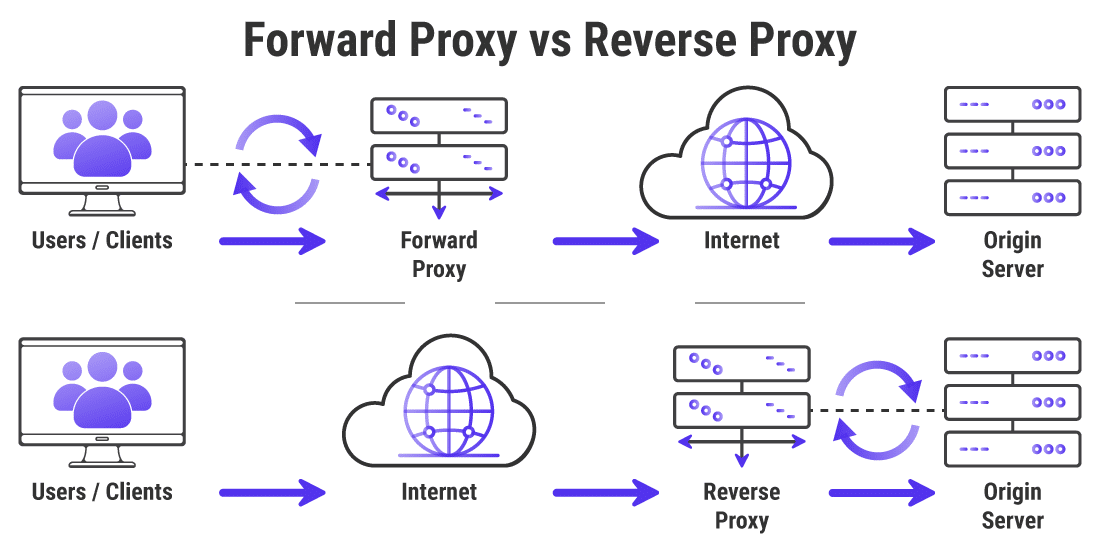
A forward proxy is a proxy server that sits between a client and the internet. The client requests a resource or service from the internet through the forward proxy, which acts as an intermediary, forwarding the request on to the internet and then returning the response to the client.
Forward proxies are typically used to control access to the internet, filter content, or provide anonymity for the client. They can also be used to speed up access to resources by caching frequently requested content.
Here is an example of forward proxy:
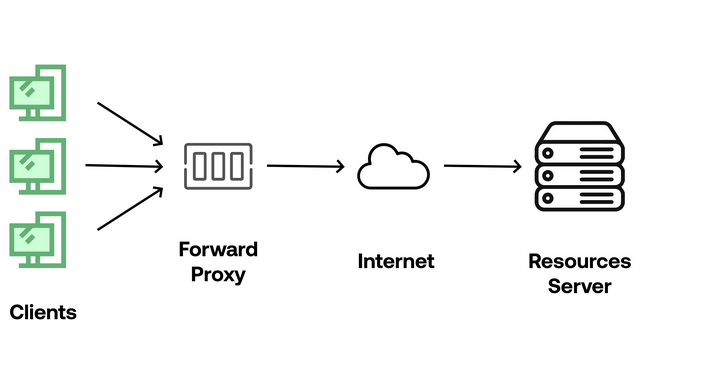
You can see that clients connect to forward proxy and then it routes request to internet.
What is Pros and Cons of Forward Proxy?
Now that you are familiar with the location of proxy in forward proxy, you can easily find out the pros and cons of it. Here are some pros and cons of using a forward proxy:
Pros:
- Enhanced security: Forward proxy can provide an additional layer of security by hiding the original IP address of the clients accessing the internet.
- Improved speed and performance: Caching frequently requested resources can improve response times for clients accessing the internet.
- Access control: By restricting access to certain resources, organizations can use forward proxies to prevent unauthorized access to sensitive data.
- Anonymity: Users can remain anonymous while browsing the internet, as their IP addresses are hidden.
Cons:
- Complex configuration: Forward proxies require a more complex configuration as they have to be set up on individual devices to be effective.
- Single point of failure: If the forward proxy fails, all the devices that rely on it will also fail to access the internet.
- Increased latency: Forward proxies can increase latency and slow down the overall performance of internet access.
- Limited control: Forward proxies can limit users’ ability to access certain resources, leading to frustration and reduced productivity.
Apart from the limitation the access control and security benefit it provides is the main reason for using forward proxy on various architecture. Now, let’s see what is Reverse proxy and how does it work.
What is Reverse Proxy? when to use it?
A reverse proxy is a server that sits between the client and the origin server, receiving requests from clients and forwarding them to the appropriate server.
The response from the server is then returned to the proxy and forwarded to the client. In essence, it helps to protect the origin server from direct access by clients.
Reverse proxies are commonly used as load balancer to balance the load across multiple servers, improve security by hiding the details of the server infrastructure, and provide other value-added services such as caching and SSL termination.
Reverse proxies are often used in the following scenarios:
- Load balancing: distributing incoming traffic across multiple servers to improve performance and availability.
- Security: protecting the backend servers from direct exposure to the internet and preventing unauthorized access.
- Scalability: allowing horizontal scaling of the server infrastructure without affecting the clients.
Reverse proxies provide a single entry point for clients, making it easier to manage and monitor the traffic to the backend servers.
They also provide a level of abstraction between the clients and servers, allowing the server infrastructure to be modified or upgraded without affecting the clients.
Here is an example of NGINX reverse proxy setup:
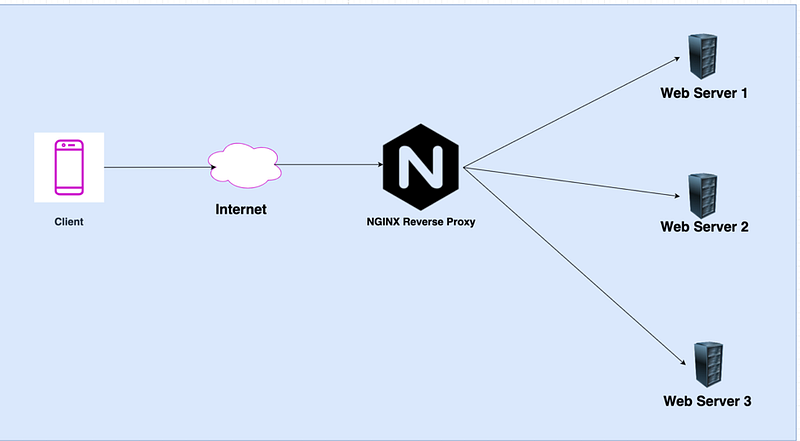
You can see that client connects to internet directly but servers are behind proxy so client will never know which server their request are processed, hence security your infrastructure from outside.
What is Pros and Cons of Reverse Proxy Architecture?
Here are some pros and cons of using a reverse proxy architecture:
Pros:
- Increased security: Reverse proxies can provide an additional layer of security by masking the identity and location of backend servers, preventing direct access to them from external clients.
- Better scalability: Reverse proxies can distribute traffic evenly across multiple backend servers, ensuring that no single server becomes overloaded and causing the application to crash.
- Improved performance: By caching and compressing data, reverse proxies can reduce the amount of data that needs to be transferred between clients and servers, leading to faster response times.
- Simplified architecture: Reverse proxies can be used to consolidate multiple backend servers into a single endpoint, simplifying the overall architecture of the application.
Cons:
- Single point of failure: If the reverse proxy fails, the entire application may become unavailable. This is its biggest drawback.
- Increased complexity: Implementing and maintaining a reverse proxy can be more complex than a simple client-server architecture.
- Limited customization: Reverse proxies may not offer the same level of customization as a direct connection between clients and servers, which could limit the functionality of the application.
- Additional cost: Implementing a reverse proxy can require additional hardware and software, which could increase the cost of the overall system.
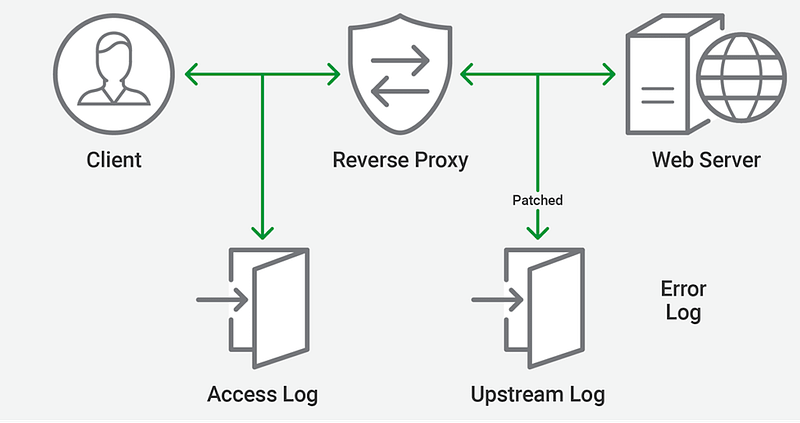
What is difference between Forward Proxy and Reverse Proxy?
Now that you have basic idea of what is forward and reverse proxy, their location as well their function, now is the time to look into differences to understand them better:
1. Direction
The main difference between a forward proxy and a reverse proxy is the direction of traffic flow. Forward proxy is used to forward traffic from a client to the internet, while a reverse proxy is used to forward traffic from the internet to a web server.
2. Client Access
With a forward proxy, clients have to be explicitly configured to use the proxy server. In contrast, a reverse proxy is transparent to the client, and clients can access the web server directly without needing to know the proxy server’s address.
3. Load Balancing
Reverse proxies can distribute incoming requests across multiple servers to balance the load, while forward proxies cannot.
4. Caching
Forward proxies can cache frequently accessed resources to reduce the load on the web server and speed up the response time for subsequent requests. Reverse proxies can also cache resources, but the caching is typically done closer to the client to improve performance.
5. Security
A forward proxy can be used to protect a client’s identity by hiding their IP address from the internet. A reverse proxy can be used to protect a server by hiding its identity and exposing a single IP address to the internet.
6. SSL/TLS Termination
A reverse proxy can terminate SSL/TLS connections on behalf of a web server to reduce the load on the server and simplify certificate management. Forward proxies typically do not terminate SSL/TLS connections.
7. Content Filtering
Forward proxies can be used to filter content, block access to specific websites, and enforce access policies. Reverse proxies can also perform content filtering, but this is typically done closer to the client to reduce the load on the web server.
8. Routing
Forward proxies can be used to route traffic to different servers based on predefined rules. Reverse proxies can also perform routing, but this is typically done based on the requested URL and other criteria.
9. Scalability
Reverse proxies can be used to scale web applications horizontally by distributing traffic across multiple servers. Forward proxies do not provide this scalability feature.
10. Network Complexity
Forward proxies are relatively simple to set up and manage, while reverse proxies can be more complex due to their load balancing, SSL/TLS termination, and caching features.
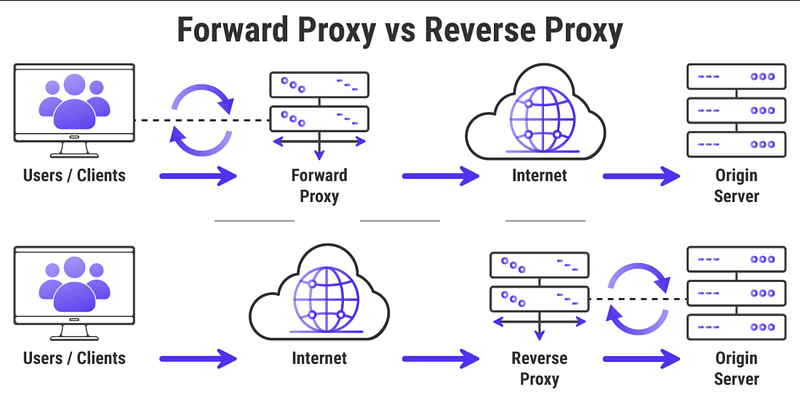
Here is a nice diagram from ByteByteGo, one of the bettter place to learn System Design which also highlight the difference between Forward and Reverse Proxy
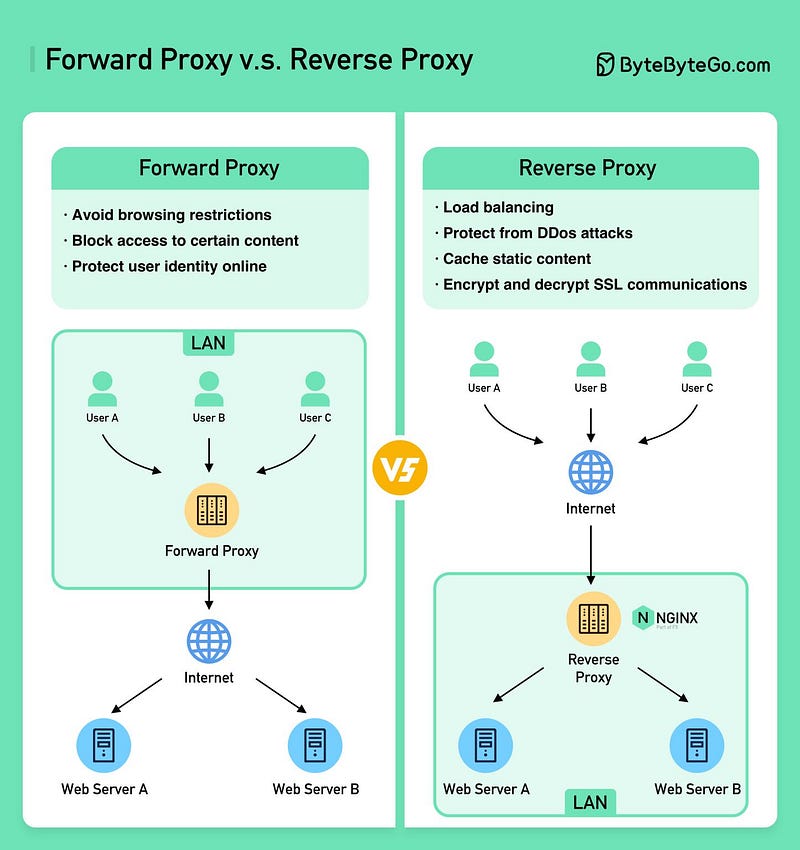
ByteByteGo is a great place to learn System Design, they also run a newsletter and have a YouTube channel, if you are preparing for System Design interview, you can also check that as a resource.
Also, if you want to learn more about reverse proxy and forward proxy you can watch this YouTube video from their channel
System Design Interview Resources
If you are preparing for System design interviews and want to learn System Design in depth then you can also checkout sites like ByteByteGo, Design Guru, Exponent, Educative and Udemy which have many great System design courses and if you need free system design courses you can also see the below article.
Conclusion
In conclusion, understanding the differences between forward proxy and reverse proxy is essential for designing and building scalable and secure systems. While both proxies play important roles in facilitating communication between clients and servers, they differ in their functions, use cases, and pros and cons.
Forward proxies are primarily used to hide a client’s IP address and to access restricted content, whereas reverse proxies are used to protect and secure servers and to distribute traffic across multiple servers. Ultimately, the choice between a forward proxy and reverse proxy will depend on the specific needs of the system and the desired outcome.
More importantly, this one is an important question for System design interviews and you must prepare for it. Additionally, you can also prepare Microservices Questions like difference between API Gateway and Load Balancer, SAGA Pattern, how to manage transactions in Microservices, and difference between SAGA and CQRS Pattern, they are quite popular on interviews.
Other System Design Articles you may like to read