
Did I Get 1.4k Views Because of My Photo?
Lessons learned from my first viral article

I’ve been writing on Medium for 4 months now. During that time, my numbers have slowly risen. I got one of the Medium bonuses, but not any of the others.
When I started, I was excited if my articles got views in the double digits. Later, I was ecstatic when my articles got views in the triple digits. I cannot even begin to describe my joy as I watched the views for this article tick over from 1.2k, to 1.3k, to 1.4k. (It’s now up to 2.5k.)
And, because I want to be able to have other articles gain thousands of views, too, I tried to figure out why. Here’s what I learned.
The article wasn’t curated
As a new writer, I felt that curation was the holy grail. Without it, no article could succeed. Well, no article from a new writer with no followers.
If Tim Denning self-published his grocery list, it would easily get a thousand views. It would spawn dozens of articles trying to interpret it. More would be written asking if it was right for you to publish your grocery list. grocery list would become a trending tag.
In practice, my curated articles tended to do better than non-curated. But sometimes they’d get less than 10 views. Curation certainly didn’t guarantee an audience.
Then this article came along. It was not curated. But the very first day, it got 150 views.
Takeaway: Curation doesn’t matter for virality.
It was in a big publication
My article was published in Start It Up (formerly The Startup). They have a huge readership. Over 726,000 people follow them, and over 8,000,000 read them each month.
Publication to a huge readership does not guarantee that those readers will view it. In fact, my previous articles for Start It Up did not do well.
The first one had only 175 lifetime views, and 48 lifetime reads, after 3 months.
The second one did better, with 406 lifetime views, and 138 lifetime reads, after 2 months.
This one got 1.4k views, 466 reads, and 50 fans within the first 7 days.
The hit article was an editor’s choice, featured on the front page, and included in the weekly newsletter. You might think that made the difference. Except, so were the others. The second one was even listed by the editor of the publication as an example of what she wanted to see more of.
Being featured on the front page and weekly newsletter did make a difference, though. I saw the views jump every time the article was promoted in another venue. The added visibility just isn’t enough on its own, if readers don’t click on it.
Takeaway: A big publication helps, but is no guarantee of virality.
The title and subtitle are catchy
The title of the viral article is “12 Best Countries with Digital Nomad and Remote Work Visas”. The subtitle, which I think is particularly inspired, is “Why just work from home when you can work from a beach?”
The title got a whopping rating of 84 on the headline analyzer. Anything above a 75 is considered a good headline. So this one is very attention grabby.
It contains a number, and promises a list. Moreover, it’s a list of the “Best”, not just any list.
It’s not clickbaity, either. The opening describes the criteria I used to determine “best”. I even mention some of the countries that didn’t make the cut, and why.
The subtitle is practically the value proposition for being a freelancer. It resonates with the creative entrepreneurs who are Start It Up’s audience.
Takeaway: A catchy title and subtitle definitely drive interest
It was a reasonable length
My article had a read time of 6 minutes. That fell smack dab in the middle of the 5–9 minute sweet spot for that publication.
Different publications have different length requirements. Some readers like shorter stories, and some want really long ones of 15 or even 20 minutes.
Promising a read length in the chosen sweet spot doesn’t make people click on the article. But having a read length too short or too long can prevent people from clicking.
I didn’t try to tease the reader with hints about the different countries in my list. Instead, I put a spreadsheet with all the information at the end of the introductory section. The rest of the article was an explanation of all the different columns.
Given that it’s racking up a massive amount of read time, I think that was a good strategy. So far today, 452 people viewed it, and spent 5 1/4 hours reading it. If I only count the 31% that read it to the end, they’d have averaged 2 1/4 minutes on the 6-minute piece.
But they’re not just skimming it. They’re reading that spreadsheet, and thinking the article is valuable. They’re posting links to it on LinkedIn and Facebook.
Takeaway: Deliver obvious value up front in a reasonable length
The timing was right
I was just on my first plane ride in over a year and a half. It was 100% full. So were the flights of everyone I spoke to in the airport. People are starting to travel again, and desperate to be somewhere other than their house.
Going someplace with a beautiful beach speaks to that desire.
Even if you’re not yet ready to go on that trip, you might want to read the article to get destination ideas.
While the rest of the family is on vacation, you can be earning a paycheck. It’s at least worth checking out.
And while I didn’t know this at the time I submitted it, the publication coincided with Croatia’s “Digital Nomad Week”. (And yes, Croatia is one of the 12 countries on my list.) That explains why so many views are coming from Google, Bing, Yahoo, and DuckDuckGo.
Takeaway: Speak to what many people are thinking
It wasn’t my idea
If you come up with all your article ideas based on what interests you, you’re not likely to catch a viral wave. Or, everything you write will go viral, if your interests mirror a huge section of the population.
Since you’re reading this article, I’m going to assume you aren’t going viral with all your content.
You can continue writing about what you’re interested in, and slowly grow your fans. Or, you can find out what they’re interested in, and see if maybe that would interest you, too.
The idea for this article came from a comment on a short-form I did asking where people would like to live. Someone commented that he’d like to live in the US, but couldn’t get a visa to work there.
I wasn’t sure what the current status of work visas for digital nomads is. I know many countries allow working vacations. And, if you’re working remotely, for someone out of the country, does that even count as working in the country?
Since I was curious, I did some looking online. And discovered yes, it’s considered working, and most countries frown on it if you’re there for long.
But, it turns out, some countries actually welcome digital nomads. They want to make it easy for people to work and live there. They’re countries many people think of when they picture the digital nomad lifestyle.
I found the information interesting, so I figured other people might, as well. I was right.
Takeaway: Answer questions asked by others that interest you
It had eye-catching artwork
This is the main reason, I think, why people stopped to look at the article. Once they stopped, the catchy title and subtitle reeled them in.
I’ve spoken before about the importance of unique artwork.
For this article, I knew what I wanted — something that had a laptop on a beach. I didn’t want a person using the laptop. I wanted the reader to be able to imagine themself in the photo.
This is the image that I found:
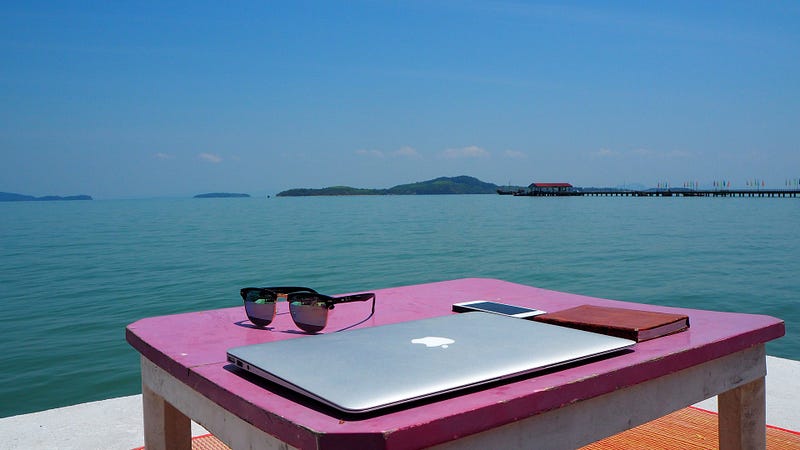
I then used Canva to tweak the image to make it unique. I changed the focus of the photo, so that the laptop was front and center. I also changed the color balance slightly. I’d read somewhere that people responded more to “warm” colors like reds and yellows. And I wanted the ocean to have that gorgeous turquoise color common in the Caribbean.
This is the image I ended up with:
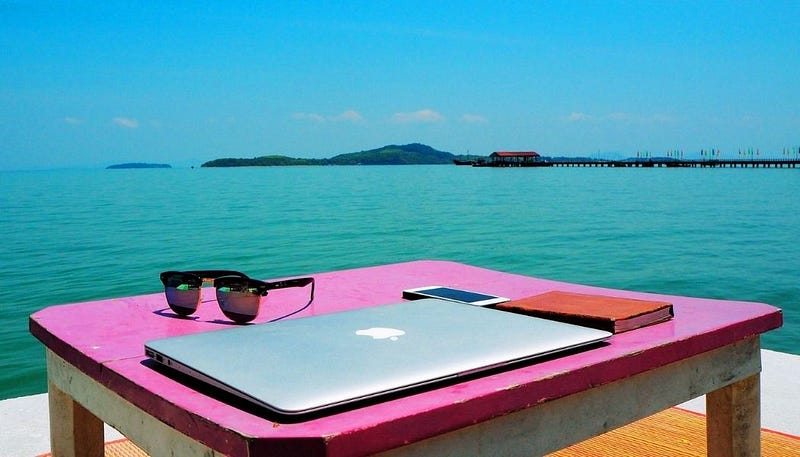
It couldn’t have taken more than 15 minutes to choose a photo, upload it to Canva, and enhance it. But it completely captures the “Wish I was there” sentiment I was going for.
Takeaway: Create a unique, eye catching piece of cover art
Conclusion
You never know which articles are going to take off and become hits. But there are some things you can do to give your article a better chance.
Don’t worry if your articles aren’t curated. This one got 1400 views in a week without being curated.
Write for a big publication whose audience cares about the subject of your article.
Write the best, most compelling title and subtitle that you can. Deliver up-front value in a reasonable length.
Try to tap into the zeitgeist of the moment by answering questions from your readers. Don’t rely on your own interests to generate story ideas.
Give your story unique, eye-catching artwork.
If you do those things, your next story may also go viral.
Ready to have a better tomorrow?
I’ve created a guide to help you increase your confidence and improve your life. If you follow these tips, you will level up your life very quickly!


