
12 Best Countries with Digital Nomad and Remote Work Visas
Why just work from home when you can work from a beach?
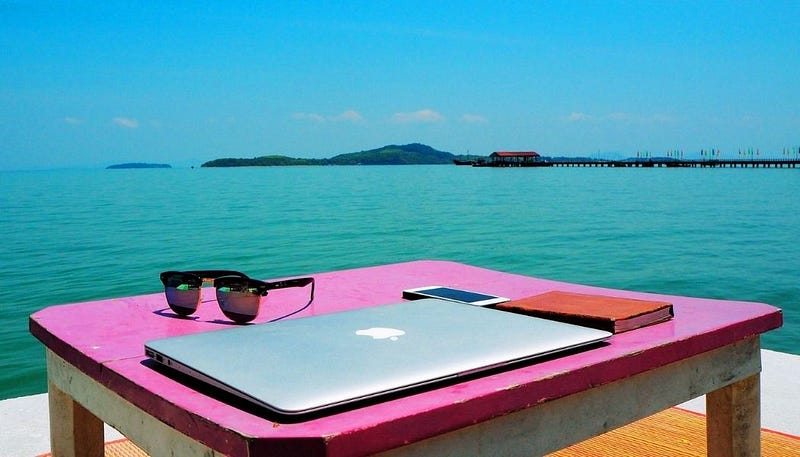
As long as you’re able to work remotely, why should you simply work from home? Or work from your local coffee shop?
Working from another country allows you to live somewhere with a lower cost of living. You can travel and see the sights in your spare time, instead of budgeting time and money for a vacation. And you can network with the other ex-pats and digital nomads also living and working there.
The trick is that most countries frown on you working while you are on a tourist visa. Some do allow a “working vacation” visa, but those tend to be short-term. The countries that made my list all allow digital nomad or remote work visas for at least a full year.
Other countries, such as the Czech Republic, Germany, and Norway, have work restrictions. You must have clients, contracts, or licenses for that specific country. The countries on my list have no business restrictions.
Here is the list of 12 countries, in alphabetical order. (I listed the city of Dubai instead of the country of the United Arab Emirates. The city is the one with the visa program, not the country as a whole.) In the rest of this article, I will describe the columns on the table, and how to apply for each country’s visa.
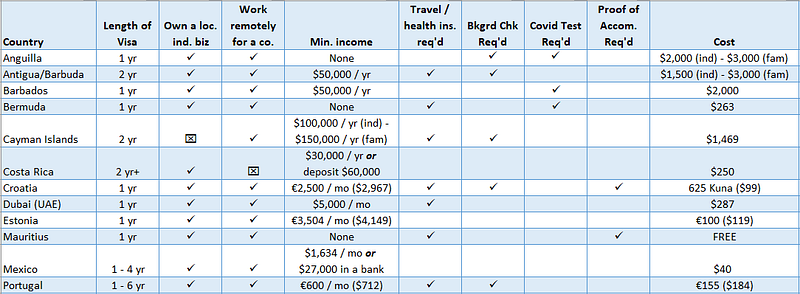
Note that I have approached this list from the viewpoint of someone traveling from the US, on a US passport. If your country’s passport is not accepted by one of these countries, obviously, you are not able to get a visa for that country.
Length of visas
All countries on this list offer digital nomad visas for at least one year. Where a range is given, the initial visa is for one year. You can extend the visa up to the maximum number of years.
In the case of Costa Rica, there is no maximum. The visa for entrepreneurs can be extended indefinitely. You can also convert it into permanent residency status, once the criteria for that are met.
Criteria for visas
There are many different criteria for the digital nomad visas. In this section, I’ll describe the different criteria.
Owner of a location independent business
Most countries grant digital nomad visas to owners of location independent businesses. The only one on my list which specifically does not is the Cayman Islands.
You can apply as a business owner (including independent contractor or freelancer). You will need to show proof that your business generates the required income amount. In some cases, this proof comes from bank statements. In other cases, the proof is an on-going contract covering the time of your stay.
Remote worker for a company external to the country
Most countries also grant digital nomad visas to remote workers. You must work for a company that does not have an office in the country where you wish to live.
The only country on my list which specifically excludes remote workers is Costa Rica. They are only interested in giving visas to entrepreneurs or freelancers.
If you apply as a remote worker, you will need to show proof of income from your company. This can be in the form of payroll statements, W-2 forms, or bank statements. Different countries want different types of proof.
Minimum income
Most countries want to ensure you have the financial resources to support yourself. The levels range from about $8500/yr in Portugal to $100,000/yr in the Cayman Islands. $100,000/yr sounds like a lot. That’s still less than half the amount you need to support yourself in Silicon Valley.
Some countries, such as Costa Rica and Mexico, allow you to show money in the bank instead of income. This may be a good alternative if you have a cushion of cash, but your freelance business isn’t making much.
Travel and/or health insurance
About half of the countries on my list wanted proof that you had either travel or health insurance. This insurance needs to cover you for the duration of your stay.
If you’re young and healthy, you can get very affordable digital nomad insurance. If you are older or have pre-existing conditions, you will most likely pay more. Check your current insurer to see what provisions they may have for living abroad.
Background checks
A third of the countries on my list include background checks among the paperwork they want. These range from copies of your police record to full investigations.
I don’t know what you’re supposed to do if you never came to the attention of the police. Get a certified letter from your local police saying they have no idea who you are?
While it might be a pain to come up with this, especially if you moved around a lot, it shouldn’t be a deal breaker.
Covid tests
A fourth of the countries on my list have strict rules involving what Covid tests you must pass. You need to have a clean test before you arrive, when you arrive, and at the end of your quarantine period.
Since these are for small islands with closed borders or very strict borders, it makes sense. They don’t want an outbreak on their island.
I’m assuming you would also prefer there not be an outbreak on the island. So the minor inconvenience is something that will help to keep you safe for the year you’re there.
Proof of accommodation
Finally, two countries demand proof of accommodation before they will give you a visa. This can be where you are already staying, if you are already in the country on a tourist visa. Or it can be a reservation or housing lease for where you will stay.
I’m not sure if housing is especially tight, and they want to make sure you are not homeless? Or they want to have an official address on file for you if they need to reach you in country.
Cost of digital nomad visas
There is a wide range of prices to grant digital nomad or remote worker visas. At one end of the range is Mauritius, who does not charge any visa fees. At the other end of the range is Anguilla, who charges $2,000 for an individual, and $3,000 for a family.
Some of these costs are denominated in the local currency (Euros). In those cases, I’ve included the current US costs, based on the June 20, 2021 exchange rate with the Euro. You’ll want to recalculate those rates closer to your departure.
How to apply for digital nomad visas
There are three basic methods for applying for visas. You can apply online, directly with the appropriate country’s department that grants visas. Some countries require that you apply in person, at a consulate or after arrival on a tourist visa. The third method involves hiring an attorney or visa specializing agency.
While you could hire a specialist for any of the countries, it is only recommended for the Costa Rican visa. They require that all paperwork be translated into Spanish, and certified by the originating country. It’s best to have someone who knows what they’re doing handle this.
- Anguilla — apply online.
- Antigua and Barbuda — apply online.
- Barbados — apply online.
- Bermuda — apply online.
- Cayman Islands — apply online.
- Costa Rica — hire an attorney or agency.
- Croatia — apply from within the country.
- Dubai (UAE) — apply online.
- Estonia — apply at a consulate or embassy.
- Mauritius — apply online.
- Mexico — apply at a consulate.
- Portugal — apply at a consulate.
Conclusion
If you can work remotely from anywhere, why not work someplace lovely? These twelve countries are beautiful destinations in their own right. Plus, they all offer visas for digital nomads and remote workers lasting at least a year.
Each country has its own requirements for their visa. Most have minimum income requirements. Some require proof of travel and/or health insurance, background checks, Covid tests, or proof of accommodation.
Additionally, the costs to apply for the visas range widely, from free to $3,000. Most can be applied for online, but four require that you apply in person. Because of translation and certification requirements, it is recommended that if you’re interested in Costa Rica’s visa, you hire an expert attorney or agency.
Ready to have a better tomorrow?
I’ve created a guide to help you increase your confidence and improve your life. If you follow these tips, you will level up your life very quickly!