avatarLisa Zane

Free AI web copilot to create summaries, insights and extended knowledge, download it at here

7420

Abstract

="https://www.amazon.ca/Sprint-Solve-Problems-Test-Ideas/dp/150112174X/ref=asc_df_150112174X/?tag=googleshopc0c-20&amp;linkCode=df0&amp;hvadid=293020323119&amp;hvpos=&amp;hvnetw=g&amp;hvrand=3625462131832997276&amp;hvpone=&amp;hvptwo=&amp;hvqmt=&amp;hvdev=c&amp;hvdvcmdl=&amp;hvlocint=&amp;hvlocphy=9001028&amp;hvtargid=pla-436091533585&amp;psc=1"><b>Sprint-style</b></a>” using short design sprints to come up with low-fidelity prototypes that can then be quickly evaluated and prioritized)</li><li>Baking ethics into product requirements</li><li>Incorporating ethics in QA practices, internal, and external testing</li><li>Continuing to focus on ethics post-launch</li><li>Communicating with your users regularly about ethics</li></ul><h2 id="3dcc">Establishing your own career code of ethics</h2><p id="160e">This is something <a href="https://readmedium.com/creative-ways-to-find-your-own-product-market-fit-f69099c48659"><b>I learned the hard way, by going through the school of hard knocks</b></a>. Where I eventually landed was, in order to feel like my efforts and energy and time were being put into places that were aligned with my values, I needed to first <a href="https://lzane.gumroad.com/l/problemfinding"><b>define the problem spaces I care the most about and why</b></a>, and define where I want to go — my <a href="https://lzane.gumroad.com/l/pmcareernorthstar"><b>North Star</b></a><b>. </b>This process<b> </b>included strong ethical considerations.</p><p id="457c">Asking yourself the hard questions up front to define your trajectory and why that really matters to you and what legacy you are leaving behind is not only one of the best investments you can make in yourself — it’s also one of the the most impactful investments you can make on broader society and the planet.</p><p id="0500">Reddy’s book is short, to the point, and in my opinion, is very aligned with more conversations we need to be having in the ethics space.</p><h1 id="7fb3">The Larger Conversation</h1><p id="2a50">I recently posed this question on <a href="https://twitter.com/LisaZane15/status/1516428797352022030"><b>Twitter</b></a> and <a href="https://www.linkedin.com/feed/update/urn:li:activity:6922179099805278208/"><b>LinkedIn</b></a><b>:</b></p><p id="9ac5">Most human-centered professions have universal codes of ethics (i.e. Medicine, Law).</p><p id="107c">What’s stopping us from having one in product?</p><p id="2930">I found the responses passionate, eye-opening, and polarizing. Click on each post below to view the larger conversation:</p><figure id="e3e6"><img src="https://cdn-images-1.readmedium.com/v2/resize:fit:800/1*xkQFn3tzg33NxC6nrc3mPg.png"><figcaption></figcaption></figure><figure id="cdee"><img src="https://cdn-images-1.readmedium.com/v2/resize:fit:800/1*A-f5fIB9dGYiLTnbyWYhZg.png"><figcaption></figcaption></figure><p id="fac6">In medicine, we’ve got universal codes like the <a href="https://en.wikipedia.org/wiki/Hippocratic_Oath#:~:text=The%20Hippocratic%20Oath%20is%20an,to%20uphold%20specific%20ethical%20standards."><b>Hippocratic Oath</b></a> and <a href="https://www.themedicportal.com/application-guide/medical-school-interview/medical-ethics/"><b>The Four Pillars of Medical Ethics</b></a>. In Law, there are official <a href="https://www.cba.org/Publications-Resources/Practice-Tools/Ethics-and-Professional-Responsibility-(1)/Codes-of-Professional-Conduct"><b>codes of professional conduct by jurisdiction</b></a>. In engineering, there are <a href="https://www.nspe.org/resources/ethics/code-ethics#:~:text=Engineers%20shall%20hold%20paramount%20the,authority%20as%20may%20be%20appropriate."><b>National Codes of Ethics for the U.S</b></a>. and <a href="https://engineerscanada.ca/publications/public-guideline-on-the-code-of-ethics#-the-code-of-ethics"><b>Canada</b></a>.</p><figure id="cf60"><img src="https://cdn-images-1.readmedium.com/v2/resize:fit:800/1*EuOmGEjW_3aKgJ1BbDZ6qg.png"><figcaption>Excerpted from <a href="https://www.themedicportal.com/application-guide/medical-school-interview/medical-ethics/">The Medical Portal</a></figcaption></figure><figure id="0fa7"><img src="https://cdn-images-1.readmedium.com/v2/resize:fit:800/1*NbrxJxJQO3thfBfbYRPdzw.png"><figcaption>Excerpt from the <a href="https://www.nspe.org/resources/ethics/code-ethics#:~:text=Engineers%20shall%20hold%20paramount%20the,authority%20as%20may%20be%20appropriate.">National Society of Professional Engineers</a></figcaption></figure><p id="17bd">In product, we don’t have this — not yet, and not in a universal or regulated way.</p><p id="315f">To my knowledge, while there are courses and bootcamps and certification programs, there is currently no officially recognized product management accreditation program at a university or college like there exists for professions like medicine, law, and engineering.</p><p id="b673">Similarly, there have been several iterations of an initial “code” like <a href="https://copenhagenletter.org/"><b>The Copenhagan Letter</b></a>, <a href="https://www.humanetech.com/policy-principles"><b>Humane Tech Policy Principles</b></a>, and what Mariah Hay Covers in her talk, “<a href="https://www.mindtheproduct.com/first-do-no-harm-by-mariah-hay/"><b>First, Do No Harm”</b></a>, but none that have been universally adopted.</p><p id="b33d">I really like Radhika Dutt’s take on things — she has a new book out, “<a href="https://www.amazon.com/Radical-Product-Thinking-Mindset-Innovating-ebook/dp/B08ZNV7SW4/ref=sr_1_1?dchild=1&amp;keywords=radical+product&amp;qid=1624988263&amp;sr=8-1"><b>Radical Product Thinking: The New Mindset For Innovating Smarter</b></a><b></b>and<b> </b>was <a href="https://podcasts.google.com/feed/aHR0cHM6Ly9mZWVkLnBvZGJlYW4uY29tL29uZWtuaWdodGlucHJvZHVjdC9mZWVkLnhtbA/episode/b25la25pZ2h0aW5wcm9kdWN0LnBvZGJlYW4uY29tL2RjMTU3OGJjLTYyMDEtMzZjYy1iZWViLWJiN2E0ZDA1MTA1Nw?sa=X&amp;ved=0CAUQkfYCahcKEwiYnr-38KL3AhUAAAAAHQAAAAAQQw"><b>recently interviewed by Jason Knight on his One Knight in Product</b></a><b> </b>podcast. Dutt describes developing products without ethical thinking built in up front like driving somewhere without a map. You may have the ability to go really fast with agile processes and figure a lot out along the way, but to end up in the best destination, we need to complete the picture using both the product vision and ethical principles applied to that vision.</p><p id="58b3">Kara Swisher, one of the most outspoken journalistic voices in tech who has been around through an enormous technological evolution over the past 20+ years and has vouched publicly for greater ethical considerations as we are building and releasing products, has said that she thinks every founder should need to pass an ethics class as a minimal requirement in order to start a company. She has written about <a href="https://www.nytimes.com/2018/10/21/opinion/who-will-teach-silicon-valley-to-be-ethical.html"><b>teaching Silicon Valley to be more ethical</b></a>, asking questions like, “How can an industry that, unlike other business sectors, persistently promotes itself as doing good, learn to do that in reality?”, and has serious concerns about where we are going. In <a href="https://www.cnn.com/videos/business/2019/04/11/kara-swisher-big-tech-regulation-boss-files-orig.cnn-business/video/playlists/business-boss-files/"><b>a 2019 interview with CNN</b></a>, Swisher said:</p><p id="2484">“My worry is that we can’t

Options

stop it. It’s like someone’s built a city — Mark, or Jack, or whoever you want to pick — without street signs, without sewage, without police, without garbagemen. Imagine that city? It’s not a good city to live in but they collect all the rent.”</p><p id="9007">While there are some big questions we’d need to answer to develop such a code, including, “What should be included?”, “How would companies take on individual ownership and accountability when building and releasing products?”, “How would it be regulated?”, and “Who would regulate it?”, I would argue that having a code of ethics as a universal standard in product across both software and hardware products would have prevented a lot of issues we have seen when products were launched that then had a negative impact on users (i.e. health, well-being, security and in some cases death) and that created more problems than the initial one they were trying to solve.</p><p id="2502">While a universal standard is not necessarily in the cards in the short-term, and regulations take a long time to not only enact, but also to get right, there are perhaps some steps we can take right now to improve things for the lives of users, including:</p><ol><li>Giving a damn. It starts with caring about this and having empathy for the people we are potentially or realistically impacting with the decisions we are making about our products.</li><li>Speaking more about product ethics, openly. Change starts with a conversation.</li><li><a href="https://readmedium.com/a-call-for-more-conscious-products-6eb4c62124a6"><b>Making more conscious decisions about what we’re putting our energy into developing and why</b></a>.</li><li>Making sure that we are spending at least the equivalent amount of time in the problem finding and framing space as we are in the solutions space and we are picking impactful, <a href="https://lzane.gumroad.com/l/problemfinding"><b>meaningful problems to solve</b></a>. Our solutions should not be creating more problems. If they are, we haven’t done a great job in our roles.</li><li>Doing a better job to <b>tangibly quantify</b> good ethical practices in product development.</li><li>Looking at what we are creating or thinking about creating and bringing into the world in a holistic and inclusive way.</li><li>Holding ourselves to a higher standard than we currently are and being accountable and owning not only what we do, but also what is happening around us.</li><li>Not just thinking about change, but actually <b>doing</b>. For example, if you’re actively working on a product that you know will negatively impact users — think critically about if that’s really what you want to be putting time and energy into. Don’t be afraid to walk away. <a href="https://readmedium.com/my-5-criteria-for-meaningful-sustainable-work-and-3-companies-that-fit-all-of-them-ae612d57f16b"><b>There are more companies popping up that you can work for</b></a> and get behind that share similar values and are developing more ethically-focused products.</li></ol><p id="d616">What do you think?</p><p id="1a42">Whose responsibility is it?</p><p id="641d">What’s the best way for us to move forward?</p><p id="2725">How can we do a better job creating more ethical products, not only for people, but also for the planet?</p><p id="e24c">I would love to hear your thoughts — please comment below.</p><h1 id="2697">Ethical Product Tools and Resources:</h1><ul><li><a href="https://www.forbes.com/sites/forbestechcouncil/2021/07/30/10-current-and-potential-ethical-crises-in-the-tech-industry/?sh=2b715b6f6405"><b>10 Current And Potential Ethical Crises In The Tech Industry</b></a></li><li><a href="https://www.amazon.ca/Ethical-Product-Development-techniques-development/dp/B09PHL29TM/ref=sxts_rp_s1_0?crid=SN8C43AVU671&amp;cv_ct_cx=ethical+product+development&amp;keywords=ethical+product+development&amp;pd_rd_i=B09PHL29TM&amp;pd_rd_r=08da00f9-0a5e-4f26-a1fb-038e05a83b68&amp;pd_rd_w=HUQ4C&amp;pd_rd_wg=WZrw1&amp;pf_rd_p=f246b130-b2b7-478c-84a3-51d0c82e2da1&amp;pf_rd_r=W7HQMZCN9N08T933WA4X&amp;psc=1&amp;qid=1650466555&amp;sprefix=%2Caps%2C249&amp;sr=1-1-f0029781-b79b-4b60-9cb0-eeda4dea34d6"><b>“Ethical Product Development: Practical Techniques to Apply Across the Product Development Life Cycle” by Pavani Reddy</b></a></li><li><a href="https://www.mindtheproduct.com/first-do-no-harm-by-mariah-hay/"><b>First, Do No Harm by Mariah Hay: Talk at Mind the Product 2018</b></a></li><li><a href="https://www.radicalproduct.com/ethics/digital_pollution/2020/04/30/hippocratic-oath/"><b>The Hippocratic Oath of Product by Radhika Dutt</b></a></li><li><a href="https://www.amazon.com/Radical-Product-Thinking-Mindset-Innovating-ebook/dp/B08ZNV7SW4/ref=sr_1_1?dchild=1&amp;keywords=radical+product&amp;qid=1624988263&amp;sr=8-1"><b>Radical Product Thinking: The New Mindset For Innovating Smarter by Radhika Dutt</b></a></li><li><a href="https://podcasts.google.com/feed/aHR0cHM6Ly9mZWVkLnBvZGJlYW4uY29tL29uZWtuaWdodGlucHJvZHVjdC9mZWVkLnhtbA/episode/b25la25pZ2h0aW5wcm9kdWN0LnBvZGJlYW4uY29tL2RjMTU3OGJjLTYyMDEtMzZjYy1iZWViLWJiN2E0ZDA1MTA1Nw?sa=X&amp;ved=0CAUQkfYCahcKEwiYnr-38KL3AhUAAAAAHQAAAAAQQw"><b>One Knight in Product Podcast Episode: Digital Pollution & The Product Hippocratic Oath (with Radhika Dutt, author ”Radical Product Thinking”)</b></a></li><li><a href="https://copenhagenletter.org/"><b>The Copenhagan Letter</b></a></li><li><a href="https://ddc.dk/tools/toolkit-the-digital-ethics-compass/"><b>The Digital Ethics Compass by The Danish Design Center</b></a></li><li><a href="http://tarotcardsoftech.artefactgroup.com/"><b>Tarot Cards of Tech</b></a></li><li><a href="https://readmedium.com/2019-is-the-year-to-stop-talking-about-ethics-and-start-taking-action-9cb55673f062"><b>2019 Is the Year to Stop Talking About Ethics and Start Taking Action</b></a></li></ul><p id="86e4">Follow me on Twitter: <a href="https://twitter.com/LisaZane15"><b>@lisazane15</b></a></p><p id="0e00">🧠 Join 800+ people interested in building products and their product careers more consciously: <a href="https://www.consciousproductdevelopment.com/newsletter"><b>https://www.consciousproductdevelopment.com/newsletter</b></a></p><p id="2055">🧭 If you’re ready for a role transition or just want to make more conscious career moves going forward, check out The Product Manager’s Career Guide that I just launched: <a href="https://www.consciousproductdevelopment.com/the-product-managers-career-guide"><b>https://www.consciousproductdevelopment.com/the-product-managers-career-guide</b></a></p><h1 id="2ba8">Related:</h1><ul><li><a href="https://readmedium.com/a-call-for-more-conscious-products-6eb4c62124a6"><b>A Call For More Conscious Products</b></a></li><li><a href="https://readmedium.com/my-5-criteria-for-meaningful-sustainable-work-and-3-companies-that-fit-all-of-them-ae612d57f16b"><b>My 5 Criteria for Meaningful Sustainable Work (And 3 Companies That Fit All of Them)</b></a></li><li><a href="https://readmedium.com/cultivating-an-exceptional-team-211c27bd4edb"><b>Cultivating an Exceptional Team</b></a></li><li><a href="https://readmedium.com/creative-ways-to-find-your-own-product-market-fit-f69099c48659"><b>Creative Ways to Find Your Own Product-Market Fit</b></a></li><li><a href="https://readmedium.com/reimagining-the-term-stakeholder-management-1a7a29a817c5"><b>Reimagining Stakeholder Management</b></a></li></ul></article></body>

Developing More Ethical Products

A summary of key topics in Pavani Reddy’s book on the subject and a larger conversation.
French philosopher Paul Virilio once said, “When you invent the ship, you also invent the shipwreck.”

This doesn’t mean you can’t think of adding life boats, whistles, flare guns, life preservers, and other measures to keep those on board safe, however. It also doesn’t mean you shouldn’t have a map and know where you’re headed and why.

In our rapidly evolving world that’s now embedded with tech, you often hear of “oh sh*t” moments when companies realize they have done harm to users or the planet, or both. Sometimes they aren’t aware at all, and sometimes they refuse to admit that there is a problem. Often there are rush bandaid solutions and large PR campaigns to “soften the blow” and “protect the company”. But what about protecting users? And baking this into every stage of product development, from the very beginning?

I refuse to accept that this is the best we can do.

Pavani Reddy has a similar perspective. I recently read her book, “Ethical Product Development: Practical Techniques to Apply Across the Product Development Life Cycle” and it really got my wheels spinning.

Below are:

  1. Some of the key topics Reddy covers
  2. A larger conversation about ethics in product development
  3. A summary of resources you can use if you’re interested in developing products more ethically

Let’s dive in.

Key Topics in Reddy’s Book, “Ethical Product Development”

Building a product code of ethics (PCOE)

While most companies rely on values (or none at all), establishing a specific Product Code of Ethics highlights, pre-emptively, what a company will prioritize, from a human perspective, as it builds products. Reddy suggests using something called the “Ethics Eight” to prompt building yours. If you can define the following, you’re off to a good start:

  1. Problem Being Solved
  2. Users
  3. Intended Use
  4. Unintended Use
  5. Risks
  6. Testing (how will we test our product holistically?)
  7. Broader Impact (what are potential negative side effects for users/broader society?)
  8. Upholding Principles (how will we uphold these principles within the org?)

While codes of ethics haven’t stopped some large organizations from doing unethical things, it’s a good way to begin thinking about things early and doing so with some degree of transparency within an organization.

Establishing accountability internally — champions responsible for specific elements in the code of ethics

Things can easily fall apart without a clear plan in place of not only how the principles will be upheld, but also WHO will do the upholding.

Establishing which key people in your organization are responsible and accountable for individual elements of the PCOE, and how they will bring others into the fold in a collaborative way is crucial.

Identifying a product’s potential ethical failures

If you look at some of the most well-known ethical failures among products we’ve used, including the Facebook-Cambrdidge Analytica scandal, Zoom’s security and privacy issues around secure encryption that resulted in calls being mistakenly routed through China and sending user data to Facebook without user’s permission, Google AI’s racist connotations in tagging images, inequity in facial recognition algorithms, women being 73% more likely to be severely injured and 17% more likely to die than a male driver in the drivers seat of most cars due to lack of design for diversity of body sizes, and more examples along similar lines, identifying potential ethical failures up front pre-mortem style probably would not have hurt.

Identifying things like who you may be underserving, potential failure points of algorithms being used, doing your homework and knowing Product Law and research best practices, and using tools like The Tarot Cards of Tech and The Danish Design Center’s Digital Ethics Compass to consider how what you are building may impact your users and broader society holistically up front.

Baking ethics into your product development process

We’ve seen so many cases where a failure point was discovered after a product was in users’ hands, and a bandaid solution was implemented to fix it along with a whole lot of PR.

By baking ethics into the product development process, it helps to ensure teams are thinking about the holistic direction they are headed not just from the beginning, but every step of the way. Additionally, by baking it into the culture, it creates collaborative buy-in vs. it just coming from a select few individuals who think it’s important.

What does this actually look like?

  • Setting responsible metrics (i.e. “Responsible reduction in X” vs. just “Reduction in X”)
  • Developing ethical alternatives when potential problems are discovered (i.e. “Sprint-style” using short design sprints to come up with low-fidelity prototypes that can then be quickly evaluated and prioritized)
  • Baking ethics into product requirements
  • Incorporating ethics in QA practices, internal, and external testing
  • Continuing to focus on ethics post-launch
  • Communicating with your users regularly about ethics

Establishing your own career code of ethics

This is something I learned the hard way, by going through the school of hard knocks. Where I eventually landed was, in order to feel like my efforts and energy and time were being put into places that were aligned with my values, I needed to first define the problem spaces I care the most about and why, and define where I want to go — my North Star. This process included strong ethical considerations.

Asking yourself the hard questions up front to define your trajectory and why that really matters to you and what legacy you are leaving behind is not only one of the best investments you can make in yourself — it’s also one of the the most impactful investments you can make on broader society and the planet.

Reddy’s book is short, to the point, and in my opinion, is very aligned with more conversations we need to be having in the ethics space.

The Larger Conversation

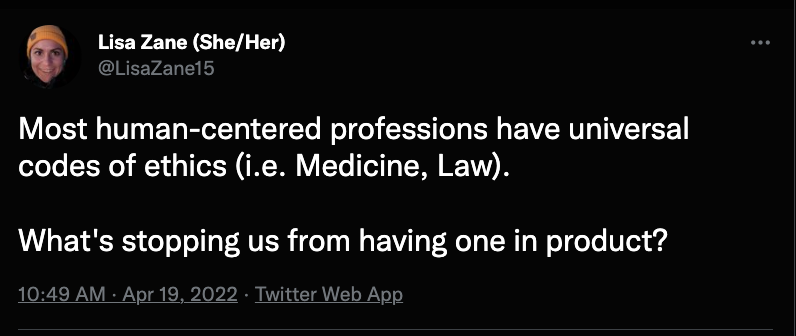
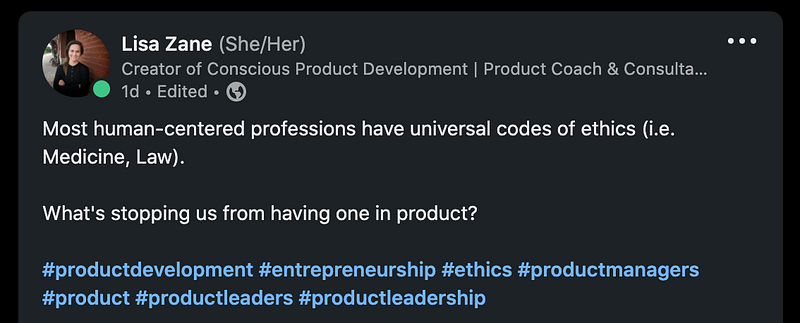
I recently posed this question on Twitter and LinkedIn:

Most human-centered professions have universal codes of ethics (i.e. Medicine, Law).

What’s stopping us from having one in product?

I found the responses passionate, eye-opening, and polarizing. Click on each post below to view the larger conversation:
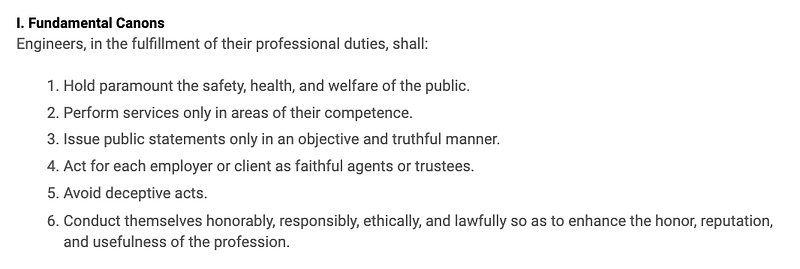
In medicine, we’ve got universal codes like the Hippocratic Oath and The Four Pillars of Medical Ethics. In Law, there are official codes of professional conduct by jurisdiction. In engineering, there are National Codes of Ethics for the U.S. and Canada.
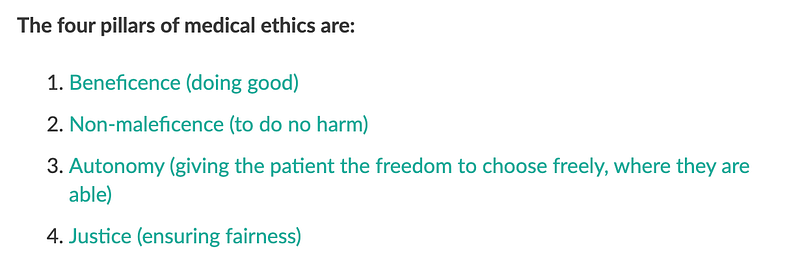
Excerpted from The Medical Portal
Excerpt from the National Society of Professional Engineers

In product, we don’t have this — not yet, and not in a universal or regulated way.

To my knowledge, while there are courses and bootcamps and certification programs, there is currently no officially recognized product management accreditation program at a university or college like there exists for professions like medicine, law, and engineering.

Similarly, there have been several iterations of an initial “code” like The Copenhagan Letter, Humane Tech Policy Principles, and what Mariah Hay Covers in her talk, “First, Do No Harm”, but none that have been universally adopted.

I really like Radhika Dutt’s take on things — she has a new book out, “Radical Product Thinking: The New Mindset For Innovating Smarterand was recently interviewed by Jason Knight on his One Knight in Product podcast. Dutt describes developing products without ethical thinking built in up front like driving somewhere without a map. You may have the ability to go really fast with agile processes and figure a lot out along the way, but to end up in the best destination, we need to complete the picture using both the product vision and ethical principles applied to that vision.

Kara Swisher, one of the most outspoken journalistic voices in tech who has been around through an enormous technological evolution over the past 20+ years and has vouched publicly for greater ethical considerations as we are building and releasing products, has said that she thinks every founder should need to pass an ethics class as a minimal requirement in order to start a company. She has written about teaching Silicon Valley to be more ethical, asking questions like, “How can an industry that, unlike other business sectors, persistently promotes itself as doing good, learn to do that in reality?”, and has serious concerns about where we are going. In a 2019 interview with CNN, Swisher said:

“My worry is that we can’t stop it. It’s like someone’s built a city — Mark, or Jack, or whoever you want to pick — without street signs, without sewage, without police, without garbagemen. Imagine that city? It’s not a good city to live in but they collect all the rent.”

While there are some big questions we’d need to answer to develop such a code, including, “What should be included?”, “How would companies take on individual ownership and accountability when building and releasing products?”, “How would it be regulated?”, and “Who would regulate it?”, I would argue that having a code of ethics as a universal standard in product across both software and hardware products would have prevented a lot of issues we have seen when products were launched that then had a negative impact on users (i.e. health, well-being, security and in some cases death) and that created more problems than the initial one they were trying to solve.

While a universal standard is not necessarily in the cards in the short-term, and regulations take a long time to not only enact, but also to get right, there are perhaps some steps we can take right now to improve things for the lives of users, including:

  1. Giving a damn. It starts with caring about this and having empathy for the people we are potentially or realistically impacting with the decisions we are making about our products.
  2. Speaking more about product ethics, openly. Change starts with a conversation.
  3. Making more conscious decisions about what we’re putting our energy into developing and why.
  4. Making sure that we are spending at least the equivalent amount of time in the problem finding and framing space as we are in the solutions space and we are picking impactful, meaningful problems to solve. Our solutions should not be creating more problems. If they are, we haven’t done a great job in our roles.
  5. Doing a better job to tangibly quantify good ethical practices in product development.
  6. Looking at what we are creating or thinking about creating and bringing into the world in a holistic and inclusive way.
  7. Holding ourselves to a higher standard than we currently are and being accountable and owning not only what we do, but also what is happening around us.
  8. Not just thinking about change, but actually doing. For example, if you’re actively working on a product that you know will negatively impact users — think critically about if that’s really what you want to be putting time and energy into. Don’t be afraid to walk away. There are more companies popping up that you can work for and get behind that share similar values and are developing more ethically-focused products.

What do you think?

Whose responsibility is it?

What’s the best way for us to move forward?

How can we do a better job creating more ethical products, not only for people, but also for the planet?

I would love to hear your thoughts — please comment below.

Ethical Product Tools and Resources:

Follow me on Twitter: @lisazane15

🧠 Join 800+ people interested in building products and their product careers more consciously: https://www.consciousproductdevelopment.com/newsletter

🧭 If you’re ready for a role transition or just want to make more conscious career moves going forward, check out The Product Manager’s Career Guide that I just launched: https://www.consciousproductdevelopment.com/the-product-managers-career-guide

Related:

Product
Business
Product Management
Product Development
Ethics
Recommended from ReadMedium