
Millennial, Fighting Back When the Odds Are Against You
I did it. You can, too!

Disclosure: The original title of this story was “Dear Millennial, I’m An OK Boomer, And You’ll Be OK, Too!”
I recently read an excellent reflection in this venue by Hanna Brooks Olsen, How I Paid Off My Student Loans. She tells how she paid off her loans, of course, but she also presents other issues faced by millennials. “Members of my generation are more educated, more productive, yet we earn less than previous generations did at our age.”
It is so easy to see things you are facing through a single lens. You are on a path others have followed, and many more will tread.
More Educated
Check the Highest Level of Education: [ ] High School Diploma
If you don’t have post-high school training and you’re relying on your high school diploma and your hard work, intelligence, and wits, I wish you the very best.
If you’re smart enough, work hard enough and take advantage of opportunities as they arise, you can still make a good life. It’s not easy, though. You have to pick an area where your competition can not get ahead of you through education.
Check the Highest Level of Education: [ ] College Degree or Trade School Certification
If you have a college degree or a trade school certification, I applaud you. It’s a highly competitive world out there. Every bit of post-high school training you can get will benefit you.
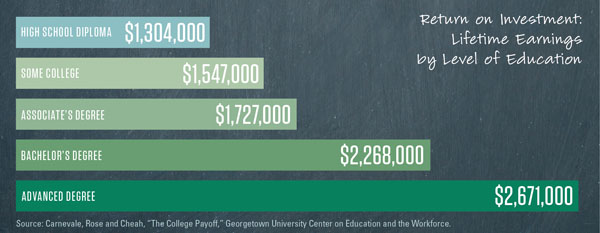
Perhaps, you found that traditional college or university was not a good fit for you. I get it. I taught in public and private conventional schools for 40 years. I saw more than a handful of kids pass through for which the institution of “school” didn’t work for them. Trade schools are often a better fit for many students.
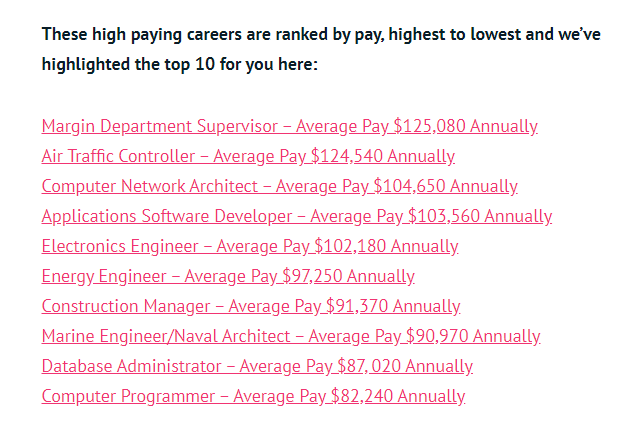
Trade schools can provide the credentials you need to make the following careers per onlinesschoolscenter.com.
I get it. I graduated from high school in 1973. To get a good job, I could either go to college or go to work for Texas Power and Light Company. The entry-level position was usually 40 feet above ground level. I like heights almost as much as I love liver and onions for dinner. Almost.
So, I went to college. College also provided a deferment from being drafted to go to southeast Asia, compliments of Uncle Sam.
Ah, what was to be my major? My first thought was mathematics. I liked math. I’d always found math to be comfortable and still do. In my freshman semester, I took Calculus. I got a C in the class. I was shocked by the C. I’d never made a C in any math class before.
Yuck. If I was going to have to work, do homework, go for tutoring, and have more classes with that professor, then being a math major wasn’t for me.
Dropping mathematics as a major was the first BIG mistake of my life. Instead of buckling down and pushing myself to succeed, I looked for a less demanding path.
The next semester my major was accounting. Remember, I had a head for math. Surely adding columns of numbers would be more comfortable than finding the area of a region under a curve.
Introduction to Financial Accounting went well. Debit on the left, credit on the right, or was it the other way. Forgive me if I’ve erred. That was 44 years ago. As I said, Intro to Financial Accounting went OK. I got an A. The next semester, I encountered Introduction to Managerial Accounting. It went OK, too. I think. But my enthusiasm for this stuff was waining.
The epiphany of my calling came to me during the following summer when I worked a few weeks at a Cub Scout Day Camp. I found I loved working with elementary school-age kids. Before fall registration, my major changed to elementary education.
December 1977 Graduation, No Job, and a Teacher Surplus
I graduated in December of 1977. At that time, there was a teacher surplus. I know that it is hard to believe these days. But that was the case then. So I did what every other new teacher without a job did. I did whatever I could to earn money.
Mostly, I substitute taught. Unless you are a long term sub, and I wasn’t, a sub would be at one school one day and another school the next day. Every day was a different school, a different grade level, or subject.
I also applied to school districts in the Dallas / Fort Worth area. Do you know how many school districts there are in the DFW area and surrounding counties? I think there are around 50 to 60, depending on how far out one is willing to go. I recall applying to Palo Pinto, a tiny school district in Texas, 66 miles west of Fort Worth.
Every district I applied to in the DFW area said the same thing. They wanted teachers with experience. I bet you’ve heard that line, too.
More Productive — Efficiency
What does more productive mean? In my experience, more productive means producing more product with fewer resources. If the product is measured by work accomplished in less time, then this should be a positive. You are using your time efficiently.
Being more productive can also have adverse consequences. Producing 1000 widgets may have provided a week’s income to your parents at your age, but only three day’s salary for you.
More Productive — Longer Work Hours
If more productive means longer hours worked, then let’s talk about this.
I’ve taught more than 42 years. I still teach. Now I teach on my terms, my hours, and my way.
A Common Scenario
The majority of my experience was similar to this scenario. A large public high school in San Antonio started daily classes at 8:50 am and ended at 4:05 pm. Students attended classes for 7 of 8 periods of the day. A period at midday was designated for lunch. Teachers were required to be on campus by 8:25 am and must remain on campus until at least 4:30 pm. By state law, they were guaranteed a duty-free 30-minute lunch. At this particular school, the 30-minute lunch was generally honored. At first glance, this looks like a typical work schedule for many employees in the workforce. Eight hours at the site with a half-hour for lunch.
This work schedule does not take into account periodically required morning duty, required morning tutoring, required lunch duty, required afterschool duty, or required after school tutoring. Lunchtime was sometimes forfeited due to required parent meetings and Special Education Admission, Review, and Dismissal meetings (ARDs). Coaches and administrators had even more time obligations.
Now let’s talk about lesson preparation, student evaluation, and grading. Very few of these things get done from 8:25 to 4:30. Oh, you say, “What about teachers’ state-mandated planning and preparation time?” In Texas, teachers are entitled to 450 minutes of planning and preparation time over a ten workday period. This time may not be added to the workday. At this particular school, one period a day was designated for planning and preparation, AND for parent conferences, ARDs, team meetings, administrative meetings, administrative tasks, and running copies. A planned 10-minute copy job often took 30 to 45 minutes because of paper jams.
Let me summarize it for you. Forty-five minutes a day doesn’t even come close to adequately preparing for classes.
Preparation and student work evaluation rolls over into nights and weekends.
I preferred to complete my work at school. I would stay until 7 or 8 pm weeknights. This sort of work schedule is pretty hard on family life. Saturdays were my ME time, except for fall and spring UIL events. I had to attend those if my students were competing. Sunday afternoons would be dedicated to student evaluation and planning.
But you say, “What about summers off? Teachers only work nine months a year, but get paid 12 months a year.” Teachers work on contracts. My last contract with the district was for 187 days per school year. Saturday and Sunday were not usually contracted days unless they were used to make up bad-weather school closing days. A contract began about August 21st and ended on about June 6th.
As for being paid year-round, that is for the benefit of the school district and taxpayers. My first employer allowed for teacher salaries to be paid out over ten months instead of twelve months. I found it simple to set aside 20% of each paycheck into a savings account. When summer rolled around, I’d have two months of pay already in the bank. In 1978, banks were paying close to 8% interest. That was 8% interest I was earning on my money.
School districts typically pay salaries out over twelve months. Public school salaries are public information. Once, I put my math skills to use. I figured out the school district of my vast high school was making about 1.2 million dollars a year in interest from the payroll of my school alone by paying out salaries over 12 months.
When you say you’re working long hours, I say, “Welcome to the adult working world.” — author
We Earn Less Than Previous Generations Did At Our Age
My first teaching job for the 1978–79 school year paid an annual salary of $4000. The equivalent purchasing power in 2019 would be about $15,788 per the Inflation Calculator. Really? Are you making less than $15,788 per year? The federal minimum wage of $7.25/hr generates $15,080 per year.
The world in 2019 is much different than in 1978
Let’s say the assumption that millennials do earn less than previous generations at the same age. Millennials live in a different world than in past generations.
When I was in my 20s, somebody half-way around the world was not my competition for a job.
The work that I do now is almost totally done online. I teach a live online high school AP Computer Science class once a week. I do contract technical writing for several educational non-profits online.
I conduct professional development for Computer Science teachers online. This past Tuesday, my co-hosts for CS PD were in Texas and Kentucky. Our learners were in New York and Arkansas. For another organization, I do face-to-face in-person AP coaching for high school students in Texas, Louisiana, and California.
I also write in this venue intending to make a little money. Competition here is worldwide.
We can be anywhere in the world to do online jobs. So can our competitors.
Our competition for employment may settle for a much lower income than we’d like. We have to figure out how to be worth more.
How Do We Get Ahead?
You will get ahead in ways similar to the techniques I used. You’ll develop side hustles and improve your worth.
Teaching in public schools does not have the best reputation for building wealth. I’ve found that to be true. However, the structure of the contract teaching days gave me flexibility.
I did these things.
I worked in the summers. I got a master’s degree; which bumped me into a higher pay grade. I invested 34 years in the Teacher Retirement System.
I took on side hustles.
I bought foreclosed properties and rented them. I sold real estate. I purchased used small sailboats, cleaned them up, and sold them for a profit. I tutored and taught sailing lessons. Most importantly, my wife and I lived on a single income, though both of us were working.
I took retirement when my pension matched my salary.
Now I do these side hustles in addition to my retirement.
I buy and sell small sailboats. I write Computer Science (CS) courses curriculum for educational non-profits. I put on professional development for teachers in-person and online for educational non-profits. I coach AP CS students online and in person. I teach high school AP CS courses online for a homeschool co-op.
Wait, don’t order now, there’s more. I write for this online blog site, substitute a few days a month for private schools, and participate in other money-making activities as opportunities arise.
Millennial, you are not alone. Your generation is not the first to face economic challenges, and yours won’t be the last.
A Few More Insider Secrets
One foot in front of the other. Keep your eye on your goal. Life is a marathon, not a sprint.
Teacher new hire salary schedule for 2019–20 School Year of Northside ISD, San Antonio, TX.
© 2019 Randle B. Moore All Rights Reserved, (minor editing done 2022)
Please click this [LINK] if you have enjoyed reading this story and would like to have my stories delivered to your email inbox when I publish.
Medium is a beautiful site for innovative and exciting stories. Paying $5 for a monthly subscription or $50 for an annual subscription entitles you to read all articles. Use this [LINK] to join. Your membership fee supports writers of Medium.
If you enjoyed this article, you might find these other stories interesting.


