
Machine Learning Architecture
Become the Data-Driven Architect
You’d never guess how deep the rabbit hole goes. Curious? Explore AI architecture and design with MLearning.ai!
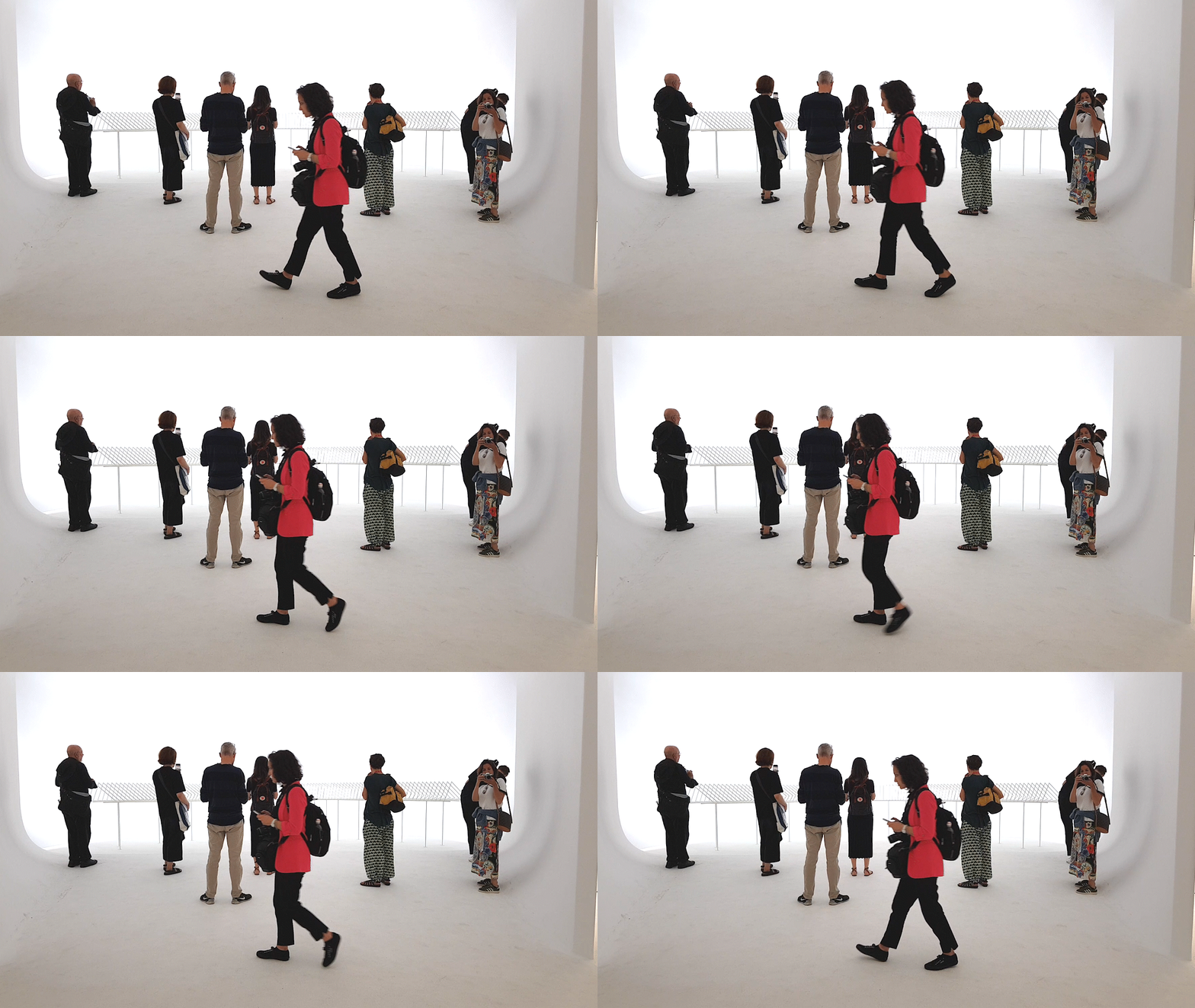
What is data-driven design? It’s a booming, cutting-edge industry that shapes the built environment and more than just physical space. With it, buildings, cities, public areas, transportation systems — nearly every facet of our environment — can be designed to help people live better lives in more satisfying ways. The data-driven design uses different types of information to create a living ecosystem for human beings: data about human behavior (emotions), data about the environment (light), data about building performance, and mechanical equipment (air conditioning). Once combined with artificial intelligence and deep learning applications like Generative Architecture, data-driven design can make buildings more efficient, inviting, and beautiful while improving the lives of people who use them.
Architecture with data is the presence of creative studios. You will be surprised to know the many ways in which machines are already shaping the buildings that you see. This meta-story explores what we can expect from this architectural trend and how it shapes our lives and societies of today.
The influence of data-driven architecture: What is the future of design, how will it impact our lives? Is this something we can expect soon?
The story describes what intelligent buildings look like and how they affect us. Data-driven architecture is already shaping our cities and economies. The trend has been evolving for years but has not yet reached its peak. So what does the future hold for data-driven architecture?
Data and buildings come together in many ways. For example, they can be combined to predict users’ behaviors, emotions, and interactions in facilities. The main advantage of predictive analytics is that it can provide deep insights into user behavior and needs based on the data collected. How this can be applied to building design will be described. Finally, we discuss the opportunities of combining building data with engineering data.
Users are willing to share data in exchange for customized spaces or experiences. Over 45% of U.S. consumers say they rarely or never find the perfect building, shape, or experience. 57% of U.S. consumers say they would share only a small or moderate amount of data with architects, studios, and developers to be offered homes in the right size and setting. 14% of users say they would not share any data.
As data-driven architecture increases, so makes the environmental impact of buildings. 43% of U.S. residents are concerned or very concerned about the environmental impact of developing and using their facilities. Only 7% say they are not worried at all. MLearning.ai Report
List of the most essential applications of deep learning in designing the personalized architecture of public buildings:
Predicting user’s emotions by analysis of :
1. Facial Expressions- Facial recognition algorithms help understand how each user feels when entering the space. The main tasks: reduce stress, recover, relax
2. Verbal Expressions — speech recognition and voice generation help understand how each user feels when entering the space. The main tasks: predict users’ needs, emotions, stress, and recovery.
3. Physiological Signals — sensors measure the user’s physiological signals. Sent the information to a central computer to analyze and control the environment.
4. Behavior Patterns — sensors track users’ behavior while in the space. This is used to control the room’s design to reduce stress and recover.
The report explores the opportunities of combining building data with engineering data. Next, it describes what data-driven architecture is currently and how it affects us in real life. What are the advantages? What are new trends we will see in the future? Finally, we dive into what smart buildings will look like and how they affect us.
Deep learning is the hot topic in machine learning, artificial intelligence, and data science. The report describes what deep learning is, how it works and how it can be applied to designing buildings. The main applications are:
1. Generative architecture — uses deep neural networks to predict users’ emotions and behaviors based on their facial expressions and body language. Users feel more relaxed, calm, and recovered when entering this type of space
2. Deep predictive analytics — Predictive analytics uses deep learning to predict how users react and behave in the space. This can be used to control the design to maximize comfort and recovery
3. Intelligent interaction — Interaction with human-like machines is becoming more sophisticated every day. The main features include facial recognition, voice generation, speech recognition, body tracking, video analysis, and implementing intelligent responses.
4. Room optimization — Optimization of interior design based on user profile data (by tracking their movement patterns detecting their physiological signals). This can lead to the optimized design of any space, such as a specific room, a specific area, or an entire building.
Plans for machine learning in architecture are already being implemented. How are they implemented? What advantages do they have? What are the limitations and why?
As technology progresses, new deep learning methods are constantly found, more efficient than machine learning. One of them is Generative Architecture using Deep Neural Networks developed by MLearning.ai. The implementation of Generative Architecture using Deep Neural Networks is described in detail- here.
The report discusses at length how Generative Architecture using Deep Neural Networks was designed by MLearning.ai and how it can be applied to architecture design, especially in interior design, lighting design, and space optimization.
The architecture’s features:
1. Adaptive control system — this enables the space to react to changes in the environment and adapt to new situations as soon as possible
2. Real-time analysis of human behavior — the system analyzes a person’s behavior as they enter the space and controls its features accordingly
3. Personalization of data-driven architecture — adaptive control system, real-time analysis of human behavior, visual display, and user preferences — create a personalized atmosphere in the space
4. Analyzing emotions — Facial recognition, body movement, and physiological sensors are used to uncover internal emotional states. This is done by analyzing their facial expressions and body language
5. Data-driven architecture tracking — Collective patterns of movement, physiological signals, and real-time analysis of human behavior are used to create a detailed profile of the user. This enables data-driven architecture utilities for tracking the user’s behavior
6. Optimization of data-driven architecture — this enables dynamic optimization of space design through studying how users interact with the space as they move through it and analyzing their activities
7. Intelligent interaction — Interaction with human-like machines is becoming more sophisticated every day. The main features include facial recognition, voice generation, speech recognition, body tracking, video analysis, and implementing intelligent responses.
8. Deep learning in architecture — Generative Architecture using Deep Neural Networks is applied to architecture design to enable architecture in a way that was not possible before. This is a revolution in architecture
The opportunities of combining building data with engineering data.
The main tasks for this combination:
1. Process building performance data obtained from multiple sources into the framework that can be processed by the deep learning algorithms
2. Integrate with deep learning algorithms to build a multi-modal decision support system.
A building is considered a living organism, and only one of its types is man’s living organism. The essence of life and a person, in particular, is his spiritual activity — abstract thinking, creativity, imagination, and dreams. A person’s behavior is the result of his past and present experiences. They constitute an individual’s personality, which depends on these experiences. Every new venture is a new stimulus for forming a unique individual’s personality.
MLearning.ai is a data-driven design company. It has a wide range of services. The company plans to implement the data-driven design in the public space, transport, and healthcare industry because it can improve people’s quality of life and reduce costs at the same time.
I invite you to explore the concept of “AI creativity” by reading and learning from the many articles found on MLearning.ai. Then, I encourage you to ask any questions you might have in the comments section below.
I’m curious about your opinion
- Check out my instagram with new material every week
- If you enjoyed this, follow me on Medium for more
- Want to collaborate? Let’s connect on LinkedIn
- https://linktr.ee/datasculptor
- 3D Machine Learning generated model on sketchfab


