avatarRuben Bouma

Free AI web copilot to create summaries, insights and extended knowledge, download it at here

3459

Abstract

K6Vu3Bry.jpg"><figcaption>Using bioactive therapeutic scaffolds, the longitudinal spinal cord section is treated. Regenerated axons (red) regrew within the lesion. Credit: Samuel I. Stupp Laboratory/Northwestern University</figcaption></figure><p id="357a">The synthetic materials are able to communicate with cells in 3 ways:</p><ul><li>Matching the matrix’s structure</li><li>Mimicking the motion of biological molecules</li><li>Incorporating signals for receptors</li></ul><p id="c787">The researchers found that fine-tuning the molecules’ motion within the nanofiber network to make them more agile resulted in greater therapeutic efficacy in paralyzed mice.</p><p id="6bcb">Moreover, during in vitro tests with human cells, the researchers confirmed that formulations of enhanced molecular motion performed better. This indicates increased cellular signaling and bioactivity.</p><blockquote id="e148"><p>“Receptors in neurons and other cells constantly move around. The key innovation in our research, which has never been done before, is to control the collective motion of more than 100,000 molecules within our nanofibers.”</p></blockquote><p id="d7f2">Stupp said.</p><blockquote id="155d"><p>“Given that cells themselves and their receptors are in constant motion, you can imagine that molecules moving more rapidly would encounter these receptors more often. If the molecules are sluggish and not as ‘social,’ they may never come into contact with the cells.”</p></blockquote><h1 id="6aef">Two signals</h1><p id="3b0e">Once the molecules are injected and attached to the receptors, two cascading signals are triggered, both of which are critical to spinal cord repair.</p><ul><li>One signal stimulates the regeneration of axons, the long tails of neurons in the spinal cord.</li></ul><p id="06b7">Axons send signals between the brain and the rest of the body. However, if the axons are damaged this can lead to loss of feeling in the body or in the worst-case scenario, paralysis. Repairing axons increases communication between the brain and body.</p><ul><li>The second signal stimulates the regrowth of lost blood vessels that feed neurons and critical cells for tissue repair.</li></ul><p id="d817">This signal helps neurons survive after injury because it causes other cell types to proliferate, therefore stimulating regrowth. Moreover, it promotes the rebuilding of myelin around axons and reduces glial scarring. The latter acts as a physical barrier that prevents the spinal cord from healing.</p><blockquote id="ba7c"><p>“The signals used in the study mimic the natural proteins that are needed to induce the desired biological responses. However, proteins have extremely short half-lives and are expensive to produce.”</p></blockquote><p id="b403">Commented Zaida Álvarez, the study’s first author.</p><blockquote id="8a47"><p>“Our synthetic signals are short, modified peptides that — when bonded together by the thousands — will survive for weeks to deliver bioactivity. The end result is a therapy that is less expensive to produce and lasts much longer.”</p></blockquote><p id="188b">The video below demonstrates the working mechanisms behind the therapy.</p> <figure id="08cb"> <div> <div> <img class="ratio" src="http://placehold.it/16x9"> <iframe class="" src="https://cdn.embedly.com/widgets/media.html?src=https%3A%2F%2Fwww.youtube.com%2Fembed%2FQ_xvCE904YU%3Ffeatu

Options

re%3Doembed&display_name=YouTube&url=https%3A%2F%2Fwww.youtube.com%2Fwatch%3Fv%3DQ_xvCE904YU&image=https%3A%2F%2Fi.ytimg.com%2Fvi%2FQ_xvCE904YU%2Fhqdefault.jpg&key=a19fcc184b9711e1b4764040d3dc5c07&type=text%2Fhtml&schema=youtube" allowfullscreen="" frameborder="0" height="480" width="854"> </div> </div> </figure></iframe></div></div></figure><p id="9c36">Credit: Northwestern University</p><h1 id="c317">Universal application</h1><p id="3c97">Besides the possibility that the new therapy could be used to prevent paralysis after diseases or major trauma incidents (sports accidents, automobile accidents, gunshot wounds, and falls).</p><p id="1ead">The “supramolecular motion”, the underlying discovery, is a key factor in bioactivity, therefore, researchers believe that it also can be applied to other targets and therapies.</p><p id="76a0">Stupp said:</p><blockquote id="7507"><p>“The central nervous system tissues we have successfully regenerated in the injured spinal cord are similar to those in the brain affected by stroke and neurodegenerative diseases, such as ALS, Parkinson’s disease, and Alzheimer’s disease. Beyond that, our fundamental discovery about controlling the motion of molecular assemblies to enhance cell signaling could be applied universally across biomedical targets.”</p></blockquote><p id="c085">Thank you for your interest in science! Feel free to put questions, comments, and suggestions for future articles in the comment section.</p><p id="f760"><b>If you want to support:</b></p><ul><li>If you are not a <b>Medium</b> member yet, you can <a href="https://r-bouma98.medium.com/membership"><b>my referral link</b></a><b> </b>so I can get a part of your fees from <b>Medium</b>, you don’t pay any extra.</li><li>Subscribe to <a href="https://r-bouma98.medium.com/subscribe"><b>my Newsletter</b></a><b> </b>to get best tutorials, research, education, and scientific-based tools for everyday life directly in your email inbox.</li></ul><p id="54c7">While you’re here, check out one of my other articles.</p><div id="2023" class="link-block"> <a href="https://readmedium.com/creatine-supplementation-and-brain-health-efb62a25e2ea"> <div> <div> <h2>Creatine Supplementation and Brain Health</h2> <div><h3>Research suggests creatine as a potential booster for human brain function.</h3></div> <div><p>medium.com</p></div> </div> <div> <div style="background-image: url(https://miro.readmedium.com/v2/resize:fit:320/1*X4B64I0gdjIaw-6EcTBLqg.jpeg)"></div> </div> </div> </a> </div><div id="8dd3" class="link-block"> <a href="https://readmedium.com/consciousness-heres-how-the-neurochemical-dopamine-plays-a-key-role-bab8a5152736"> <div> <div> <h2>Consciousness: Here’s How The Neurochemical Dopamine Plays A Key Role</h2> <div><h3>Dopamine produced in the brain may play a key role in consciousness, a new study suggested.</h3></div> <div><p>medium.com</p></div> </div> <div> <div style="background-image: url(https://miro.readmedium.com/v2/resize:fit:320/0*yegWvACjoRnaZ_Wi.jpg)"></div> </div> </div> </a> </div></article></body>

“Dancing Molecules” Reverses Paralysis in Spinal Cord Injuries

Researchers have developed a new injectable therapy that repairs tissue damage and reverses paralysis in mouse models.
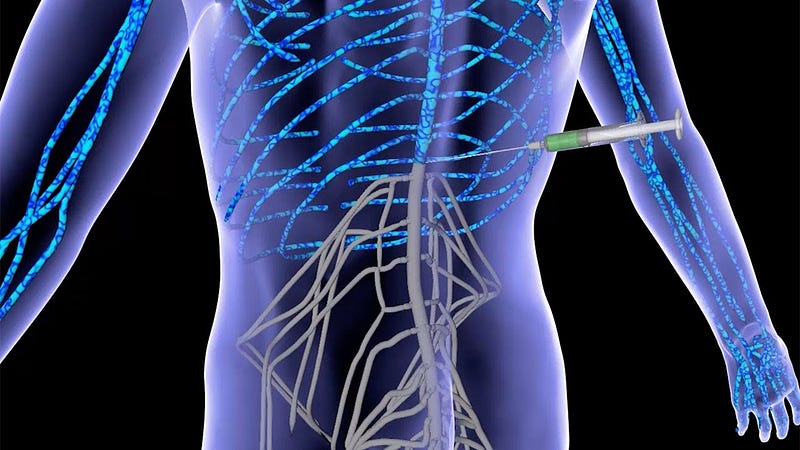
Image credit: Northwestern University

Northwestern University researchers have developed a new injectable therapy that mobilizes “dancing molecules” to reverse paralysis and repair tissue after severe spinal cord injuries.

In the new study, published in the Nov.12 issue of the journal Science, researchers administered a single injection to tissues surrounding the spinal cords of paralyzed mice. The animals regained the ability to walk after just 4 weeks.

Incredible.

The breakthrough therapy greatly improved severely injured spinal cords by sending bioactive signals to trigger cells to regenerate and repair.

Improvements happened in 5 key ways:

  • The severed extensions of neurons, called axons, regenerated
  • Scar tissue, which can create a physical barrier to regeneration and repair, significantly diminished
  • Myelin, the insulating layer of axons that is important in transmitting electrical signals efficiently, reformed around cells
  • Functional blood vessels formed to deliver nutrients to cells at the injury site
  • More motor neurons survived

The materials biodegrade into nutrients for the cells within 12 weeks, after the therapy performs its function, and then completely disappear from the body without noticeable side effects.

This is the first time that researchers controlled the collective motion of molecules through changes in chemical structure to increase a therapeutic’s efficacy.

Samuel I. Stupp, who led the study, and is on the Board of Trustees Professor of Materials Science and Engineering, Chemistry, Medicine and Biomedical Engineering at Northwestern, where he is founding director of the Simpson Querrey Institute for BioNanotechnology (SQI) and its affiliated research center, the Center for Regenerative Nanomedicine commented:

“Our research aims to find a therapy that can prevent individuals from becoming paralyzed after major trauma or disease. For decades, this has remained a major challenge for scientists because our body’s central nervous system, which includes the brain and spinal cord, does not have any significant capacity to repair itself after injury or after the onset of a degenerative disease. We are going straight to the FDA to start the process of getting this new therapy approved for use in human patients, who currently have very few treatment options.”

‘Dancing molecules’ hit moving targets

Tuning the motion of molecules is the secret of this therapeutic therapy. In this way, molecules can find and properly engage constantly moving cellular receptors. the therapy immediately gels into a complex network of nanofibers that mimic the extracellular matrix of the spinal cord, after it is injected as a liquid.
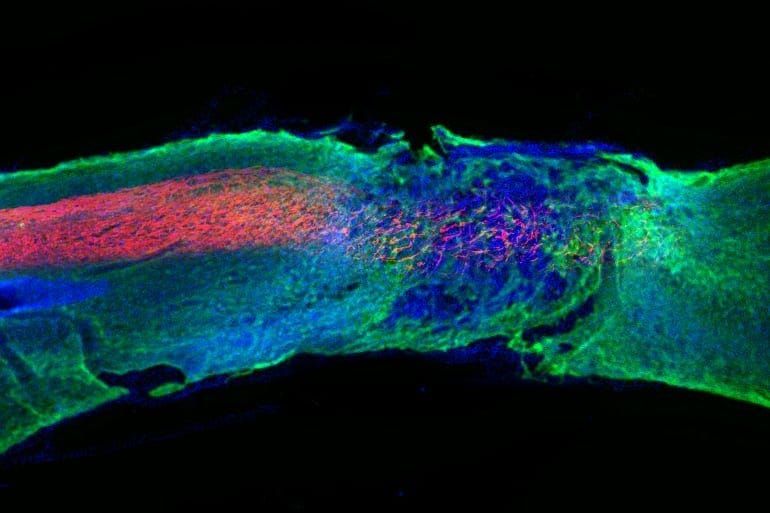
Using bioactive therapeutic scaffolds, the longitudinal spinal cord section is treated. Regenerated axons (red) regrew within the lesion. Credit: Samuel I. Stupp Laboratory/Northwestern University

The synthetic materials are able to communicate with cells in 3 ways:

  • Matching the matrix’s structure
  • Mimicking the motion of biological molecules
  • Incorporating signals for receptors

The researchers found that fine-tuning the molecules’ motion within the nanofiber network to make them more agile resulted in greater therapeutic efficacy in paralyzed mice.

Moreover, during in vitro tests with human cells, the researchers confirmed that formulations of enhanced molecular motion performed better. This indicates increased cellular signaling and bioactivity.

“Receptors in neurons and other cells constantly move around. The key innovation in our research, which has never been done before, is to control the collective motion of more than 100,000 molecules within our nanofibers.”

Stupp said.

“Given that cells themselves and their receptors are in constant motion, you can imagine that molecules moving more rapidly would encounter these receptors more often. If the molecules are sluggish and not as ‘social,’ they may never come into contact with the cells.”

Two signals

Once the molecules are injected and attached to the receptors, two cascading signals are triggered, both of which are critical to spinal cord repair.

  • One signal stimulates the regeneration of axons, the long tails of neurons in the spinal cord.

Axons send signals between the brain and the rest of the body. However, if the axons are damaged this can lead to loss of feeling in the body or in the worst-case scenario, paralysis. Repairing axons increases communication between the brain and body.

  • The second signal stimulates the regrowth of lost blood vessels that feed neurons and critical cells for tissue repair.

This signal helps neurons survive after injury because it causes other cell types to proliferate, therefore stimulating regrowth. Moreover, it promotes the rebuilding of myelin around axons and reduces glial scarring. The latter acts as a physical barrier that prevents the spinal cord from healing.

“The signals used in the study mimic the natural proteins that are needed to induce the desired biological responses. However, proteins have extremely short half-lives and are expensive to produce.”

Commented Zaida Álvarez, the study’s first author.

“Our synthetic signals are short, modified peptides that — when bonded together by the thousands — will survive for weeks to deliver bioactivity. The end result is a therapy that is less expensive to produce and lasts much longer.”

The video below demonstrates the working mechanisms behind the therapy.

Credit: Northwestern University

Universal application

Besides the possibility that the new therapy could be used to prevent paralysis after diseases or major trauma incidents (sports accidents, automobile accidents, gunshot wounds, and falls).

The “supramolecular motion”, the underlying discovery, is a key factor in bioactivity, therefore, researchers believe that it also can be applied to other targets and therapies.

Stupp said:

“The central nervous system tissues we have successfully regenerated in the injured spinal cord are similar to those in the brain affected by stroke and neurodegenerative diseases, such as ALS, Parkinson’s disease, and Alzheimer’s disease. Beyond that, our fundamental discovery about controlling the motion of molecular assemblies to enhance cell signaling could be applied universally across biomedical targets.”

Thank you for your interest in science! Feel free to put questions, comments, and suggestions for future articles in the comment section.

If you want to support:

  • If you are not a Medium member yet, you can my referral link so I can get a part of your fees from Medium, you don’t pay any extra.
  • Subscribe to my Newsletter to get best tutorials, research, education, and scientific-based tools for everyday life directly in your email inbox.

While you’re here, check out one of my other articles.

Health
Neuroscience
Education
Self Improvement
Spinal Cord Injury
Recommended from ReadMedium