
Creatine Supplementation and Brain Health
Research suggests creatine as a potential booster for human brain function.
The compelling and robust body of evidence of ergogenic — enhancing physical performance — effects of creatine supplementation (5 g/day) are well-documented. Besides the evidence supporting its efficacy in increasing exercise performance/muscle function, muscle strength, and lean mass, there is literature suggesting that creatine may also be beneficial for brain health.
Creatine can be derived from meat sources and it can also be supplemented. In the fitness world, creatine is used to bring more water into the muscle, and into the body generally.
Creatine has also been shown to have an important role in brain function. It can be used as a fuel source in the brain and there is some evidence suggesting that it can enhance certain cortical functions that connect to areas of the brain involved in mood regulation and motivation, indicating a role of creatine supplementation in mild depression.
However, there is now ample evidence that creatine supplementation can enhance brain function in certain contexts. A recently published review in Nutrients named ‘Creatine Supplementation and Brain Health’ revealed there is a potential for creatine supplementation to improve cognitive processing in conditions characterized by brain creatine deficits.
Effects of Creatine Supplementation on Brain Creatine Levels
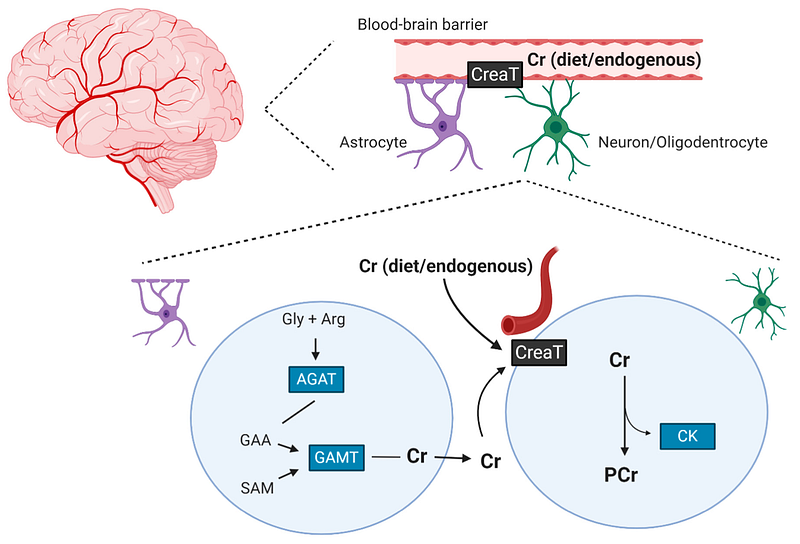
The brain can synthesize creatine while the muscle entirely relies on dietary ingestion and endogenous synthesis from the liver, kidneys, and pancreas. The necessary enzymatic apparatus are found in the nervous system while the creatine transporters are found in neurons, oligodendrocytes cells, and at the blood-brain barrier. The figure below illustrates endogenous creatine synthesis in the brain and its transport across the blood-brain barrier.
Brain creatine concentrations are affected by aging and other factors related to aging including depression, schizophrenia, panic disorder, and reduced brain and/or physical activity. The overlap between these factors may be misleading as to what might be identified as an age-related decline.
The available literature suggests significant increases in both creatine and phosphocreatine (PCr)— a molecule that serves as a rapidly mobilizable reserve of high-energy phosphates to recycle adenosine triphosphate (ATP), the energy currency of the cell — averaging about 5 to 10%, which is half the increase seen in muscle creatine or PCr.
Effects of Creatine Supplementation on Cognition
The current literature in elderly individuals is quite contradictory on the effects of creatine supplementation on cognitive performance. While one study showed improved cognitive performance, another study found that creatine was ineffective. Recently, however, a pilot study found increased cognitive performance (and handgrip strength) after a 16-week intervention combining creatine supplementation and exercise training. The results, however, are insufficient by the absence of an exercising control group and inconsistent cognitive performance across time.
Creatine supplementation is especially useful for people who are not consuming any meat — vegetarians — or other sources of food that are rich in creatine. One study found improved cognitive function in vegetarians after creatine supplementation while another study found greater effects on memory in vegetarians compared to omnivores.
Interestingly, one study found comparable brain creatine concentrations between meat-eaters and vegetarians, which undermines the theory that vegetarians should respond better than meat-eaters due to lower pre-supplementation brain creatine.
For athletes, improvements in cognitive processing capability could be useful. Key aspects of performance such as reaction time, coordination, decision making, motor control, and other cognitive tasks may be affected by mental fatigue. Next to the ergogenic role creatine may play, it also may limit mental fatigue, thus promoting performance.
Indeed, one study showed that creatine is effective in reducing the effects of sleep deprivation on throwing accuracy in rugby players, while no effect was observed on passing accuracy in non-stressed soccer players. Although brain creatine levels were not assessed in these studies, raising uncertainty whether changes in brain creatine are responsible for the observed results. Still, the differences in results could be related to the suggestions that creatine is most effective under stressed cognitive conditions such as sleep deprivation.
Creatine Supplementation and Brain Injury, Concussion, and Hypoxia
The alteration of ATP demand due to hypoxia and reduced blood flow is one of the characteristics of traumatic brain injury. The authors reported:
Importantly, brain creatine is reduced following a mild traumatic brain injury (mTBI), making creatine supplementation, and subsequent increase in brain creatine, a potentially valuable strategy to reduce the severity of, or enhance recovery from, mTBI or concussion by offsetting negative changes in energy status. The duration of the dysregulation in brain energy metabolism is not clearly defined, but could remain for weeks if not years.
In a cohort study, retired National Football League (aged 40 to 69) who had experienced repetitive head impacts during their career reported complaints of cognitive and/or behavioral/mood symptoms many years later. Researchers found a relationship between decreased brain creatine in the parietal white matter and greater exposure to repetitive head impacts.
Additionally to its role in alleviating the cellular energy crisis induced by injury, creatine could potentially lessen other features of mTBI, such as inflammation, mitochondrial dysfunction, nerve damage, oxidative stress, and membrane disruption leading to calcium influx.
One study mimicked the effects of mTBI and found that creatine supplementation increased brain creatine and cognitive processing during oxygen deprivation. Furthermore, animal models are used to study the effects of creatine supplementation on TBI. A significant reduction in brain damage following TBI in both mice (36%) and rats (50%) was observed. Although these results are compelling, however, it is difficult to generalize those data to the general population because creatine supplementation increases brain creatine levels by roughly 10%.
Conclusion
As has been documented elsewhere and is grounded with an abundance of scientific data, creatine supplementation has documented muscular performance benefits, has a strong safety profile, is inexpensive, and is widely available.
Moreover, encouraging supplementation to reduce damage or enhance recovery from mTBI would ordinarily be considered premature. However, the authors of this paper stated the following:
There is a potential for creatine supplementation to improve cognitive processing, especially in conditions characterized by brain creatine deficits, which could be induced by acute stressors (e.g., exercise, sleep deprivation) or chronic, pathologic conditions (e.g., creatine synthesis enzyme deficiencies, mTBI, aging, Alzheimer’s disease, depression).
Further research is needed to obtain the same grounded scientific data for creatine supplementation to improve cognitive processing in conditions characterized by brain creatine deficits, as already has been done for the muscular performance benefits.
Thank you for your interest in science! Feel free to put questions, comments, and suggestions for future articles in the comment section.
If you want to support:
- If you are not a Medium member yet, you can my referral link so I can get a part of your fees from Medium, you don’t pay any extra.
- Subscribe to my Newsletter to get best tutorials, research, education, and scientific-based tools for everyday life directly in your email inbox.
While you’re here, check out one of my other articles.