
Better Than Steroids? Magical Cooling Glove Lends Athletes a Hand
Stanford researchers developed a cooling glove that boosts exercise performance and recovery.
Imagine a product that could eradicate muscle fatigue in just minutes. Allow you to recover exponentially faster and train substantially harder. Significantly boosting your endurance, strength, and overall athletic performance while maximizing your training efficiency.
Sounds good to be true? Absolutely, at least without failing a drug test.
But what if I told you it’s neither a drug nor illegal. Sounds impossible right?
Apparently, cooling the palm of your hand using some kind of ‘cooling glove’ reduced core temperature levels and eliminated muscle fatigue.
“I expect this [cooling glove] will be either everywhere in pro sports in a couple of years or banned.” ~ Jason Snell — tech columnist on the RTX Cooling Glove
Next to sports athletes using this device, the United States Military Defense department did extensive research on this topic. Even firefighters and Mixed Martial Arts fighters are interested in using this glove.
Thermoregulation
First, let’s back up.
To understand the effects of this cooling glove, we first have to dive deeper into the biology of muscle fatigue and thermoregulation.
One of the biggest limiters in athletic performance is elevated core temperature. During your workout, muscle cells in your body start to heat up due to the exertion. Your body does its best to dump this extra heat via a process called arteriovenous anastomoses (AVA).
AVA’s are a fascinating aspect of how we humans and animals are built. Normally blood goes from the arteries to little capillaries, to the veins, and then back to the heart. However, in the palms of our hand, the bottom of our feet, and in our upper face, the blood goes directly from the arteries to the veins. In those three hairless areas on our body — we don’t have any hair follicle cells there — we can dump heat rapidly from our bodies.
In the really hot summer months, when you’re going to overheat really fast, people tend to cool off their bodies by placing a wet towel or icepack on their necks.
This is a terrible idea because you can literally cook your organs.
Yes, you read that right. When you place an icepack or wet towel on your neck, you cool the blood going to the brain and the brain thinks you’re cooling off. Next, the hypothalamus is going to heat the body which can result in people cooking their organs. Literally...
So the best way to reduce your core temperature is by cooling off the heat coming from the palms of your hands, the bottom of your feet, or the upper face.
Let’s go back to the AVA’s.
Craig Heller, physiology and biology professor at Standford, and his colleague David Grahn wrote a paper about the effects of enhancing the thermal exchange of AVA’s — networks of veins exclusively devoted to rapid temperature management a.k.a radiator-like structures — in humans. They reported two findings:
“We have quantified the area-specific heat loss from glabrous skin (palms and face) and nonglabrous skin (upper arm, back, thigh, and abdomen). Results show that the heat loss from the nonglabrous skin does not change appreciably over the course of exercise in the heat, whereas the heat loss from the glabrous skin rises to values more than five times that of the nonglabrous skin.”
And
“The application of a mild vacuum increases the heat loss from the glabrous skin by an additional 33%. The effect of cooling of these different skin areas on the heart-rate response to a fixed exercise load was significantly greater for the glabrous than the nonglabrous skin. The intermittent application of vacuum cooling to the palms of individuals exercising in a hot environment had the effects of lowering the rate of rise of core temperature and enhancing performance.”
So, if you decide to continue to push yourself during your workout, not cooling your palms in between sets, your core temperature will continue to rise, compromising the effectiveness of a heat-sensitive enzyme crucial for energy production called pyruvate kinase.
The result? Fatigue, weakness, and cramping.
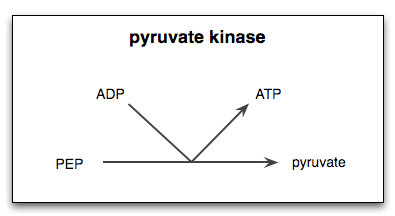
For example, when you do a set of bicep curls your bicep is heating up and eventually, you hit failure. The reason you hit failure is not that you didn’t have the strength to do it, it’s because muscle contraction is dependent on the enzyme pyruvate kinase. So when the muscle heats up, pyruvate kinase can’t work and thus can not convert energy into ATP.
The heating of the muscle tissues is the reason you hit failure. So when you cool the body at its core, pyruvate kinase can continue to convert energy into ATP and the muscles keep contracting.
The Cooling Glove
The study of thermoregulation in the performance and recovery context is hardly new. Athletes have been experimenting with cryotherapy, ice packs, ice baths, and ice vests for decades.
The problem with most of these techniques is that they just don’t work all that well. It has do to with a physiological thing called vasoconstriction. Overwhelming cold causes blood vessels to constrict, slowing cool blood flow to the core and thus undermining elevated core temperature reduction.
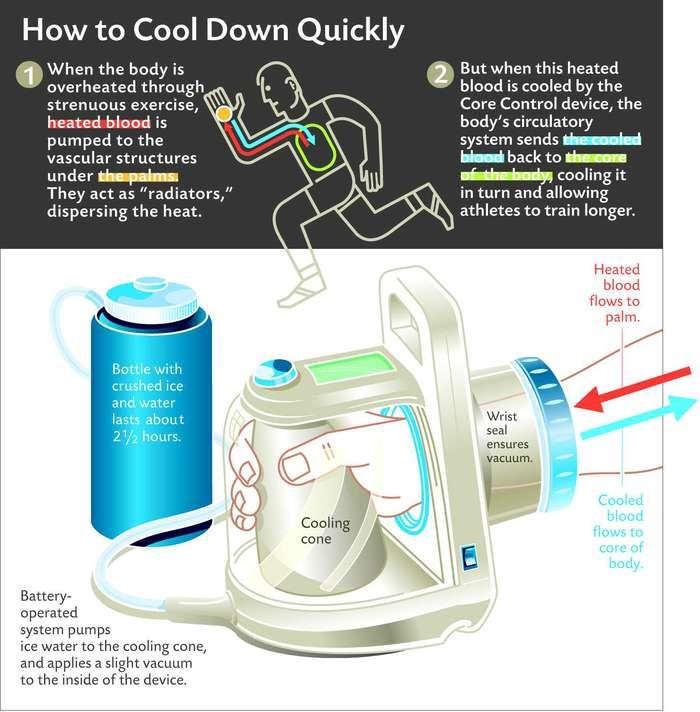
Enter the RTX Cooling Glove. It’s an apparent solution for core temperature regulation without that vasoconstriction thing going on. It’s made by a team led by Craig Heller.
Essentially a plastic hand enclosure is attached to a pump that circulates water across the palm’s special network of radiator-like heat-transfer veins, i.e., AVA’s, that specializes in something called rapid thermal exchange (RTX).
By strictly regulating the cool water temperature (cool but not too cool), the glove overcomes the vasoconstriction problem. Moreover, the glove creates a slight vacuum around the hand to keep the blood vessels open in the hand.
Cool blood then gets distributed directly to the core organs most in need of relief, allowing the body to chill out and the muscles to keep producing energy.
Studies Show Promising Results
After Craig Heller and his team used AVA’s to heat anesthetized patients who were hypothermia after surgery, they realized that they could reverse this mammalian adaptation for heat loss in people who recover from hyperthermia.
A friend of Heller’s lab and a seasoned gym rat, Vinh H. Cao, was asked to train in Heller’s lab for a few weeks so they could study his performance when he was overheated during his workout.
It’s more a positive anecdotal story than a real one-person study but I want to share it so you could see the positive results of cooling the palm of your hand in between sets.
First, Heller’s friend performed 10 sets of pull-ups. In the first set, he did 15–20 reps, second set like 14 reps, and it declined further after that. In 6 weeks he went from 100 to 180 pull-ups in 10 sets, when he just used his normal workout routine.
In the next 6 weeks, the only thing that had changed was that they were cooling him in between every set of pull-ups. He increased his pull-up maximum from 180 to over 620 by utilizing the glove in between sets.
More than a 3-fold increase in the maximum amount of repetitions. In just 6 weeks. Astounding.
Craig Heller said:
“Cooling enables you to increase the capacity of your workout. If you increase the capacity of your workout, you get a conditioning effect. So essentially in order to get the gains, you cool. But once you get the gains, you keep them. So you don’t have to keep cooling to maintain the conditioning effect.”
Based on these results, Heller and his colleagues repeated the above-mentioned ‘study’ in a similar way, but now from a more scientific perspective. They assessed the impact of palm cooling on work volume and strength training when participants completed biweekly bench press or pull-up exercises for multiple successive weeks. Palm cooling was applied for 3 minutes between sets of exercise.
The results of this study were:
- Over 3 weeks of bench press training, palm cooling increased work volume by 40% (vs. 13% with no palm cooling).
- Over 6 weeks of pull-up training, palm cooling increased work volume by 144% in pull-up experienced subjects (vs. 5% over 2 weeks with no cooling).
- Over 6 weeks of pull-up training, palm cooling increased work volume by 80% in pull-up naïve subjects (vs. 20% with no cooling).
- Strength — 1 repetition maximum (a measure of strength) — increased 22% over 10 weeks of pyramid bench press training.
The authors of this paper even concluded that palm cooling shows greater strength improvements than athletes who use performance-enhancing drugs, such as steroids.
“In bench press–based studies of a similar design and duration as reported here, the strength improvements attributed to the use of anabolic-androgenic steroids (AAS) were proportional to the duration of the treatment, for example; 9% improvement in 3 weeks of training, 15% improvement in 6 weeks, and 22% improvement in 10 weeks. Despite minor differences in experimental methods, the bench press 1RM improvements observed in this study (4 weeks of training with interset rest only followed by 6 weeks of training with palm cooling during interset rest) were greater than those attributed to 6 weeks of training with AAS supplementation and equivalent to those attributed to 10 weeks of training with AAS supplementation.”
Craig Heller’s colleague and co-author of this paper Dennis Grahn commented on this finding:
“Everyone in sports knows that if you stick a syringe full of steroids in a padded area of your body it will make you play better. Well, we want to say, ‘Instead of that, try sticking your hand in the Glove for three minutes and you’ll play better.”
A recently published study used a randomized control trial to examine intermittent palm cooling’s impact on rowing ergometry. They found numerous significant differences.
Intermittent palm cooling as they rowed showed a significant workout effect — the total distance rowed. Moreover, they found physiological inter-workout differences for heart rate and blood lactate concentrations. The authors of this paper reported:
“We conclude that lower heart rates and blood lactate concentrations from intermittent cooling caused subjects to experience less fatigue during those workouts and enabled more work to be performed.”
Conclusion
Although more research needs to be done, we can definitely say that this cooling glove has the potential to revolutionize professional sports performance and recovery.
Because temperature is a primary limiting factor for performance, the enzyme pyruvate kinase begins to deform into an inactive state as the muscle heats up. David Grahn said:
“Your muscle cells are saying, “You can’t work that hard anymore, because if you do you’re going to cook and die,’”
When you cool the muscle cell, you return the enzyme to the active state, essentially resetting the muscle’s state of fatigue. By quickly pulling the heat away from the palm and fingers or soles of the feet, this glove taps into the body’s real cooling system working like a heat exchanger.
Maybe this device will be banned in the future. Maybe not. We shall see. But I do know that a lot of professional sports teams and athletes use this cooling glove.
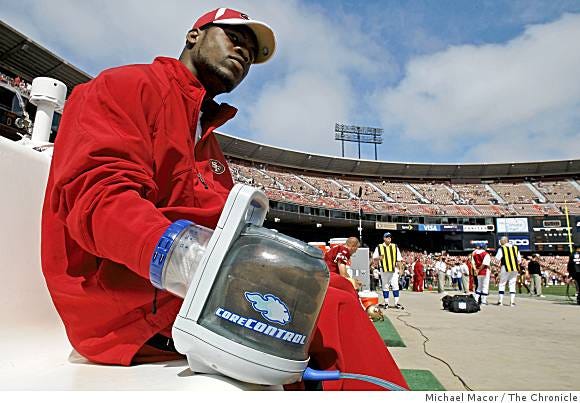
Right now several Olympic teams (US Men’s Beach Volleyball Team, Japanese Olympic Team, British Track & Field Team), teams from the NFL (San Fransisco 49ers, Seattle Seahawks), NBA teams (Golden State Warriors, Boston Celtics), and the Premier League teams Manchester United FC and Chelsea FC are using the cooling glove.
But perhaps the most notable is the 2014 World Cup Champion German football team, they used the cooling glove throughout training and World Cup matches.
Disclaimer: I have zero professional or financial affiliation with AVAcore (the company behind the glove) or with Craig Heller and David Grahn. In fact, I’ve never even tried this technology myself (although I would love to try this device during my workouts). The reason that I highlight this cooling glove is that I’m fascinated by the biological working mechanisms of the heat exchangers in our bodies and how one can leverage that.
Thank you for your interest in science! Feel free to put questions, comments, and suggestions for future articles in the comment section.
If you want to support:
- If you are not a Medium member yet, you can my referral link so I can get a part of your fees from Medium, you don’t pay any extra.
- Subscribe to my Newsletter to get best tutorials, research, education, and scientific-based tools for everyday life directly in your email inbox.
While you’re here, check out one of my other articles.