Our “Win at All Costs” Sports Culture Encouraged Russia’s Abuse of its Child Athletes
Figure Skating fans knew of Kamila Valieva’s abuse BEFORE the Olympics.
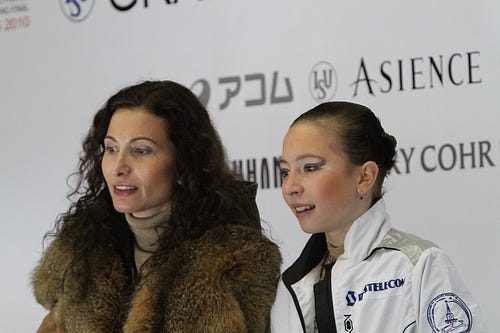
By now, unless you don’t have electricity, you’ve probably at least heard of the fallout from the final event in figure skating of the 2022 Olympics, regardless of whether or not you follow sports, as I don’t. Former figure skater Johnny Weir has become a pivotal outspoken voice regarding the doping scandal where the skating phenom, 15-year old Kamila Valieva, was revealed to have had three different heart medications in her system from a December drug test.
Valieva’s “entourage”, including her now-notorious coach, Eteri Tutberidze, has hilariously attempted to deny that anyone from the Russian Olympic Committee (ROC) had engaged in administering the banned drugs to their minor athletes, claiming that they must have gotten into the 15-year old’s system from her grandfather’s meds that just coincidentally all seem to be concocted for endurance enhancement.
Absolutely no one with at least half a brain is buying that, with the strange exception of the Court of Arbitration for Sport (CAS panel), as Russia has been implicated in state-sanctioned doping of their athletes before, in addition to the unlikeliness that Valieva “accidentally” ingested the amount of substance found in her system.
Weir and fellow Olympic commentator (who is also a former competitive ice skater) Tara Lipinski frequently lamented the decision of the CAS panel to let Valieva continue competing because she is a “protected person” due to her age throughout their interviews and commentary, and I had once felt that they were doing an excellent job standing up against what clearly is not only unfair to the clean athletes but potentially damaging to Valieva herself.
Well, now I’ve changed my mind.
For you see, the sad reality is that Weir, and likely every other person closely involved with figure skating knew of the shocking nature of the Russian training “techniques” that produce these youthful prodigies, which were unbeknownst to me as someone mostly ignorant to sports in general.
I had wondered why the skaters coming out of Russia were said to be able to accomplish feats that little or no female American skaters could, such as the coveted “quad” turns that apparently earn them untouchable scores in the sport. Does Russia really just have a more talented population of humans or better work ethic, as I’m sure they’d love people to believe and for that to be a fact?
Nah, the truth is that, in addition to the higher public interest in their country and the presence of elite, state-sponsored training academies, young children are subjected to a series of egregious abuses, with doping merely scratching the surface.
There is absolutely no way that Weir was or is unaware of this, given his proficiency and understanding of the sport and knowledge of how these little girls are excelling. In fact, people in the industry have a saying for skaters trained by Eteri; that they are “one-and-done” or that there is an “Eteri Expiration date” because they only compete in one Olympics before discontinuing elite-level skating due to injuries as teenagers.
In order to complete the airborne quad turns that most skaters find impossible, it is ideal to be extremely thin and lightweight, therefore, it is an “open secret” that Russian trainers make attempts to delay puberty through the use of strict powdered diets and medication that induces menopause. They are weighed daily and subjected to various forms of verbal and physical torment while being forced to practice with injuries.
As it is the case that puberty often causes young skaters to lose their ability to do advanced jumps, the frequent emergence of eating disorders has been reported among young female figure skaters in a sport where the scoring system specifically rewards the most difficult jumps over other elements.
Therefore, Olympic figure skating is innately designed to encourage these dangerous practices, but what do the Olympic committees do to prevent harmful training methods for children?
Nothing.
The skills that are best performed by prepubescent bodies are rewarded, therefore there is a strong incentive for unscrupulous coaches to push out skaters as young as possible with stunted growth, and the various Olympic organizations still permit children to compete with the adults, despite acknowledging that subjecting them to adult rules would cause “irreparable harm.”
Also, the Olympics permitted the supposed-to-be-banned Russian teams to compete simply because they changed their name to “Russian Olympic Committee”, and when they proceeded to get caught doping again, they were still allowed to compete with some stipulations, leading to Valieva’s disastrous final performance where she fell twice and was subsequently subjected to very public devastation that likely led to higher ratings for the television networks.
It just boggles my mind that Weir and Lipinski are acting as though they are just now realizing that something is wrong with Russia’s team’s conduct and their systemic permittance of actual child abuse — well actually, no, it’s even worse — Weir had actually visited the elaborate training center of the “Eteri girls”, Sambo-70, and had nothing but praise during his visit. He seems to have developed an affinity for Russia and their training methods.
I have yet to discover any objection to Eteri receiving the International Skating Union’s inaugural “Best Coach” award as recent as 2020, while audiences continued to be mesmerized by her immensely talented but abused pupils. In a disturbing display of tone-deafness, Ted Barton, the executive director of Skate Canada, referred to Tutberidze’s child-age trainees as a “stable of thoroughbred horses.”
Praising the girls without acknowledging the unacceptable “training methods” that they endure serves to do nothing but encourage Russia to continue these tactics, aiming to continue to impress the world with their reigning skating champions and their dominion of the podium.
And for what? Because people want to apply a feel-good narrative to sports, telling themselves that excellence is the result of enviable hard work and virtuous character. Certainly the better an athlete is, the stronger the nation they are from must be, or something preposterous like that. We treat sports players like they are soldiers going to war, therefore their harsher training methods are a necessity.
That’s why these nations have some level of pride over athletes “bringing them” a gold medal. It’s the reason why Lipnitskaya earned herself a hug and kiss from Vladimir Putin when she captivated audiences during the 2014 Olympics in Sochi, Russia, and Tutberidze, the country’s “Order of Honor” when her trainees took gold in the 2018 Winter Olympics.
It’s this romanticism of sports culture that has allowed us to willfully remain blind to these treacherous realities staring us in the face. Disregarding the welfare of children — not “spirit, passion, and determination” — is mostly responsible for the perfection exhibited by Eteri’s prodigies.
These same delusions led to the opposition some had against Simone Biles dropping out of several gymnastics events due to the “twisties” in the 2021 Summer Olympics last year, many of them drawing comparisons to and praising former gymnast Kerri Strug, who limped to the end of the runway to complete a vault on an injured ankle at her coach’s request, risking further damage to her tendons. Considered a “national sports hero” instead of a malleable victim, after being treated for a “third-degree lateral sprain”, she had several television appearances, met with President Clinton and was placed on the cover of magazines and cereal boxes. The sad irony is that the U.S. would have won anyway if she had refused.
While Simone Biles ultimately came away from that controversy riding high as a selfless advocate for “mental health”, such a narrative was likely only allowable because she had been such a prolific winner in the past. It’s doubtful that someone who hadn’t amassed so many accolades, including previous gold medals, would be praised for refusing to compete. Only winners get to refuse to risk their lives over a sport.
We have limitations on how much we care about the welfare of athletes and Russia is following suit.
Frankly, it’s absurd. It’s absurd that Weir and others are quite literally crying over the circumstances surrounding the doping but weren’t speaking out against the eating disorders, water deprivation, and inevitable drugging we haven’t found out about that has been going on throughout these girls’ childhoods. It’s almost as though no one cares because doping the girls before the Olympics as well as abusing them is not against the Olympic rules.
Not to mention the outcry, even acknowledged by Olympic International Committee President Thomas Bach who professed to be “disturbed” by the “tremendous coldness” over the coach saying to Valieva “Why did you let it go? Explain to me, why? Why did you stop fighting? You let it go after that axel. Why?”
I mean, it’s relatively harsh given the circumstances, but I’d wager that Eteri was actually trying to pretend to be nice here. I bet Valieva is used to much worse and this is the extent of what her coach is willing to commit in front of an international camera lens.
To me, Bach’s sentiment honestly feels like it’s for show, as the entire world was putting the situation under a microscope. Of course, Russia, clearly frazzled by the commentary, defended their actions. A spokesperson for President Vladamir Putin said “the harshness of a coach in high-level sport is key for their athletes to achieve victories.” So there you have it.
Ultimately we cannot control the actions of another country, but we can send them a message. We can show them that their legacy is not one of superior athletic talent and perseverance, but a willingness to commit unspeakable harm to vulnerable little girls, not to mention cheating.
An example needs to be made of them on the international stage that is the Olympics. Kids don’t belong in such an event, for starters. If that means no impressive quadruple jumps, SO BE IT. There are more important things in life than being “the best” at some arbitrary man-made game, and people literally seem to forget that.


