Sha’Carri Richardson is Right to be Outraged, but Evidence for Racism is Still Nil
Pretty much everyone except Russia agrees.
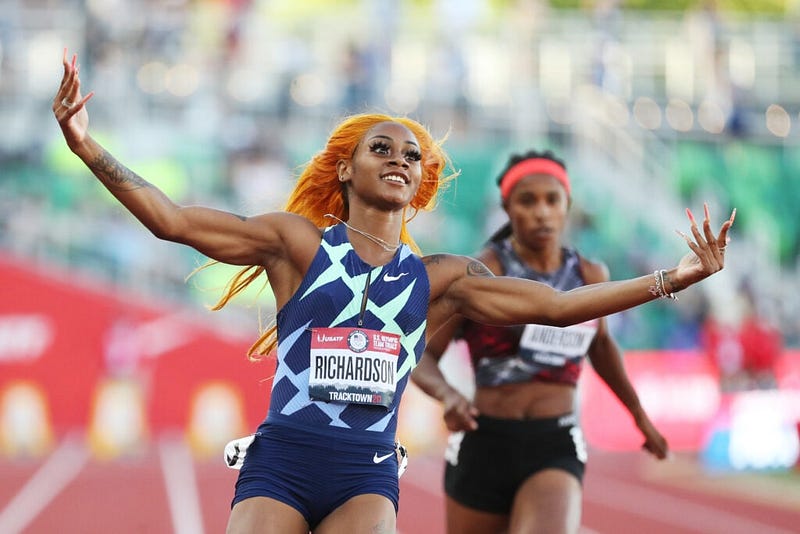
Sha’Carri Richardson, who is an American track and field sprinter, is justifiably outraged that Kamila Valieva, a Russian figure skater who is being described as a prodigy and the best in the world, is allowed to continue in the Olympic competition despite testing positive for three different heart medications including the banned substance trimetazidine, just like the rest of the world’s Olympic spectators.
I don’t enjoy the Olympics, but even I knew of Richardson before the controversy with her testing positive for THC erupted, as I’d constantly scroll past Youtube thumbnails with her colorful hair lighting up the image. I figured there was a fascination with her because she didn’t resemble the typical elite athlete, sporting an unapologetic style normally associated with a subset of urban black culture, and when her participation in the Olympic games fell into question, I was pretty miffed that an exemption would likely be made for her due to her surging popularity and influence.
I also figured that, given the social climate of 2020, there would be apprehension to punish a person of color, especially for marijuana use, which many have reiterated that black people have been disproportionately arrested for in America. Therefore, I was pretty surprised to learn that she had been suspended from one of her competitions, which ultimately resulted in her missing out on the Tokyo games despite the substantial public outcry last year (2021), but I was glad the rules were fairly upheld.
Many people object to the inclusion of marijuana as a banned substance for “moral” reasons instead of being a performance-enhancing drug, but I don’t see how that is relevant to whether or not she should have been punished for violating the established rules unless the complainers were protesting this cause before Richardson tested positive. I did however wonder how many other athletes were barred from the competition due to doping.
Now that Valieva, who is white, is still competing (although there will be no medal ceremony if she places in the top 3), the situation looks especially insidious. The shocking decision of the “Court of Arbitration for Sport” (CAS) panel gives off the appearance that little white girls are receiving favoritism or special privileges. It seems like a textbook example of inequality, giving credence to the narrative that black people are treated unfairly. The Grio states that black people are penalized for marijuana possession 3.64 times more often than whites, according to an ACLU study (in America), despite the usage of the drug being similar with both groups, but what does this have to do with the Olympics, which is an international organization?
The World Anti-Doping Agency, several professional skaters including Johnny Wier and Tara Lipinski, The United States Olympic and Paralympic Committee, and everyone I’ve seen on social media have all expressed dismay over Valieva’s being permitted to skate. Even as Valieva performed her renowned quadruple jumps, commentators Wier and Lipinski gave subdued commentary and reiterated their feelings of disappointment, noting that a permanent scar had been made against the integrity of their sport. Good for them. They and nearly the rest of the world agree that Valiava, while having infatuation for her technical brilliance, should be removed from the competition as Richardson was. In contrast, Richardson had received massive support for her reinstatement, as well as endorsements from celebrities.
An argument has been made that the fact that Richardson was penalized so heavily for a non-performance enhancing drug while Valieva escaped suspension with medications that aim to increase endurance, reveals the extent of the bias against her, suggesting racist motivations. However, despite the unfairness of this situation, there are some differences between the two scenarios.
For one thing, the CAS panel ruled that 15-year old Valieva is a “protected person” who isn’t “held to the same standard as an adult athlete” and that banning her would do “irreparable harm.” It sounds like bulls*t because it is. If 15 year olds are too vulnerable to be held to the same standards as adults, they shouldn’t be competing with them. More important, however, is how failing to enact a harsh enough punishment for doping a child is said to be protecting them from harm. It seems to me that this would accomplish the opposite.
I’m not very familiar with figure skating, although I do follow ballet to an extent, and I’ve observed that Russians seem to value difficult athletics that involve extreme flexibility (figure skating, rhythmic gymnastics, circus), and that their coaching styles involve exceptionally stringent methods, starting with refusal to even accept training those whose physical characteristics are not “ideal” and advancing to oppressive tactics on young people that some might consider to be borderline abusive. However, their dancers and competitors are often considered to be the “best in the world” and relished by Americans, some expressing why we can’t be so disciplined for the sake of excelling at a sport and that our children are overly coddled.
The utterly crazy fact is that Russia has been caught doping their athletes before and they are still technically banned from the Olympics! Ejecting Valieva from the games is an appropriate punishment for the absurd obsession of certain Russian coaches to prioritize medals over the well-being of their stars. In fact, the entire culture behind sports and people’s perception of its importance needs a wake-up call.
Still, during the same year that Richardson was punished for marijuana use, which she explained occurred as she was coping with the recent loss of her mother, another athlete who was white received less attention. Shelby Houlihan, a white middle-distance runner, received a 4-year ban that was upheld by the CAS panel when she tested positive for the steroid nandrolone, a substance she claimed resulted from eating a burrito from an “authentic Mexican food truck.”
All of this just shows that if you’re looking for logic and consistency with the Olympics, you’re going to be searching for a very long time. I do, however, see insufficient evidence of racism.
This debacle is yet another example of the harm involved with convincing people of color that every unfair outcome in their lives is racially motivated until proven otherwise. This has been shown to be taxing to mental health.
Sha’Carri Richardson was actually doing pretty well with the tremendous attention and support she received after learning of the disappointing blow, however, after those events took place, she started speaking in ways that have been described as “arrogant”, even after she came in last place after her month’s suspension expired (I had wondered why she wasn’t in the news as often, but now it makes sense, since winning is so essential to how people view your character).
She needs to learn from the situation with Simone Biles, where her disappointing need to drop out of the gymnastics competition was transformed into heroic mental health advocacy. As of right now, her formidable talent is being overshadowed by her assertive words without the results to show for it.