
Long-term Risk Management #22 Isn’t ESG a finance term? Can’t our CFO Just Take Care Of It? Nope.
Context, culture, and leadership requirements have shifted. Forward-thinking businesses want to develop authentic, ethical, inspiring long-term-risk management culture, and you kinda want everyone involved.
What does ESG mean and why should others in the business care? Sideline the political talk and look at the underlying issues & intent. Plus, why are prominent folks talking more about the intersections of issues and industries? Some context, a few example practices, and some of the “weeds” of defining your business’ ESG metrics.
Have you noticed how some “non-business” practices are increasingly regarded as indispensable to executive and the company success? Both large and start-up company CEOs are talking about mindfulness (e.g. William C Ford Jr, Mark Benioff of SalesForce.com, Oprah, Katy Perry). Others have created policies to support their communities and staff members in “unexpected” ways, saying it is crucial to their corporate culture e.g. flex time, adoption and/or childcare support, or paying employees for an afternoon volunteering for a cause.
Why? Because these all support employees in their happiness and mental health, which means there’s more calm focus, productivity, and smoother team work. Also, corporate volunteering is a key ingredient to fostering employee and community engagement — it creates opportunities for the teams to interact in fun and meaningful ways. All these supportive policies show that the company is not only focused on managing-the-minutes and money. And, perhaps counter-intuitively, the attitude actually increases business efficacy. It’s part of recognizing the psychological impact of business practices and culture, and understanding that those psychological impacts affect worker and team culture and productivity… and in turn, the business’ reputation and resilience. I’ve written about these topics in other articles in the series — in SMB, in large businesses , purpose of a company, carbon footprint 101 for businesses, and culture of inclusion & purpose increases innovation (for my fellow data geeks, lots of statistics are shared in all, but especially the innovation article — enjoy!).
More and more businesses are talking about a deeper understanding of motivation, loyalty, and resilience; about community building and why they want to create stability, growth, and ever healthier neighborhoods by contributing to the ecosystem of supporting services in their communities. This can manifest in different initiatives.
Some businesses are offering a guaranteed minimum income to increase retention, reduce hiring and training costs, and further the development of their community. You might have heard about Seattle-based Gravity Payments (see Effects of Setting A Minimim Wage), and its founder, Dan Price’s 2015 decision to cut his salary by 90% and guarantee all of his employees a minimum $70,000 salary. That announcement made waves, and prompted forecasts of Gravity Payment’s imminent collapse, yet within five years, it had resulted in tripling their business, more home-buying in the community, and a growing eco-system of businesses in the area.
A Mississippi caterer increased his employees minimum wage to almost $4 above the local average, and experienced nine improvements in his business. “It’s a great lesson on how people will provide you even more value when you show they’re valuable.” The whole experience has changed the way Roberts sees himself and his business. Check out the story here.
Roberts wrote. “Last week was the HIGHEST grossing sales week we have had as a company since opening 3 years ago. And we are expected to have a growth of near 30–40% about to occur in the next month with the opening of a new location.”
“The best thing I ever did for my company was take a long hard look at how I was leading and began working on my leadership,” he wrote. “I went from leading with an ‘iron fist’ to now a compassionate heart. Needless to say, the results speak for themselves!”
ESG encompasses the environmental, social, and governance practices and impact a company has. It is an acronym that has acquired political toxicity, yet its substance digs into the context in which a business operates, and how it manages its long term risks, as consumers and regulators become more sophisticated and demanding. And it digs into the deeper understanding of what creates motivation, loyalty and resilience in the 21st century.
There are many good ideas for improving work conditions and environmental impact (whether by generating energy from renewable sources, or agricultural production with soil regenerative techniques, or ensuring suppliers observe human rights and ecological standards, etc). There are also many explanations of why it’s not only good for the employees, but also the teams’ and the company’s performance. You have probably heard the terms employee engagement, diversity equity and inclusion (DEI), corporate sustainability (CS), corporate social responsibility (CSR), socially responsible investing (SRI) or impact investing, and similar terms. Many of these initiatives have been around for decades such as the concepts of sustainability and DEI, others such as ESG, have evolved from those concepts, more recently. The prominence and practice of all these “corporate citizenship alphabet soup” concepts has grown in the last 10–15 years, and especially during the pandemic which accelerated awareness of workplace, supply chain, and structural “-isms” issues. It also laid bare the need for a global, sustainable recovery.
There has been a gradual cultural and market shift to companies having not only function, but character and a need to exemplify customers’ (sometimes aspirational) values. In this article, we have discussed some context, a few of the changes from stereotypical management styles of the 20th century, and the examples begin to highlight why your business might want to think more deeply about productivity and resilience, and how to incorporate ESG into your growth strategy. Information and media technologies, government regulations, and market demands have brought greater transparency and access to information, as well as made us all more interconnected in this fast changing world. These cultural and market shifts manifest in
i) Closer customer interactions & high touch reputation management in the social media era;
ii) generational shifts increasingly demanding that brands or employers embody customer’s and employee’s personal values; and
iii) increasing awareness that there are global threats in the form of extreme climate events; inequities in access to opportunities, healthcare and wealth ; rising authoritarianism, etc. and everyone has a role they can play.
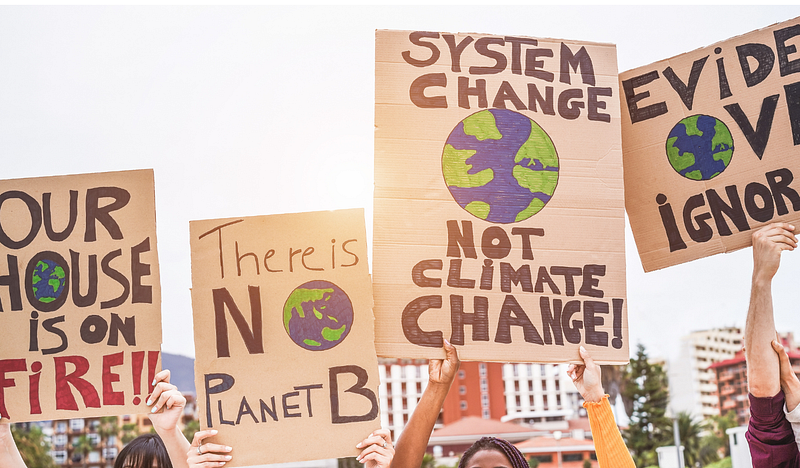
Doing good is no longer the purview solely of non-profit organizations. This is the context in which businesses operate, and they have a role to play (and mandate) in addressing community and global issues. Acknowledging, and atoning for, or minimizing negative consequences is slowly, yet increasingly being incorporated into business and financial models — whether by court cases and regulations (remember Erin Brockovich?), by market and employee demands, or by forward looking executives who have personal insights and commitments to specific issues, and want to stay ahead of trends.
As a result of these shifts, you’ve probably noticed that many corporations and financial institutions have evolved their messaging from simple product promotion, to showing how they practice their (and our) actual or aspirational values. The businesses are marketing their charitable partnerships, promoting and highlighting employees whose profiles have been historically under-represented in leadership, discussing their response to the climate (or other) crises, or explaining how they are redesigning their manufacturing processes, and/or no longer doing business with certain types of suppliers or clients.
Much of publicity put out by these large companies and firms mention the reasons behind and impacts of their own environmental, social and governance (ESG) initiatives. The initiatives may or not represent a significant portion of their cash flows, but it is a start and is growing. On a related note, companies and financial institutions are increasingly focused on addressing not only the operations and market demands, but also
i) the externalities (e.g. the cost of the pollution their product manufacturing or computer use creates, by buying carbon credits, engaging directly in reforesting initiatives, or updating their processes and technologies to reduce consumption and waste, etc.),
ii) managing for the long-term and the good of a variety of stakeholders vs the next quarter’s shareholder reporting, and
iii) increasing customer retention and employee engagement (to reduce turnover, hiring and training costs, and increase creativity and loyalty).
And as they say in mindfulness and performance circles, where attention flows, energy goes, and things grow. And the table below, illustrates the growing interest in and importance of businesses considering their environmental, social, and governance practices.
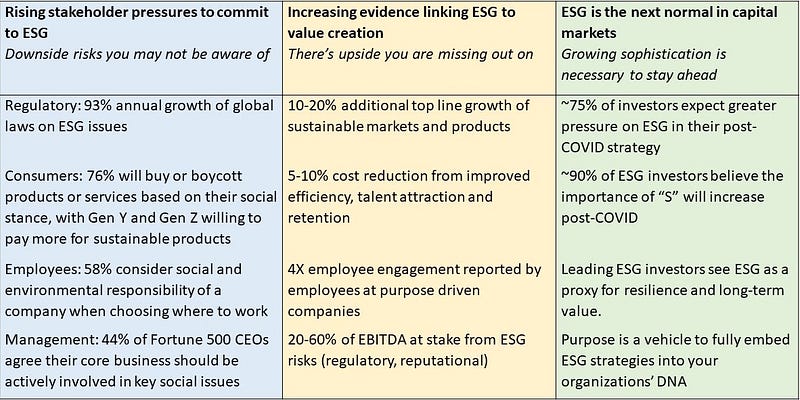
So, as you can see, the CFO can’t take care of all of this long-term risks or ESG “stuff”; all departments in the business need to think about the many policies and practices that generate motivation, productivity, and resilience… and which constitute what I call “the alphabet soup of corporate citizenship” (ie caring about your stakeholders and creating a culture of purpose).
Here might be a good place to give some examples of the issues involved in corporate sustainability, or ESG factors, and a few, related certifications. Admittedly, there is significant, but not complete, overlap in ESG factors, B Corp certification practices, and characteristics of benefit corporations (a legal structure that is beholden to wider range of stakeholders, not only the owners). All of these terms, structures and certifications reflect a still emerging area, so there is an increasing number of tools and measurements, as well as much discussion on the need for standardized metrics. How to get data that is relevant for each sector, and data that are consistent, transparent and comparable are current working areas of thought. FASB, UN agencies, and other organizations have been working on this; there are several promising sector approaches, but nothing seems to have emerged as ready to be adopted market wide (whether for rigor of thought & application, or for the awareness of the ideas and political will around them).
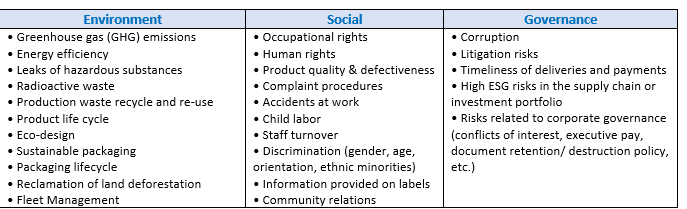
The table below was created by FASB[1] (Financial Accounting Standards Board). It is not exhaustive, but provides context for the discussion and is a good list of the key issues which have environmental, social, or corporate governance impact on a company’s performance.
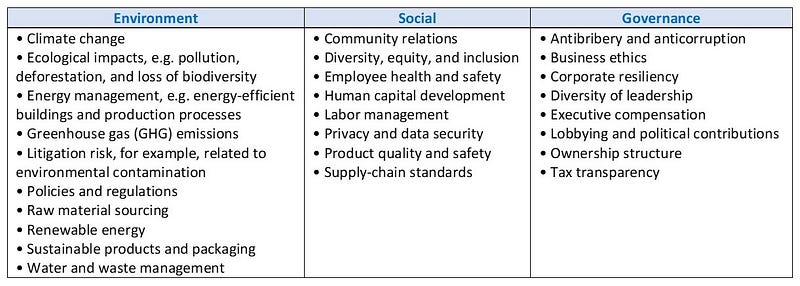
Given how broad these issues are, the differing priorities and drivers across sectors, and the data & comparison challenges mentioned above, it can be tough for a company to make a list of relevant issues they might affect, and ways they can measure progress. With a little research and group discussion, however, some good proxies can generally be discovered. Despite it’s current (2024) political toxicity, the term ESG is useful for its inclusion of a broad range of elements illustrative of the considerations in true, long-term-risk-management. For illustrative purposes, below is an example of the main ESG risk areas, for a manufacturing company.
Once we identify what to measure and report on, how to measure it is the next challenge. The specifics on quantifying a business’ ESG impact depends on your company’s processes and location, what you already track, and what you can somewhat easily begin tracking. Given the amount of detail that is specific to each company, a workshop is more helpful (and fun), than any long discussion of scenarios we might offer here. But, for the purposes of illustration, a few sample metrics for our manufacturing company could be the number and percentage of cars in the fleet which are EV (and powered by renewable energy) (E), or what percentage of the employees leave each year (S), or the multiple of the CEOs compensation over that of the average worker (G). Or, in a services company, it could include any of those metrics and/or, the GHG emissions (paper and computer use, etc.- E), the number of discrimination complaints filed with the HR department or outside authorities (S), and the percentage of senior leaders, execs and Board, who reflect DEI criteria (G).

So, as the tables, photos, and discussions above illustrate, companies have many incentives to develop their corporate sustainability, responsibility and wellness practices and ESG metrics. And, of course, a couple of the main ones are managing risk and ensuring access to capital. However, ESG is a term that really bridges financial risk management, and creating a culture of purpose, to ensure staff and company resilience.
As OMFIF President, Patricia Haas Cleveland, pointed out at the December 2021 release of the OMFIF-Mazars report ESG in Asset Management: The Future is Now, “it’s easy to forget that ESG was first coined in a 2004 UN study, ‘Who Cares Wins’. After a slow start, 15 years on, the efforts and trends have snowballed. In the US alone, assets under management (AUM) with ESG factors now exceeds $51T or 33% of total US AUM. Green bond issuance reached a record of $290B in 2020, and is on track to reach $500B in 2021.”
I hope this article was helpful in illustrating what ESG is, how to think about it and measure certain initiatives, and why it’s important for business’ long-term success to develop an ESG culture, across departments. Feel free to ask me any questions, and to comment on things that stuck with you, or that you agree or disagree with.
***
Rachel E Patterson helps innovative SMB and their leaders grow ethically, so that they navigate constant change, keep their best employees and customers, and build their long-term profits and positive legacy. A Chicago-Booth MBA with heart, and experience living/working in 12 countries, she bridges change and multi-cultural management. Labels? She/her, Leadership coach, change management & corporate citizenship consultant.
— —
[1] FASB Staff Educational Paper, Intersection of ESG Matters with Financial Accounting Standards, Feb 2021
[2] From Management 2016 Vol. 20, №1 ; “ Evaluation and reporting of CSR in SME sector”; Justyna Szczanowicz and Sebastian Saniuk