CS/R-ESG #4— How can a small or medium sized business do corporate sustainability or wellness programs?
Why would we? Can we afford not to?

Corporate wellness might bring to mind dimly lit meditation rooms, playful furniture and spaces throughout, ready access to certain foods, dry cleaning and massage services, a gym, and other expenses (or investments?). While it can certainly include that and more, how much does schedule flexibility, non-micro-management, and letting folks manage themselves and their energy actually cost? Consider a manager encouraging someone to take a 30 minute walk and come back clear-headed, rather than stay and push through with an unfocused mind…. At the end of the day, which choice would have been more productive?
Or, how about being committed to doing things with corporate social responsibility(CSR), sustainability (CS), or ESG metrics in mind, from the beginning? There’s a management mindset that can actually attract employees who believe in the brand (not just the paycheck). It creates loyalty and fosters innovation, when there’s an atmosphere of trust and psychological safety, and a culture of purpose. We’ll talk about that more in other articles. The point is, on the surface it might seem like it costs more to lose minutes of work; however, digging a little deeper, to human motivations and current cultural trends, the focus on pushing through can fall into the “penny wise, pound foolish” territory. Being committed to a vision, to a purpose, even in small companies might limit the choice in how things are done (but those limits create clarity, and culture), and it has all kinds of benefits in employee and customer loyalty.
It might cost a bit of money or time to change the way we do business, or to stay away from short-cuts, but there is an ever-growing body of statistics and stories illustrating that doing better and doing good make sense for the long-term bottom line, however big or small your company might be. Purpose driven companies (of all sizes) experience 4x the employee engagement of other companies. And companies with high employee engagement experience 21% higher profitability. And smaller companies are powerful at creating or changing their culture.
So, it’s not just big businesses talking about environmental, social and governance issues (and metrics). I’ll share a bit of the scholarship context, and a few examples of small businesses doing things differently, and doing well, while doing good. The metaphor is more about David and Goliath co-existing and maybe even learning from each other.

It’s almost a truism, that small and medium enterprise (SME or SMB) owners and execs are “spread thin”, on both attention and financial resources. Research has shown, however, that although they are often “unaware of the CSR term or concept/s, [they] demonstrate a high potential for its implementation.[…] It is interesting to see the high percentage of enterprises declaring actions corresponding to the CSR concept (special attention to its impact on workers — 80.42%, environment — 82.83%, and on the local community — 75.15%)”. [PARP #1]
And since this quote is from a report published in 2013, it is highly likely that CSR awareness has only increased in the last 10 years. “Consumer expectations, trends focused on sustainable development and concerns for social welfare are leading to CSR being imposed on the SME sector.”
The random and limited CSR implementation in SMEs (PARP research) suggests a lack of solutions to support their process. Any SME enterprise management solution supporting the rollout of consistent CS/R-ESG [2] policies and practices would need to be designed in a way to
1) be practical and results-oriented, simple-to-implement, and flexible enough to be accessible for diverse SMEs;
2) help management focus on key elements, by make monitoring and reporting easy; and
3) it would likely include a catalog of ESG factors, and a tool for management of and reporting on their ESG risks, based on KPI methodology.
Of course, expectations have to be managed, and it’s not all-or-nothing, but selecting your purpose and actions. “Incorporation of CSR into business strategy, identification, analysis and management of ESG risks (environmental, social and organizational) and reporting are important issues, however it is crucial to be realistic when it comes to capabilities of the smallest companies in the sector.” [1]
That said, where there’s a will (or sometimes a push), CSR will develop in some form. And will’s “cousins”, confidence and convictions, are magnetic, which is especially important in a social media-fueled world. Do you begin to see the path toward change?
Neighborhood businesses (in democracies) can develop and act on their principles, whether that’s observing ecologically friendly practices, supporting local economic development, or standing with social issues.
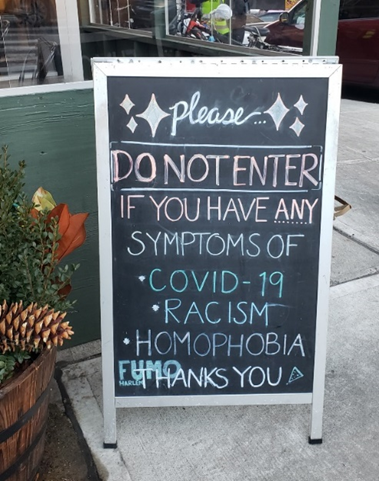
In walks around my neighborhood, I see welcome signs like the one above; or a nearby nail salon has a lovely floral poster in the window that also includes the text “botanicals are in, toxins are out” (and all their products are non-toxic, for the customers’ and workers’ wellness). The few things I dry-clean go to my neighborhood cleaner who advertises their practices as “organic, zero synthetic preservatives, zero harsh chemicals,” a nice addition to the facts they are convenient and the staff are friendly. And a nearby commercial real estate development, anchored by a Fortune 100 company, is highlighting themes of community and of local and minority owned businesses (and is sponsoring or incubating many of those businesses, plus using their sign’s real estate to remind people how to stay healthy in the pandemic).
So, businesses of all sizes, whether sponsor/ed or independent are undertaking CS/R-ESG [2] initiatives because of:
i) the need to address the risks caused by global issues — will their supply chain be disrupted by extreme climate events, or nationalistic governments, or employee turnover?
ii) the cultural shift wherein a growing segment of customers is demanding not only product convenience and/or quality, but that the products and services they purchase observe reputable practices, and play a role in addressing the world’s issues (or at least minimize their impact).
There are many things a small business might choose to do. The important thing is to discern your mission, vision, values… and then commit to some action or decision-making-guidelines, and start. It’s tough to start, yet once in movement, it’s easier to accelerate impact and incorporate further initiatives.
“Know that true policy is gradual in its advances, that it is conditional and not absolute, that it must deal with facts and not with sentiments.” James Russell Lowell, wrote this in… October 1860 about the new political party of Abraham Lincoln. The distillation of this concept applies well to any large endeavor, especially one that is inspiring, important and potentially fraught with emotion. And small business and sustainability both fall into that category, don’t you think?
So, we’ve talked about all sizes of organizations doing CS/R-ESG. Does it make sense for all industries? There are obviously different concerns and impacts from different industries, but there are leaders in every sector broadening their focus from (short-term) financial considerations to including cultural and environmental factors in their decision making. They are doing some version of “triple bottom line” (people, planet, profit) thinking, possibly tightening margins in the short-term, but engaging more deeply with their audiences, gaining more trust commitment and support, which results in greater resilience over the long-term.
For example, Broadway, the famed theater and musicals district in New York City, was hit hard by the pandemic, and activities re-opened in September 2021, 18 months after going dark. A then-new arrival to Broadway (from off-Broadway), Clyde’s, gave a portion of its story-telling proceeds to related social justice causes (I won’t give away the plot and fun story) and made the viewing more accessible to those who can’t get to the theater or afford a ticket. But the business doesn’t need to be flashy or direct to consumers, Hagbros is a small manufacturing company based in Austin, Texas that has grown both organically and through acquisitions. They boast one of the fastest company growth rates in the area, across industries, as well as a higher employee retention rate than their competitors. This family-run company has an intriguing governance and ownership structure (which forces a focus on family-healthy practices), a variety of employee empowerment and engagement policies, and the management combines hard core business skills with spiritual values… to great success.
I have talked about some of the shifting cultural context, and mentioned small companies in my neighborhood or across Europe and the USA, ie wealthier regions of the world. But businesses around the world have long been practicing citizenship, some as a marketing tool (bordering on greenwashing), but more of them, as an authentic ethos of being part of and giving back to their community. Many will support local tutoring or youth sports initiatives or, or will collaborate with other businesses to improve access to water, or other sorts of community projects.

Here, I’ll share quick profiles of two small businesses I’ve had the pleasure of visiting, both outside of Europe and North America. NamibSky in Namibia, and Ecofiltro in Guatemala are both making active corporate citizenship a key part of their brand… and their success. If you would like to read about additional, similar examples, check out the B Corp database and website — you can search by country, number of employees, etc. and you can be inspired by what other companies have put into action (and maybe even adopt a few practices in your own company).
Namib Sky is a hot-air-ballooning company based in Sossussvlei, Namibia, which provides spectacular experiences over the ancient desert dunes and mountains, at sunrise, followed by an elegant, generous, and delicious, locally made breakfast, near wherever you happen to land (which depends on that day’s winds). This business also has a small curio store, selling products from local micro-entrepreneurs and cooperatives, including shopping bags made from old balloon material (strong enough for multiple milk jugs and then some), and has built and operates a school for the local population — children of the hotels staff, and nearby communities.
Ecofiltro is located in Guatemala, where tap and source water are full of bacteria and parasites. The options people are are to boil the water for 10+ minutes, buy bottled water, or drink what they get and live with being sick. Ecofiltro became a “social business” in 2010, when the Executive Director realized they couldn’t solve the healthy water access problem in Guatemala depending on donations. So, they built a factory capable of producing 20,000 highly-effective, low-cost water filters/month. The filters are replaced every two years, and are made from three natural materials — clay, which creates microscopic channels; sawdust, which becomes activated carbon during use, eliminating bad odor, color and taste in the water such as chlorine; and colloidal silver, which coats the surface of the ceramic filter after it is fired in the oven. Ecofiltro traps solid sediments, parasites, parasite eggs and bacteria that contaminate the water (NB, it does not remove heavy metals). This inexpensive filter saves 2000+ trees/day (no need for wood to boil the water), saves money (using the water available), and saves lives. The company offers special financing, and water education, to village schools and their communities (over 6,000 schools, and 960,000 children impacted, since 2014). It is a 100% Guatemalan product for family or business use, for rural or urban communities that provides one hundred percent purified water. And Ecofiltro is a Certified B Corp, working towards “developing an economy that’s more inclusive and sustainable.”
So, yes, even SMB leaders, spread thin, can create and implement an inspiring vision that both helps their business grow, and contributes to their communities’ businesses and people.
— — — — — — — —
[1] Polish Agency for Enterprise Development, Polska Agencja Rozwoju Przedsiębiorczości (PARP) 2013; published in Management 2016, Vol. 20, №1 p27 ; “Evaluation and Reporting of CSR in SME sector”; Justyna Szczanowicz and Sebastian Saniuk
[2] CS/R-ESG — I refer to the alphabet soup of corporate citizenship and its many concepts. CS/R-ESG is my personal “catch-all” abbreviation for corporate sustainability CS + corporate social responsibility CSR + environmental, social, & governance factors ESG (and I’m including DEI in the S of ESG).
*****
Rachel E Patterson helps innovative SMB and their leaders grow ethically, so that they navigate constant change, keep their best employees and customers, and build their long-term profits and positive legacy. A Chicago-Booth MBA with heart, and experience living/working in 12 countries and across multiple sectors. Leadership/Executive coach, change management & corporate citizenship consultant.