
CS/R -ESG #8 — What’s the purpose of a company?
Milton Friedman, Blackrock & other influencers of the last 70 years— shareholders, stakeholders, sustainability.

At its most basic level, the purpose of a company is to meet a market need, and to continue doing so. There are pragmatic concerns about doing it effectively, consistently, and profitably. The way to meet market needs, however, has been evolving. Because of the reasons I have mentioned in earlier articles, businesses are embracing what I call the alphabet soup of corporate citizenship (CS, CSR, ESG, DEI, SDG, PPP, 9Rs, etc), ie identifying and balancing all your stakeholders and their concerns. While complex, this has become, in many ways, the ultimate strategic growth mindset. The modern business (& firms which finance them) embrace the facts of a fast changing world full of multiple desires and needs, so it listens to multiple perspectives to get fuller insight into the “lay of the land” and trends, and fosters more folks’ creativity, to unleash greater innovation and problem solving (and long-term profit). The underlying crux of this, is tapping into and creating a culture of (psychological safety — more on this in a separate article — and) purpose.
If you’ve done any work in or reading about the corporate sustainability and ESG world, you will have stumbled across the massive asset manager, BlackRock, and it’s market-shifting, growing focus on ESG (environmental, social, governance) factors in rating a company’s impact… and assessing the desirability of investing in a company (or not). Blackrock is the world’s largest asset manager, with $9.5T under management in 2022 — roughly equivalent to half the GDP of the USA, or the combined GDP of Japan, the UK and Italy. Despite recent, political calls for anti-ESG policies, given Blackrock’s size, and CEO Larry Fink’s annual letters to CEOs since 2012, the firm is influencing companies — through it’s money and by identifying cultural shifts, and even guiding companies to a more systemic understanding of markets. Blackrock does this both through inspiration and direct encouragement to become more rigorous in developing their ESG practices.
Many of Larry Fink’s annual letters to the CEOs of their portfolio companies, have called for action on issues such as corporate governance and climate change. His 2019 Letter to CEOs “Profit and Purpose” went viral, and the 2020 letter was titled “A Fundamental Reshaping of Finance”. His 2021 Letter to CEOs addressed the pandemic, the systemic inequities it made glaringly apparent, and the important, long, but accelerating transition to net zero and other sustainability practices. The letter included a request for the CEOs to clarify their path to Net Zero, their plans to improve diversity, equity, and inclusion in their regions, and documented that sustainability and deeper connections to stakeholders drives better returns.
But, let’s step back to the question asked in the title.

Talking about purpose within a company can be challenging, because there are multiple opinions, and the recognized purpose of a company has evolved. In 1957, Harvard economist Carl Kaysen wrote that management should see “itself as responsible to stockholders, employees, customers, the general public, and, perhaps most important, the firm itself as an institution.” Managers should govern the corporation to benefit shareholders, they believed, but not shareholders alone (check out this article with a legal perspective on the brief history of a company’s purpose).
Famously, in 1970, University of Chicago professor and Nobel Prize winner Milton Friedman introduced his shareholder theory of business ethics, arguing that a company has no social responsibility to the public or society; its only responsibility is to its shareholders. And while my UofC heart is always proud at the insight and influence of our professors and my colleague-alums, I admit that I wince at this narrow focus. That said, time passes and societal mandates evolve.
In 2019, the Business Roundtable, a group of senior leaders from almost 200 major US corporations, issued this August 2019 statement on the purpose of a corporation. “Americans deserve an economy that allows each person to succeed through hard work and creativity and to lead a life of meaning and dignity. We believe the free-market system is the best means of generating good jobs, a strong and sustainable economy, innovation, a healthy environment and economic opportunity for all. […] Investing in our employees. This starts with compensating them fairly and providing important benefits. It also includes supporting them through training and education that help develop new skills for a rapidly changing world. We foster diversity and inclusion, dignity and respect.” We shall see the extent to which those intentions are followed by investigation and actions.
The World Economic Forum, put forward a new paradigm for corporate governance in 2016, and issued its 2020 Davos Manifesto embracing stakeholder and ESG (environment, social and governance) principles. This article shares more information on those developments, and aims to put Friedman’s article in context. Essentially, the i) rise of communication technologies, resulting in ii) greater awareness of community and global issues, has led to significant numbers of consumers & employees wanting their brands to represent their values, to play a role in addressing global or local issues. Businesses we buy from and work for, are to be, in a way, an admirable friend, and a signal to others of our own values.
Globally, the business sector easily represents about 2/3 to ¾ of economic value production (with governments and non-profits, creating the rest), so the business sector has a huge role to play in making and keeping the world healthier, safer, peaceful, in both small and large ways. And given cultural shifts, and the merging business and cause-organizations mindsets, a business’ purpose has been more clearly defined to providing a good or service, and doing minimal harm, or better, reversing harm, along the way.
Here’s a summary of several McKinsey & Co studies’ findings, providing quantifiable inspiration for companies to include sustainability and ESG as a central pillar of their growth strategy in this fast-changing world.
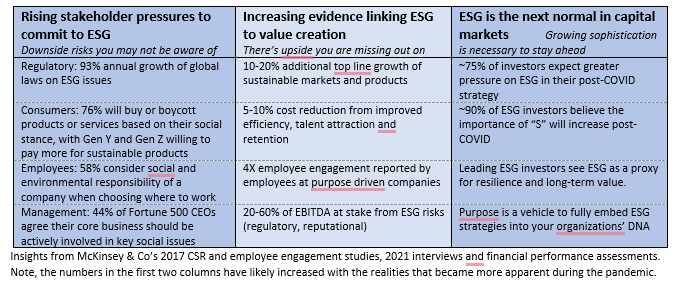
In a widgets-only world, the speed and low cost of the widgets are what counts. In the real world, more complex and systemic thinking is required. What you care about, is different from what your neighbor cares about, or what your cousin’s friend on the other side of the world cares about… and there are thousands, or millions, like each of you.
In the real world of the 21st century, quality, impact on people and the environment, decision-making processes, employee and consumer experience, and reputation will drive a company’s success or failure. Much of this shift is due to the rise of social media and information sharing; the growing awareness that business-as-usual has created climate change and catastrophes; the phenomenon Maya Angelou noted as “when we know better, we do better”; and the very human desire to leave a positive legacy, shifting the calculus of what is and isn’t worth cutting out. As a result, employees, leaders, consumers, and governments are demanding businesses think beyond short-term profits (and of their impact on the environment and people, ie, include their cost externalities). So, the purpose of a company is shifting — and causes and culture are part of the competitive edge. To illustrate this point...
· According to a Pew Research 2012 study, Ninety-three percent of millennial consumers say they would buy a product because of a cause association, or a reputation as an ethical company.
· 95% of customers say their trust in a company makes them more likely to remain loyal to a brand.
· Organizations with above-average gender diversity and levels of employee engagement outperform companies with below-average diversity and engagement by 46% — 58%. (Fast Company)
· Companies with above-average diversity had 19% higher innovation revenues. (Harvard Business Review)
· If interested, a few sustainability-related, bingeworthy movies and shows are here.
As always, there are early adopters, and various levels of involvement in the concepts of corporate citizenship. As time passes, the markets and new regulations will encourage behaviors aligned with CS/R-ESG actions. Some of the current “north stars” of how to think about this, and develop your business practices are addressed in i) Larry Fink’s annual letters to CEOs, ii) several third party certifications (see my related article on these) including B Lab’s B Corp certification, cruelty-free, etc. There are now almost 6000 Certified B Corporations, across 85 countries, over 150 industries, and of all sizes.
So, leading firms have “read the tea leaves”, recognized the societal trends, and are helping their companies embrace complexity and long-term risk management. If governments and customers are going to sideline your business due to less ethical, more short-sighted behavior, it behooves your business to develop its culture and inclusive CSR-ESG practices.
“The more your company can show its purpose in delivering value to its customers, its employees, and its communities, the better able you will be to compete and deliver long-term, durable profits for shareholders. “ ~ Blackrock CEO Larry Fink’s 2021 Letter to CEOs
#sustainability #CSR #ESG #longtermstrategy #leadership #purpose #triplebottomline
— — — — — — — -
Rachel E Patterson helps innovative SMB and their leaders grow ethically, so that they can navigate constant change, keep their best employees and customers, and build their long-term profits and positive legacy. A Chicago-Booth MBA with heart, and experience living/working in 12 countries and across multiple sectors. Leadership/Executive coach, change management & corporate citizenship consultant.
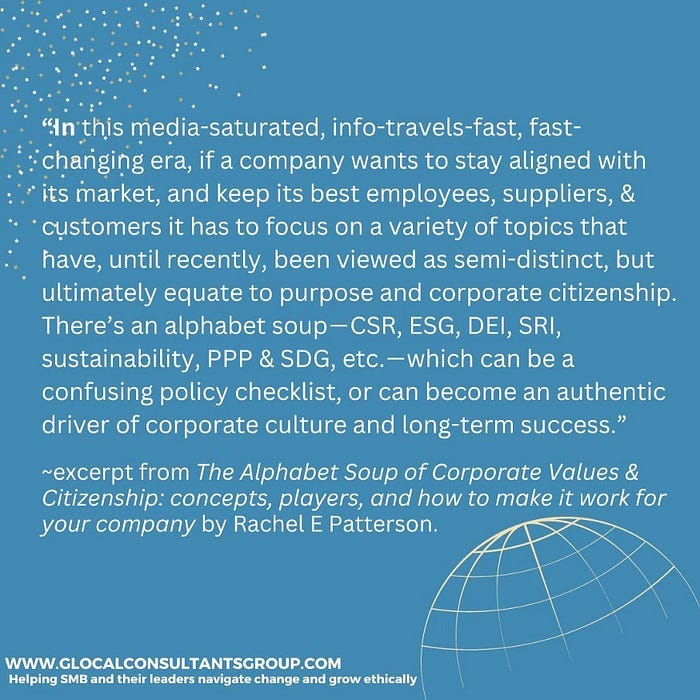
My foundational thesis? Businesses easily create 2/3 to ¾ of the world’s economy, and can make a huge and positive impact by improving their processes and practices. Businesses are also run by people who want to be not only effective at their work, but to create a positive legacy. Being better corporate citizens is of great long-term strategic benefit to companies, because aside from the “feel-good” qualities, these policies, practices, and the culture they create, have been shown to increase employee engagement and retention, foster innovation, contain risk, and improve the bottom line over the long-term (also, regulators, employees and customers are increasingly demanding it — check out the other articles in this 24-part-series, for some related stories and statistics) .


