
A conversation about toxic monogamy culture | Part one
Criticizing Toxic Monogamy Culture Is Not an Argument for Polyamory
I was called out as a hypocrite for challenging my programming on social media

Last week, I was surprised by a message from a friend’s husband; a pushback against an Instagram story I re-posted, highlighting the meaning of toxic monogamy culture. The list had spoken to me as an epitome of my previous marriage and I felt compelled to share:
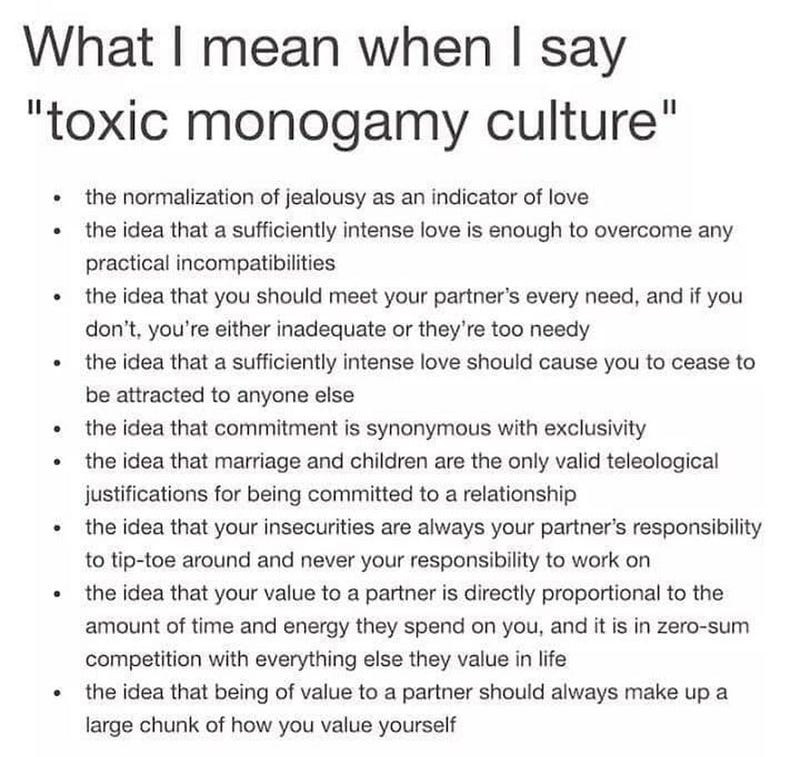
Seeing this in my feed had tickled my friend’s husband in the wrong way and he needed to tell me something. In his words, which admittedly made my jaw drop, I’m a “hypocrite for preaching polyamory”, because I “used to be in a long-term monogamous relationship and had a child while being in one — one where I had benefitted from the legal and spiritual protection of marriage and enjoyed life’s orderliness and easy long-term planning while being with one partner.”
Further, my way of life “can ruin young girls’ future and destine them for a life of single motherhood with an absent father”… And thus, my beliefs are “irresponsible and dangerous for society, especially young people.”
He added that the next time I post something about my beliefs I should insert the disclaimer that “I’m a mom and my beautiful child was made while in a monogamous marriage with the person I loved.”
Wow! Triggered much?
I responded that my intention is not to preach polyamory. Instead, I wished to highlight certain toxic beliefs perpetuated by a culture where monogamy is the only acceptable default — beliefs which, trust me, I’ve felt up close!
“That’s not what you’re saying, just look at the title of your post!” he continued.
His reaction was the equivalent of #notallmen in response to the scrutiny of toxic masculinity, to which I emphasized the word toxic. I adore masculinity in many forms (which, by the way, is not synonymous with men) just not the toxic manifestation of it. I also love to drink water, just not when it’s been poisoned. Get it? — #notallmonogamy.
What it boiled down to was that this man feels like I’m always painting monogamy black while portraying polyamory as the holy grail. In doing this, I’m telling him “that he’s living his life wrong and that giving up everything he’s worked for in favor of polyamory will fix it”.
At this point, I scratched my head. I can’t remember ever having told anyone that monogamy is bad and that polyamory is the ideal lifestyle choice — I don’t even believe this to be true — so I asked him to provide me with an example. He told me that the few times when I’d said that, “no one person can cover all of our needs and vice versa” or that “we can’t be everything for someone”, I was “directly implying the necessity to be polyamorous”. I tried to assure him that this wasn’t what I meant, but to no avail.
When I asked why he’d never spoken up or questioned my statement, he had “assumed his comeback would be so offensive (to me) that, for politeness reasons he never said it out loud.”
(For future reference to all, please don’t shut up around me out of politeness. I can absolutely handle differing opinions and do not shy away from respectful debates!)
What I kept extracting from our conversation was a ton of assumptions and projections that confirmed the ideas that “we hear what we want to hear” and, in Stephen Covey’s words:
We see the world, not as it is, but as we are — or, as we are conditioned to see it. When we open our mouths to describe what we see, we in effect describe ourselves, our perceptions, our paradigms.
It seemed clear that my friend’s husband was speaking from his worst fears and, in many ways, I’m a manifestation of these and thus make an ideal scapegoat. Just like his wife now, I was married to a man I’d been with since my twenties and had a daughter with him. Now that I’m divorced, happily exploring ethical non-monogamy — and a friend to his wife — I’m experienced as a threat.
Towards the end of our exchange, we focused mainly on the meaning of the phrase that one person can’t be everything to someone.
When the conversation eventually became nonsensical and he started saying things like “yeah, of course, I can’t be everything, I’m not a pilot”, I felt like it was time to exit and focus on more productive endeavors — such as turning our debate into an article here on Medium.
I decided to dissect what I mean when I say that no one can be everything to anyone, in a following article. For now, I want to address a couple of his arguments:
Marriage does not guarantee stability and safety
If this person knew the nature of my marriage, and that it was vastly different from the one he appears to enjoy with his wife, he’d be aware that I neither benefitted much from its “legal and spiritual protection” nor did I enjoy “life’s orderliness and easy long-term planning.” On the contrary, I clung to an abusive relationship exactly because of the toxic fallacies I’d been sold about traditional monogamy — one of them being that I could save him if only I loved him hard enough.
My marriage was void of any of the above-listed perks, and marriage, in general, does not guarantee any of those things.
Polyamory is not linked to single-motherhood or fatherlessness
To claim that the popularization of polyamory “destines young girls for single-motherhood while raising fatherless children” is an arbitrary statement.
According to various sources, including this article in the New York Times, the main reason children grow up without fathers is unwanted pregnancies. Most prevalent among low-income women between the ages of eighteen and twenty-four, unwanted pregnancies are also likelier to occur as a result of casual sex — which happens to be most widespread among young adults in this exact age range.
The average age for first-time marriage in the US is thirty-two, with similar numbers in Europe. It’s evident that tying the knot doesn’t prevent the occurrence of casual sex any more than polyamory propagates it. Instead, it’s something that a huge number of people enjoy, unrelated to relationship style, before settling in more steady relationships. Even after, about 20% of married people admit to having cheated in their marriages and roughly 70% of people have cheated at some point in their lives according to this BBC article.
The most effective way to prevent unwanted pregnancies among sexually active adults is better access to quality sex education, free and accessible birth control, and legal, available abortion help — especially to the young and underprivileged.
In my own case though, having a planned child within wedlock still did not prevent my ex-husband from jumping ship and being absent from his daughter’s life for three years after we separated. A father’s commitment hinges neither on exclusivity nor is it guaranteed by vows or promises of any kind.
Polyamory doesn’t endanger society but might challenge patriarchy
To say that pointing out the flaws of toxic monogamy culture, or popularizing polyamory, is dangerous for society is another fear-based assumption. It would perhaps make young people, and especially women, more focused on self-fulfillment and on finding themselves rather than a mate. This could, in turn, be a bit dangerous for patriarchy and the many misogynistic values interwoven into modern culture, to which I say, bring it!
It’s about time women grow up free from the belief that finding a suitable partner is the ultimate accomplishment. I, for one, wished my own parents had put in a word of encouragement in favor of staying single and focusing on myself, rather than diving straight into couplehood at seventeen.
Lastly, I do not owe monogamy my loyalty, even if it brought me a child
Having spent most of my life in monogamous relationships and having a kid from one neither obligates me to advocate for monogamy nor does it make me a hypocrite if I don’t — not any more than coming out as gay after having had a child in a heterosexual relationship makes you one. We all live, grow, and learn new things about ourselves at different stages.
I may have chosen monogamy, but it was never so much a choice as much as the only option I was familiar with. Saturated with jealousy, insecurity, co-dependency, and every other unhealthy behavior associated with toxic monogamy culture, my marriage personified the list I posted (above). Still, I held onto it like a badge of honor; proof that I’d made it.
I used to subscribe to the same beliefs held by the man who messaged me. Now, somewhat satirically, by calling me out and telling me to stay in my place and keep quiet because I owe monogamy my allegiance (as well as my child) he’s effectively backing my claims against the toxicity I’m challenging—simply by upholding it.
Today, deciding to practice non-monogamy now is a conscious choice I’m making, which first of all means I’m (finally) choosing myself.

© Ena Dahl 2021
Part two here:


