
Crip
Is this slur in the process of being reclaimed?
Today’s New York Times Spelling Bee letters:
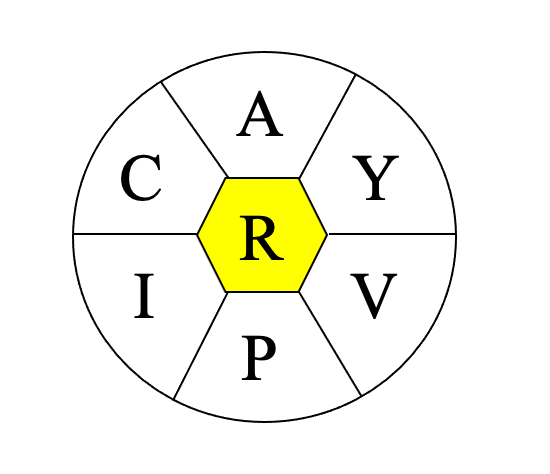
A, C, I, P, V, Y, and center R (all words must include R)
Merriam-Webster says…
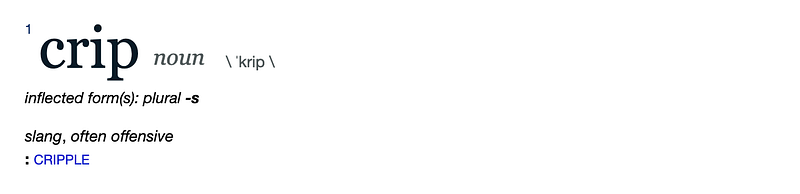
Silly little dictionary! Don’t you know crip can’t possibly be a word if the New York Times says it ain’t?
For further fascinating facts, check out the Spelling Bee Master.
What’s your favorite dord* from today’s puzzle?
My Two Cents
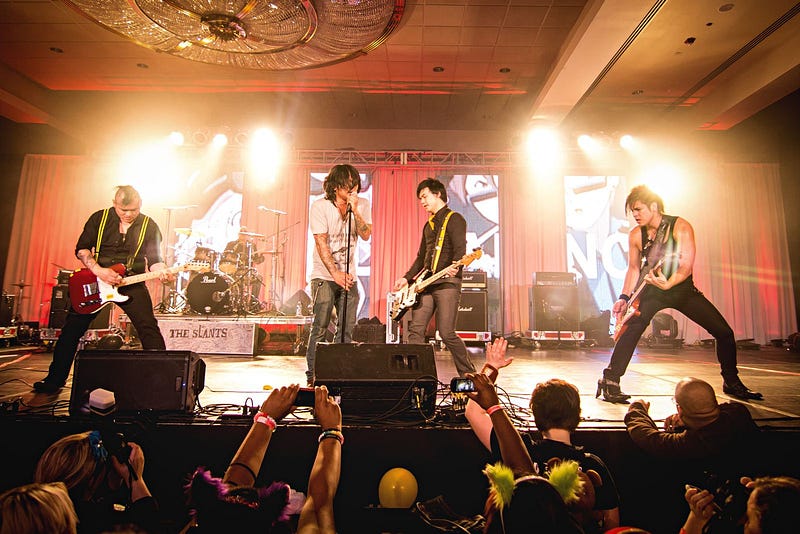
First things first: the photo. It shows the American rock band The Slants. What does have to do with our word? Well, The Slants are composed entirely of Asian Americans, and they were involved in a famous legal battle that reached the Supreme Court in 2017.
Bassist and founder Simon Tam decided to trademark the band’s name in 2010. The U.S. government’s Trademark Office rejected “Slants”, claiming it was offensive and disparaging. Tam and his band sued; seven years later the case made it all the way up the highest court in the land. The Supreme Court voted unanimously in favor of the Slants. Justice Samuel Alito wrote: “Speech that demeans on the basis of race, ethnicity, gender, religion, age, disability, or any other similar ground is hateful; but the proudest boast of our free speech jurisprudence is that we protect the freedom to express ‘the thought that we hate’."
Shortly after the case was decided, the Trademark Office granted registration for “slant” to a company that makes industrial coils.
So… what does the photo of the Slants at the top of this article have to do with the word crip? Well, in 2017 Tam wrote an opinion piece in the New York Times in which he argued in favor of communities reappropriating language used against them offensively as a way of taking away that language’s power, and a result reducing the power of those who try to offend by using said language. As Tam suggests:
“The idea of reappropriation isn’t new. The process of turning negative words, symbols or ideas into positive parts of our own identity can involve repurposing a racial epithet or taking on a stereotype for sociopolitical empowerment. But reappropriation can be confusing. Sometimes people can’t figure out the nuances of why something is or isn’t offensive…”
Bending the meaning
The word cripple can be used as a noun, a verb, and an adjective. Its connotation is never pleasant:
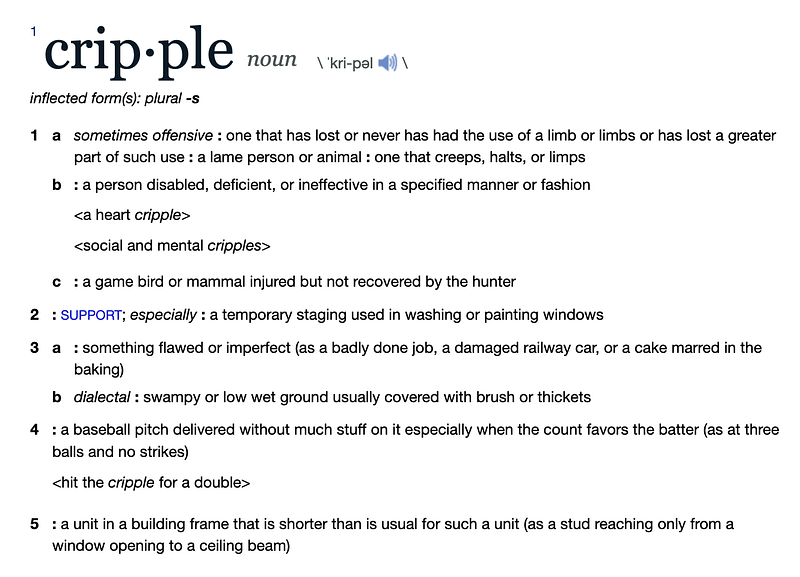
Even when talking baseball or architecture, cripple does not get a positive spin. The dictionary explains the word originated from the Middle English cripel, which came from Old English crypel; akin to Middle Low German kropel, krepel, meaning “cripple”, from Old Norse kryppill, from Old English cryppan “to bend”.
Aha! “To bend.” It’s possible that was the original usage, to describe people who were “bent” or simply “looked different”. Eventually it became a catch-all for anything humans didn’t view as being “whole” or “normal”… whatever that means.
Society may not have known the term cripple was offensive for hundreds of years. Then again, I doubt anyone gave it a second thought or asked disabled people their opinion about it. The abbreviated crip became a clearly offensive term in the same way that other slurry abbreviations have been used. Hebe, from Hebrew, and Spic, from Hispanic, are two well-known examples.
Sometime during the late 20th century the word finally was looked upon negatively by a larger portion of the population, and the term “disabled”, and later “differently-abled” gained traction.
In popular culture, perhaps the most famous disabled people have been “Tiny Tim” Cratchit, from Dickens’ A Christmas Carol, and Joe Swanson, a paraplegic police officer and friend and neighbor of Peter Griffin in the animated TV show Family Guy.
Crip theory
By 2017, when the Slants case was being decided (and now, four years later, seemingly less so), the movement to reappropriate crip had been going strong. As Wikipedia explains, with several references, those who choose to use the word do so because they wish to:
- express pride in being a member of the disability community (“crip pride”)
- express resilience in crips’ struggle for rights and equity and their resistance against ableism and oppression
- have a unified term for all kinds of disabilities, thus avoiding disability hierarchy (the idea that people with certain disabilities are more or less important than people with others)
- disempower the term’s historical pejorative usages
This has been done with other words, such as queer, bitch, and even hebe (as I’ve mentioned here).
The movement prompted the creation of a new academic area known as disability studies. The University of Wisconsin explains their program is “a transdisciplinary program dedicated to advancing knowledge by, about, and for people with disabilities. Disability studies explores models and theories that examine social, political, cultural, and economic factors that define disability and help determine personal and collective responses to difference.”
Opinions by disabled people about crip theory and the reappropriation movement as a whole are mixed. Which makes sense, because human beings will always have diverse opinions about issues that affect groups or communities they belong to.
In a 2013 article for The Feminist Wire, Mark Sherry argues that the term is used mostly by privileged disabled people. Sherry explains that “the term “crip” has a long history — one that is racialized, classed, gendered, and gang-related. Being a “crip” is not a metaphor of being a ‘bad ass’ disabled person, as many privileged academics seem to assume. It’s an actual gang, and people who’ve made deliberate choices to avoid the violence of street life deserve respect and recognition for not being a crip.”
(As an aside, the Crips gang was originally called the Cribs and the name change occurred when some members began carrying a cane, which gave the impression they were “crippled”.)
On the other side of the argument stands Neil Schoenherr-Wustl, who in a 2019 article in Futurity, explores how research about reappropriation shows “that, under some circumstances, words that seem to insult a group can be disarmed and neutralized” and that “Tt the extent that minorities can armor themselves against insults, via reappropriation or other tools, the marketplace of ideas is more likely to be effective. And, the bad words need not be banned.”
What do I think? I believe people should be treated and respected as individuals who have a right to decide what it is they wish to be called.
I’ll leave you with this beautiful and poignant article written in 2017 by Ellen Samuels, who is part of the faculty at the University of Wisconsin in Madison.
And yet… despite everything we’ve discussed today, the editors of the Spelling Bee still decided that crip is a dord*.
You can check out my previous entry on another dord* here:
*What the heck is a dord, you ask? Here’s the answer: