
Folioing
When is a noun not a noun? When it’s a verb!
Today’s New York Times Spelling Bee letters:
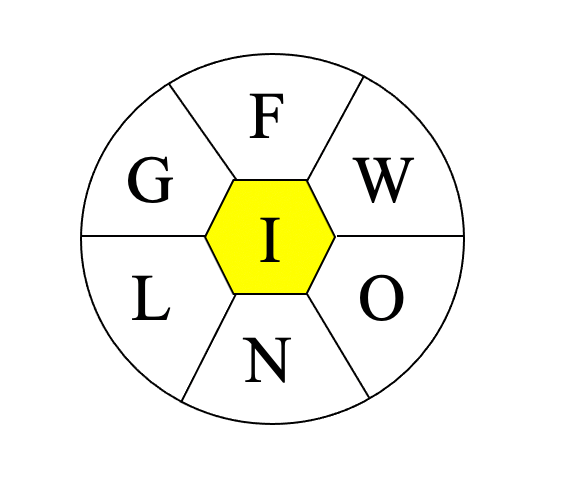
F, G, L, N, O, W, and center I (all words must include I)
Merriam-Webster says…
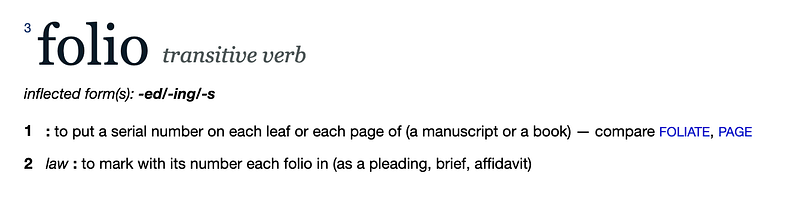
Silly little dictionary! Don’t you know folioing can’t possibly be a word if the New York Times says it ain’t?
For further fascinating facts, check out the Spelling Bee Master.
What’s your favorite dord* from today’s puzzle?
My Two Cents
One of the main reasons I have this column is because I love writing about words. (Also, the dozens of cents I get every month from Medium doesn’t hurt.) In order to write about them, I have to learn more about the words— even those I was already familiar with. There’s always some new and exciting information to glean!
On a daily basis, the Spelling Bee provides at least several words I was not previously aware of. So there’s that part, obviously. But today while researching a word I learned a few others directly related not the term itself, but to what that term represents.
Spoiler alert here: I’m going to discuss today’s game.
If you’re a regular player, you don’t need me to tell you that any time the letters I, N, and G are included in the Spelling Bee, there’s gonna be a lot of words and points that day. Today is no different: a whopping 69 words and 424 points. That’s because you can make a lot of words that end in -ing, and those words are usually worth at least 6 points. Plus, you also have the words that can stand alone without the -ing. For example, in today’s game you can make “wing”… and “winging”; “fling”… and “flinging”. But even words that are only three letters long (and won’t be accepted because they are too short) can get you points with the -ing ending. For example: “winning” and “going”.
The earlier example of “wing” and “winging” is a good one. Wing is both a noun and a verb, the -ing ending applying to the latter. There are several definitions for the verb, so if you are winging it you could be fitting something with wings or you could be improvising.
Why is winging accepted by the Spelling Bee, while folioing is not? And what does “to folio” mean, anyway? Aha…
Let me count the ways
I’m not sure why the dictionary distinguishes between the legal definition of the verb folio (definition 2) and the regular one, since they both involve the same basic thing: numbering pages. Perhaps the legal definition involves a specific task done by a specifically-trained person. It was probably some sneaky lawyer who came up with that in order to secure a tenured clerking position for an in-law, or something like that.
I asked a lawyer friend today and he told me he had never heard of folio being used like that.
But I have. No, I’m not a lawyer, and I never played one on TV, either. But I have worked in the publishing industry for over two decades, and folio is a Very Important Phrase in our parlance, or VIP. No, no one else calls it a VIP; I just make that up. But I’m going to try and make it a trending term from now on. So if it becomes a hot news item soon, just know you read it here first.
Anyhoo… you’re probably wondering why we use folio and not just say “page”, for example. You’re not wondering that? Well, I won’t take it personally and I’ll tell you anyway.
All folios are pages, but not all pages are folios. Wait, scratch that. It sounds clever but doesn’t actually make any sense.
I think a better way to explain it is to say that all pages are numbers but not all folios are. For example, 1, 35, 289, and 1,956 can be both folios and pages. But A, xvii, and D-3 are folios only. Why is this important? Because when you’re discussing manuscripts, using “page” may cause confusion and errors.
Let’s say your book has an introduction and you chose to number those pages with Roman numerals: i, ii, iii, iv, v, vi, and so on. Then the rest of your book has Arabic numerals: 1, 2, 3, 4, 5, 6, etc., etc., etc. Both the introduction and the rest of the book are pages. So if I say “page 2”, am I talking about the page numbered ii in the Introduction or the one numbered 2 in the main section?
Enter folio, the unsung hero… and VIP!
I can tell you I need an edit on folio viii, and you’ll know I’m not talking about the page numbered 8. Conversely, if I mention “folio 8”, you know I’m not talking about the page marked viii. And by the way, if your introduction goes up to page viii and the next section begins immediately with the number 1, that page is actually page 9 of the book (and perhaps more, if you count the title page, copyright page, and other front matter).
Stop verbing those words!
Remember earlier when I said I learned some new words today? I was referring to anthimeria (or antimeria), denominalization, and verbing. I like verbing best because it sounds like what it is: turning a noun into a verb. How? Well, in English it’s usually very easy. You just start using the noun as a verb and hope it catches on.
As Grammarly explains:
The purpose of verbing is to make what we say immediate and to-the-point. During situations in which a word is used repeatedly, as in a business meeting, verbing seems more common. In English, it’s easy to do because the base forms of verbs don’t need special endings. For example, English can use the noun action as a verb simply by using it in a verb position within a sentence. But verbing the word action in French requires you to add a special ending to the word, which would leave you with actionner. To some, verbing makes what you say sound fresher and less traditional. To others, it’s akin to workplace-appropriate slang. Benjamin Franklin said in a letter to Noah Webster that denominalization is “awkward and abominable.”
Well, the dictionary is now called Merriam-Webster, not Merriam-Franklin. So take that, Ben!
Grammarly gives these examples as words that once would have been considered strange as verbs, but are now commonplace: chair, cup, divorce, drink, dress, fool, host, intern, lure, mail, medal, merge, model, mutter, pepper, salt, ship, sleep, strike, style, train, voice.
Today we’ve also learned that folio belongs to that group.
Except the editors of the Spelling Bee did not agree, decided that folioing is still a dord*.
You can check out my previous entry on another dord* here:
*What the heck is a dord, you ask? Here’s the answer: