
Covid-19 Infection & Mortality Rates Can Be Misleading
A single figure for each remains elusive and won’t reflect the true reality anyway
Roughly five months after a novel coronavirus emerged in humans and brought us Covid-19, two of the most important questions have yet to be answered:
- How infectious is it?
- How deadly is it?
Since an unknown number of people have been infected but not tested—either because they had no symptoms, or their symptoms were mild, or tests weren’t possible—the math needed to answer these questions can’t be done. In that vacuum, estimates have emerged.
But the questions themselves are incomplete and the single-number estimates often cited don’t begin to tell the whole story of Covid-19’s ability to spread and kill people. Rather, the disease’s transmissibility and death rate need to be looked at situationally.
Reproduction number
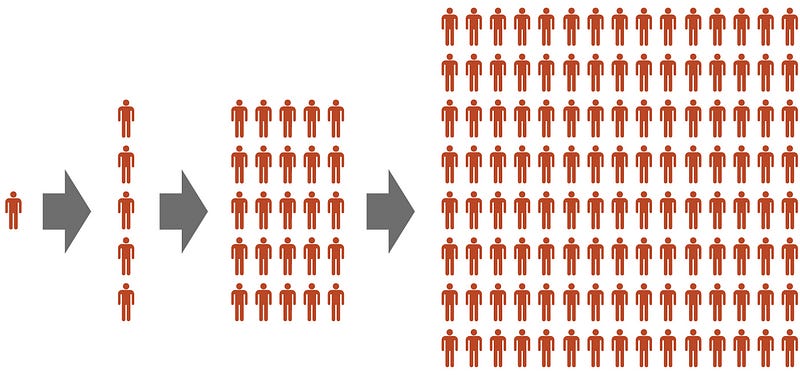
Infectiousness, or transmissibility, is measured, in part, by a reproduction number (called R0 and pronounced “R naught”) indicating the average number of new cases a typical infected person will cause. If R0 is below 1, the number of new cases should decline and a disease will peter out. An R0 above 1 suggests the number of new cases will rise.
The R0 for seasonal flu is said to be between 0.9 and 2.1. For measles it may be 12 or higher.
SARS-CoV-2, the coronavirus that causes Covid-19, “has shown that it’s an extremely transmissible pathogen in the right environment,” says Michael Mina, MD, an assistant professor of epidemiology at Harvard T.H. Chan School of Public Health.
In a crowded urban area like New York City, the R0 might be around 5, Mina says, but in sparsely populated rural areas it might be 2 or 3. Nobody knows how accurate these estimates are, but they’re in line with what other infectious-disease experts have been suggesting. Regardless, the R0 can change dramatically across an entire state if people stay at home or otherwise work to actively prevent spread.
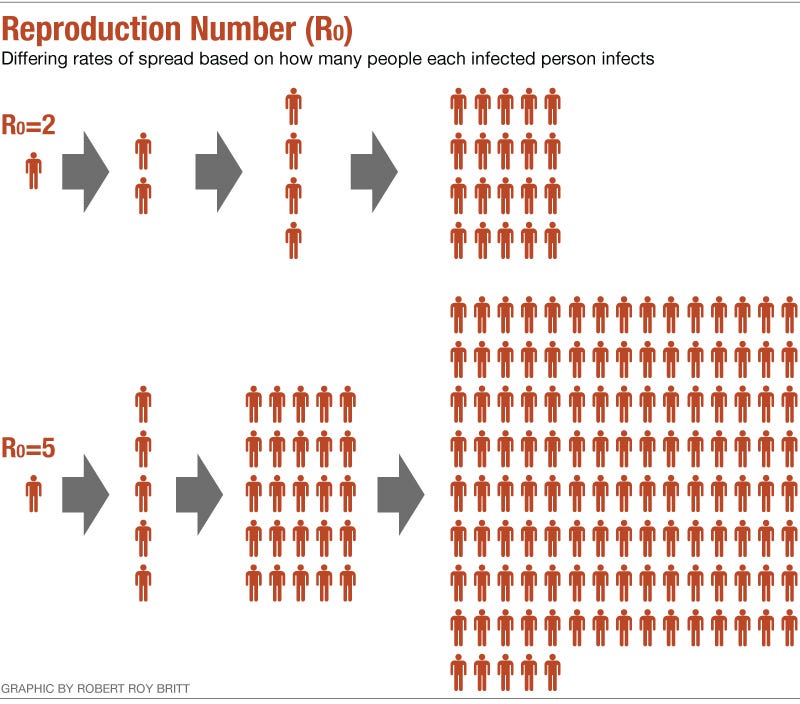
Mina’s point is that there isn’t just a single R0. Covid-19’s spreadability is dependent on its environment and ecosystem.
The virus spreads most easily anywhere people are packed tight, whether in a city in general or more localized, such as a neighborhood or a nightclub or a senior care center.
Most Covid-19 transmissions occur in clusters, says Jamie Lloyd-Smith, a University of California, Los Angeles professor who studies the ecology of infectious diseases. “Most people do not transmit,” Lloyd-Smith tells Science Magazine. An example might be someone who feels sick and stays at home, versus someone who has no symptoms, or ignores their symptoms, and carries the disease into a crowd. Such was the case recently 61 people attended a choir practice. One person carrying Covid-19 led to 53 other infections and two deaths.
There may be a climatic effect on the spread, too. If the virus is less active in warmer, humid weather, for example (we don’t know if it will be, nor to what extent), then its R0 would go down in summer, back up in the fall.
Mortality rate is a spectrum
Covid-19’s death rate, commonly called mortality, is thought by most experts to be, on average, higher than for the flu, which is said to kill about 0.1% of those infected. But any such calculation for Covid-19 right now would be a “case fatality rate,” not a true “infection mortality rate,” because, again, we don’t know how many have been infected.
Either way, it’s misleading to think that Covid-19’s mortality rate will turn out to be a single number.
“There’s a spectrum,” Mina says. “The skew is toward the older age groups, in a very profound way.”
The average Covid-19 mortality rate across the population has been estimated at between 0.5% and 0.8%, Mina says. But that doesn’t reflect the individual risk of dying from the disease for all age groups. Though no age group is immune from serious Covid-19 consequences and even death, a 15-year-old is not likely to have anywhere near that average stated risk of dying after being infected, and a person over 75 may have a risk that is 10 times greater, or even more, than the average, he says.

When better measurements are available, Mina figures the mortality rate for the very young will turn out to be less than the flu, and for the very old it will probably be higher than the flu. “That makes it a unique virus compared to influenza,” he says.
What matters in the end
The spreadability and mortality figures, and what they actually turn out to be, have implications for rural areas of the United States, where 17.5% of the population is 65 or older, compared to 13.8% in cities.
Already, some rural areas in the United States have seen high rates of Covid-19 transmission and death. Per capita Covid-19 mortality in some impoverished counties in Georgia is among the worst in the country, the Associated Press reports.
There are many factors that make rural situations different from the urban experience. Some research suggests that urban dwellers may be more cognizant of infectious-disease risks in their crowded situations, whereas rural residents may have more tight-knit social networks, in which it’s common to visit with family and friends. There may be just one grocery store in a small town, or one church — places where one person could infect a large percentage of an overall small population. Rural areas also face challenges with lack of healthcare. Many entire counties don’t even have ICU beds.
On some level, all this is semantics and math. While epidemiologists work on figuring out coronavirus reproduction and mortality figures, perhaps the rest of us just need to practice smart physical distancing and don our facemasks, keeping the highlights of the science in mind: Covid-19 spreads easily; young people can be unwitting super-spreaders and are not immune to serious outcomes; and the disease has already proven to be deadlier than any U.S. flu season in 50 years.