
Confessions of a Teacher Who Can No Longer Teach
And the messy and humbling quest to figure out how to best support children and young people
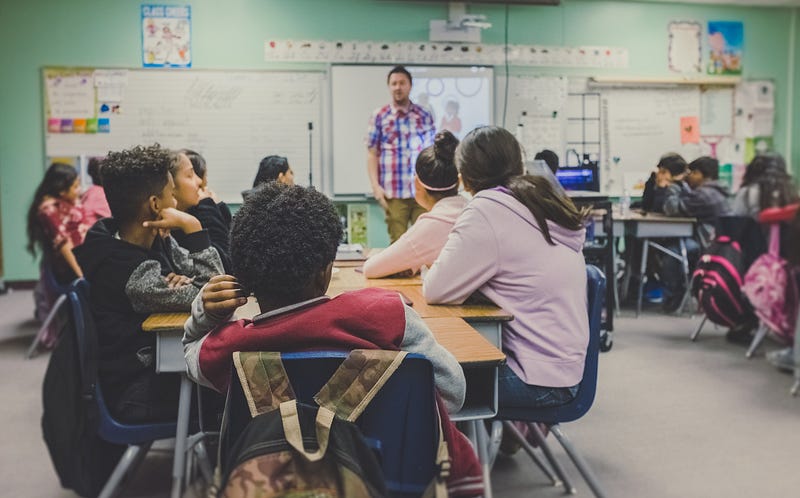
I recently found my match in a group of nine-year-old boys who pushed me to the edge of my skills and made me question what I’m doing.
I wish there was a better way to tell this story or paint a glossy picture to give you hope. Alas, I cannot. Any attempt would be dishonest and negate the only thing I have going for me — the messiness of my intuition.
I’ve been working with children on and off for twenty-five years — a career or vocation I have quit or redirected several times.
In all my adventures, working with children is the one that filled me with the greatest joy and ease. It’s the kind of no-brainer magic that lands in the centre of an Ikigai Venn diagram, and yet I cannot abide accepting this as my gift. Because the truth in all of it is, I’m a terrible teacher.
Where it started
I started out at eighteen-years-old working in an outside-school-hours care program at a local primary school. I got to see the different ways children showed up — some loved school while for others it was traumatic.
Over a period of four years, I came to work most closely with boys who didn’t fit into mainstream education. Their learning needs were not supported, which frequently led to social and behavioural challenges that many adults couldn’t handle.
Often there was a lot of trauma, although we didn’t talk about it in that way back then. My first turning point came when a ten-year-old boy disclosed he had attempted suicide the previous evening.
At twenty-one I felt inadequate to respond to his needs, which led me on a journey to find new ways to support young people in their social and emotional challenges. [Side note: he and I are still connected, and he is doing well.]
Let the mountains teach
I went to work for Outward Bound, taking groups of young people on long expeditions into the wilderness. There’s a magic about Outward Bound that shaped the way I do almost everything in my life.
The humbling heart of the approach is that nature is the teacher. The experience was never about us as group leaders. There wasn’t a platform at the front of a walled classroom that gave us power or kept the attention on us.
The adage in Outward Bound is to let the mountains speak for themselves. Nature has its own rhythm and transformation takes its own sweet time. It cannot — or should not — be rushed. And if you give it enough time, the mountains will change people.
I had to give my students space
I ended up in a high school as a teacher. It was soon evident that my talents were best served outside the classroom.
After a fish-out-of-water year teaching English, they changed the focus of my role. To be sure, I love English, words, and reading. But I could see how inadequate I was in that role and how the curriculum was a massive disconnect from the needs of the young people I was serving.
I had more success inspiring young people to read and write outside the classroom through some creative approaches I’ll link to at the end of the article.
I ended up creating a program teaching fifteen-year-olds conflict management through games, and then taking them to a local primary school so they could teach younger children about how to resolve conflict.
The best way to learn is to teach. The approach honoured the skills and capabilities of the young people and put them in front of an audience that matters. They had to step up, so they did.
For my students to become the teacher, I had to give them space to succeed and fail. It meant standing back, staying quiet, and not rescuing them when the heat was on. Naturally, it worked.
Outside of these and many more positive moments, there were equally challenging ones. School cultures can be as uninspiring and demoralising for teachers as much as students. I ultimately left in search of other approaches.
Story is the deepest work
I later found myself working with teens in out-of-home care. Their complex trauma backgrounds required a great deal of presence and creativity.
When working with any young person — or even adults for that matter — the deepest work is on one’s story. No learning or growth will ever take place if the internal story doesn’t allow for growth.
I arranged a private party for a group of teens at the Big Brother house. I saw that their lives in foster care were not that different from the reality TV show:
- They were forced to live in conditions outside of their control.
- They had to keep their bags packed and be ready to go, as they could be evicted at a moment’s notice.
- People they didn’t know had information about their lives and spun a narrative they had no control over.
The most important work was to help them reshape their personal stories, and Big Brother proved an ideal vehicle. They got to meet the series winner, who’d overcome his own trauma experiences.
Each young person had a chance to reshape their own story in the safe and supportive presence of peers. I’m not sure there is anything more powerful than that.
Except, perhaps, the power that comes through the consistent presence of someone in your life over time. And this is the invisible power many teachers bring to their profession.
Teaching is about much more than standing in front of a class and imparting knowledge. It is the love, skill and care that is gifted when working with young people over time. It is dangerous for any society when the power of this is undervalued or not recognised.
Sometimes the important work is messy
I recently found myself working in a school with a group of five boys with high social and emotional needs — the kind that needs one-to-one support and attention.
I met my match and felt inadequate in being able to respond. The school asked me to work with the boys for a couple of hours a week over four weeks. They need much more than this, but the school doesn’t have the resources to provide it.
My approach is intuitive and messy. I let them initiate play and I stay with them as they work through (or not) the inevitable challenges that come up when children play.
Schools are increasingly driven to achieve results and want to see changes that can only be achieved through a natural and supported process over time.
Access to nature, outside space and silence is almost non-existent in modern schools, and we wonder why kids can’t cope. School systems place unspeakable demands on teachers to do things that don’t support the whole development of a child.
When I work with schools, I no longer feel like I am making a difference in the life of a child. If anything, I reflect back to boys’ teachers what I am observing in an attempt to support them in their roles. Teachers still have my deepest respect and admiration.
This article was inspired by a prompt from Raven Witch in response to an article I wrote about seeing beyond ‘bad behaviour.’ Raven wanted to know more about what I do and my approach to working with children.
There isn’t any formula. My approach is messy and intuitive and the furthest thing from what schools currently consider teaching. I’m not sure it is what Raven or I expected, but nonetheless, this is my story.


