
Concept Dynamics: An Ontological Discussion about “Service”
“Service Thinking”, “Design Thinking”, and “Service Design Thinking”
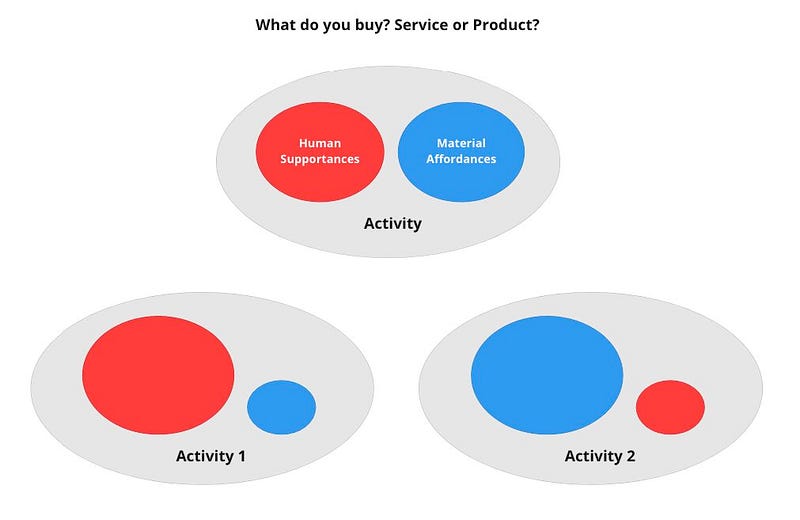
One week ago, I had a wonderful discussion about “Service” with a friend on Linkedin. The discussion is an Ontological Discussion about “Service” for the “Service Thinking” project.
I used the above diagram for our discussion. This article offers more information about the discussion.
The Background
On Feb 10, 2022, I published Thematic Space: The Connected Hub and “Service Thinking” and started a new project that aims to connect Activity Theory and other theories with Service. See the diagram below.
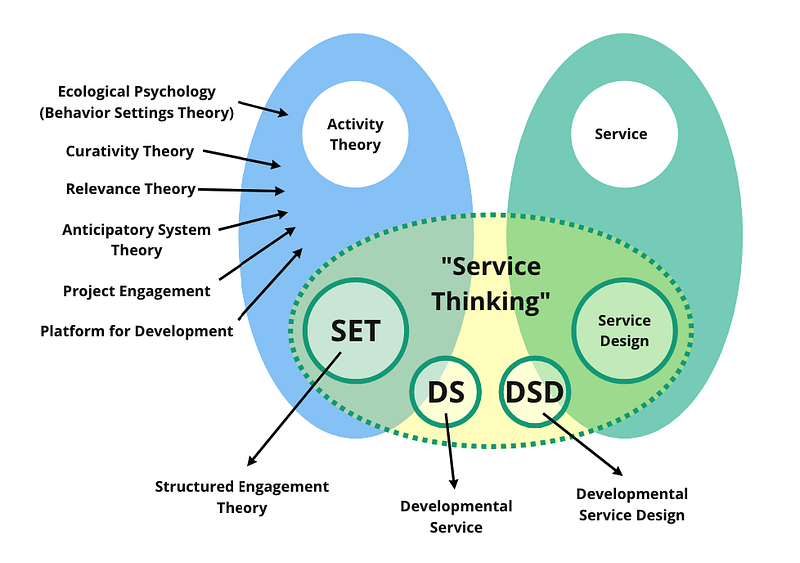
The above diagram represents the process of connection. My first spark is SET which stands for “Structured Engagement Theory”. To be honest, it is just a framework, not a theory. However, I want to keep the name “SET” because it points out the core of the framework. In order to keep the name “SET”, I have to keep the word “Theory”. Anyway, let’s call it SET or the SET framework.
In 2019, I started adopting some theories to reflect on my experience and thoughts about “Social (Digital) Design” which refers to digital products for interpersonal communications. Eventually, I developed the SET framework and used it for my own projects later.
The notion of “Developmental Service” is a new idea. I just made it in Feb 2022. It refers to a special type of service such as educational services, summer camps, adult life development programs, life discovery activities, etc. This notion refers to my own perspective of individual development. It also echoes the concept of “Developmental Platform” and the “Developmental Project Model”.
In 2021, I used the SET framework to study Digital Whiteboard Platforms in order to test my book Platform for Development. I recently used the SET framework to study an adult developmental program. This change encourages me to think about the connection between my theoretical frameworks and service design.
Finally, I found the notion of “Developmental Service Design” is a great connector.
The article about the above ideas was published on Feb 10, 2022. In the past two months, I started hosting a 1:1 life coaching program on Milanote. The program is called AAS4LT which stands for Anticipatory Activity Systems (AAS) for Life Transitions (LT). See the screenshot below.
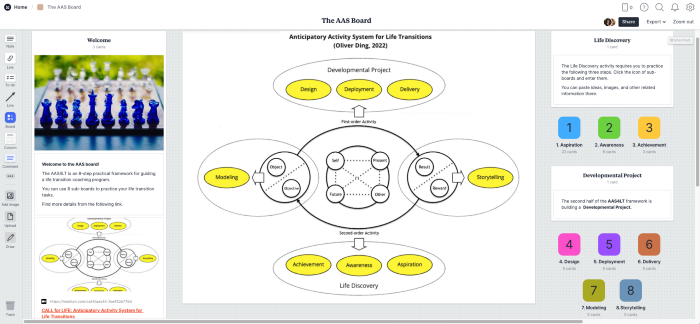
The AAS4LT framework was formed with 8 steps.
- Aspiration
- Awareness
- Achievement
- Design
- Deployment
- Delivery
- Modeling
- Storytelling
The AAS4LT framework aims to offer life coaches a new tool for dealing with life transitions from the perspective of the Anticipatory Activity System framework. Though the theoretical support is very important, the result depends on the long-term engagement between life coaches and clients.
I use Milanote to build a prototype of the AAS4LT 1:1 life coaching program.
You can find more details about the AAS framework and the AAS4LT framework here.
The Concept of “Service”
I also want to mention a theoretical concept called “Supportance” which is a core concept of the Ecological Practice Approach. In 2021, I applied the idea to develop the Platform for Development framework. I also used it to develop the Lifesystem framework.
From the perspective of the Ecological Practice Approach, the concept of “Supportance” is a perfect concept for understanding the concept of “Service”. I’d like to emphasize the Ecological Practice Approach is inspired by Ecological Psychology, it’s not a theory of economic theory.
While we tend to understand the concept of “Service” from the economic perspective, it doesn’t mean we can’t understand the concept of “Service” from other perspectives.
What’s “Supportance”? I published The Concept of Supportance: An Ecological Approach to Social Support and Beyond on March 12, 2021. The article started with the picture below.

Two women are standing on the beach by the sea, carrying a big picture frame. It is a normal sense. How can I use it for theoretical development?
Let’s consider it as a minimal collective activity. There are at least three people here, the two women carrying the frame, and a photographer taking the picture. It is worth noting that any one of these three people is an indispensable component of the activity. Without the photographer, no one came to take this picture. If there is only one woman, she can’t carry such a big picture frame, thus this shooting activity — taking such a specific photo — can’t be accomplished.
Usually, the story I described could lead readers to the notion of ‘Social Support.’ Traditionally, researchers pay attention to the effect of social support on health, quality of life, and especially mental health. I aim to adopt the ecological practice approach to discuss the notion of ‘social support’ in a broader scope in a general sense.
Suppose there is only one woman and a 3-year-old girl at the scene. The woman can’t hold the picture frame because the little girl doesn’t have enough strength to help her. Thus, the woman should look for potential support from others who could offer such support with corresponding capacities.
The concept of Supportance refers to potential supportive action possibilities offered by the social environments. It is inspired by Ecological psychologist James J. Gibson’s concept of Affordance which refers to potential action possibilities offered by environments. Both two concepts are potential action possibilities. However, the concept of Affordance can be applied to both animals and humans and Gibson uses it for talking about visual perception. In order to discuss potential supportive action possibilities between a person and other people and social environments in general, I coined the term Supportance and developed it as a theoretical concept for the Ecological Practice approach.
To be honest, I didn’t think about “Service” when I was working on the concept of “Supportance” in March 2021. Now we can use the concept of “Supportance” to understand the concept of “Service”. Let’s look at the definition of “Supportance”:
The concept of Supportance refers to potential supportive action possibilities offered from a social environment.
Moreover, from the perspective of Supportance, ‘support’ means not only intended support but also unintended support.
- Intended support: Person A intends to give some support to person B.
- Unintended support: Person A doesn’t intend to give some support to person B, but person B actualizes some supportances which are offered by Person A.
Both intended support and unintended support require Perception and Capability from Person B, however, unintended support doesn’t require Intentionality from Person A. The same logic can be applied to the level of institutionalized actions.
Since Supportance is potential, if we don’t talk about its actualization, then this concept doesn’t have any value. Once we pay attention to the actualization of supportances, we see a new creative space for developing a new theory of social actions.
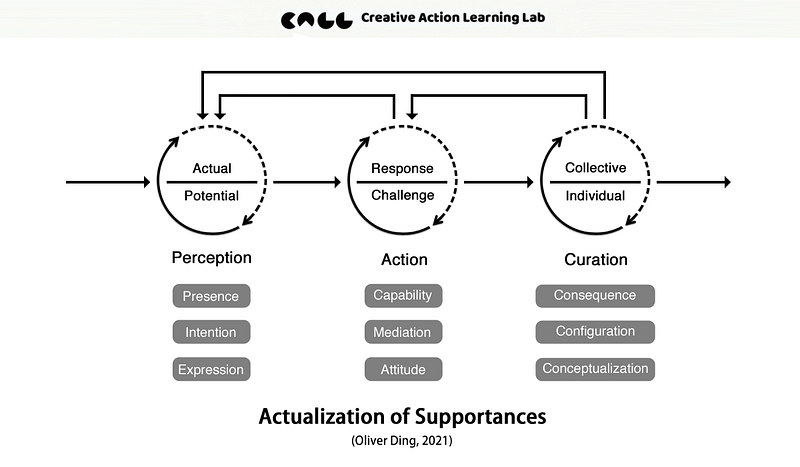
The above diagram roughly presents my ideas on the Actualization of Supportances which considers a structure of three phases. Phase 1 is Perception, it focuses on the transformation between Potential and Actual. Phase 2 is Action, it focuses on the transformation between Challenge and Response. Phase 3 is Curation, it focuses on the transformation between Individual and Collective. As a dynamic process, these three phases don’t form a simple linear process. Phase 2 and phase 3 often provide feedback to phase 1.
If we apply the above Supportance Framework to discuss “Service”, then we can consider “Service” as “Actualization of Intended Supportance”.
Why didn’t I connect “Service” with the concept of “Supportance”? Because my primary interest is “Unintended Supportance”. However, I recently started paying attention to “Intended Supportance” after having a discussion about charity with a friend.
So, this is my view on the concept of “Service” from the Ecological Practice approach.
If you want to explore more perspectives on the concept of “Service”, you can check out the following ideas:
You can also recommend relevant perspectives by leaving a comment.
The Concept of “Service Design”
I have read many books and articles about Service Design. However, I can’t figure out the following question:
What’s the difference between Product Design and Service Design?
For example, let’s look at Steven J. Slater’s definition of Service Design:
Service Design is a non-aesthetic design practice that helps service providers offer a benefit to users. The user-centric tools and techniques of the practice allow providers to achieve more predictable, successful outcomes. The tools and techniques used by service designers are used to design new services and address concerns or challenges with existing services, such as whether to improve the service, alter key parts of the service to adapt to changing circumstances and assess the value of a service to users and providers alike.
Furthermore, a successful service is one that ‘satisfies’ the needs of users by having them achieve a desired outcome through a reliable service experience.
Steven J. Slater is a service designer and co-founder of the International Service Design Institute.
I made a common on his post and used “product” to replace “service”:
Product Design is a non-aesthetic design practice that helps product providers offer a benefit to users. The user-centric tools and techniques of the practice allow providers to achieve more predictable, successful outcomes. The tools and techniques used by product designers are used to design new products and address concerns or challenges with existing products, such as whether to improve the product, alter key parts of the product to adopt to changing circumstances and assess the value of a product to users and providers alike.
Furthermore, a successful product is one that ‘satisfies’ the needs of users by having them achieve a desired outcome through a reliable product experience.
It works perfectly too! This test encouraged me to think deeply about the concept of “Service Design”.
I think we need a real theory about Service Design in order to make a difference between Service Design and Product Design. Thus, I shared this idea on Linkedin and gave my definition:
I’d like to give a theoretical definition of “Service Design”:
Service Design is a design practice that aims to design an activity of offering supportances.
This definition is inspired by Activity Theory and the Ecological Practice approach.
From the perspective of Activity Theory, a service is an activity.
From the Ecological Practice approach, Service is about Offering Supportances which refers to human to human engagement while Product is about Offering Affordances which refers to human to material engagement.
The major difference between Service Design and Product Design is the former considers double-side agency while the latter only needs to think about single-side agency.
For example, if we design a developmental service such as “teacher — student” engagement, we need to think about both teacher’s agency and student’s agency.
However, if we design a book for learning, we can focus on “book — reader” engagement. A book doesn’t have agency.
A friend who is a co-author of two books about Service Design made some comments from their perspective:
If I get to page 47 of my book and find ten pages missing, what happens? The publisher or bookshop replaces it. It’s the same as if a restaurant meal is below quality, or a haircut is poorly done. And the book may transform me, just like a lecture might.
A service is a product is a service. :)
I replied to him with the following message:
You are right. If you call the publisher or bookshop, someone should respond to you and mail a new book to you. This interaction is about human-to-human engagement. This is a service.
I really like your Service Design Thinking approach.
I just want to explore something that is related to my theoretical approach. Maybe I should stop using the word “Service” for discussing “human-to-human engagement”.
Each theoretical approach has its own primary focus. My approach focuses on the evolution of Affordance (human-to-material engagement) and the evolution of Supportance (human-to-human engagement), and the “Afforadnce — Supportance” transformation.
In this way, I need to identify the piece of “‘human to material’ engagement and the piece of “human to human” engagement.
Why? Because new technology will offer new affordances that can replace old Supportance. It means some old Human services will be replaced by Technological Products.
For example, HireVue offers video interviewing solutions for HR teams. Before, the interview process is about human-to-human engagement. After, the interview process is about human to material engagement.
He replied with the following message:
Sorry, I still don’t see how the distinction is useful. I’m annoying, I know ;) That interview machine will presumably be some kind of AI, so not human to human but at least human to intelligence; perhaps soon (human) person to (artificial) person. How is it relevant that the agent it is made up of cells rather than chips? :). Perhaps I am just too far away from the theories you describe; for me it seems like a non-useful distinction where almost every conceivable value exchange includes both sides, and the line between them blurs as non-humans become intelligent actors.
I realized that we are talking the same thing at two different levels. I am talking about the Ontological level: how to define a thing (concept)? He is talking about the Epistemological level: how to understand a thing (approach)?
One thing is the nail while the other thing is the hammer.

The Ontological Discussion
So I made the diagram below and started a new post for an ontological discussion.
This is an ontological discussion, not an epistemological discussion. While the ontological discussion is about discovering a definition of a concept for a thing, the epistemological discussion is about developing an approach to understanding a thing.
For example, Service Design Thinking (SDT) is “an interdisciplinary approach” is an approach (2011, p.28–29). It doesn’t want to define a concept. The authors of This is Service Design Thinking claim that “Service Design is an evolving approach, this is particularly apparent in the fact that, as yet, there is no common definition or clearly articulated language of service design. A single definition of service design might constrain this evolving approach, whereas a shared language is undoubtedly important for the further growth and development of service design thinking.”
This post doesn’t aim to discuss the development of Service Design Thinking (SDT). I am going to discuss the ontological definition of the concept of “Service”.
First, I start with an activity that combines two parts: 1) human supportances (human-to-human interaction), and 2) material affordances (human-to-material interaction).
Second, we need to perceive a real activity in the real-life world. Let’s say there are two types of activities.
Activity 1
The part of human supportances is bigger than the part of material affordances.
Activity 2
The part of material affordances is bigger than the part of human supportances.
How do people perceive Activity 1 and Activity 2?
Should we call Activity 1 “Service” and consider Activity 2 “Product”?
Now let’s move from perceptual psychology to business. The core of any business is buying something.
The common sense of business knowledge tells us, that if you buy a product, you will own the product.
However, if you buy a service as a customer (not an investor), you can own the service. What you can own is the experience of using the service.
Why can’t we own a service?
The major difference between Product and Service is the Objectification of Value.
1) Product: the Value is objectified with a material object. You buy a product, then you own an object which is the container of value. You can resell the Value by reselling the Product.
2) Service: the Value is objectified with an experiential event. The container of value is a process, not a material object.
I think Joe Pine’s book The Experience Economy offers a clear distinction between Product and Service. This is a common sense of business knowledge.
I’d like to emphasize this discussion doesn’t impact Service Designing Thinking (SDT) because SDT is an approach that can be used to understand Activity 1 and Activity 2.
The Concept of “Service Design Thinking”
The friend provided more information about his books and service design:
Thanks for the tag. It’s an interesting discussion. :)
A couple of thoughts for you…
TiSDT is ten sears old, and in the 2019 sequel This is Service Design Doing, we did indeed discuss definitions, testing many of them with practitioners and choosing a “favourite”. You might find that interesting.
Also, the authors of “TiSDT” never used the term “service design thinking” except in the title of the book which was a mostly graphical gag to include both the terms “service design” and “design thinking” without wasting words. Throughout the book, and its two sequels, they speak only of service design and design thinking. Since then, others have started treating the term “service design thinking” as if it were a thing; whereas the authors were actually saying there is no difference between DT and SD.
The graphic with affordances and supportances reminds me a bit of the spam sketch in Monty Python.
One is eggs, eggs and spam; the other is spam, spam and eggs. But they are both eggs and spam, and it seems strange to have different names for them. :)
He also mentioned Service-dominant logic:
Another thought: you say that a product is a container of value, which I can resell. Can I resell my worn out socks? Or last year’s cheese?
I can resell the knowledge from a qualification. So socks and cheese are services and training is a product?
This is why I find service dominant logic more useful.
This conversation led to the Ontological definition of “Service Design Thinking”. I replied to him with the following message:
I think the difference between DT and SD is the issue what we are talking about. DT doesn’t use “service” to cover everything while SD uses “service” to cover everything.
We can use DT for everything, a service, or a product.
We can use SD for everything too, a service, or a product.
Why do we need a new name for DT if there is no difference between DT and SD?
If SD is a sub-field of DT and it focuses on service only. That’s fine.
If SD adopts Service-dominant logic as a foundation, then this is a major difference between SD and DT. DT doesn’t claim that its foundation is Service-dominant logic.
From his comment, they only used “Service Designing Thinking” as the title of a book. They don’t want to establish a new approach called “Service Designing Thinking” because “Design Thinking” is the approach to “Service Design”.
They also adopt “Service-dominant logic” as a perspective to view products and services in order to apply “Design Thinking” techniques.
I am not familiar with the development of the “TiSDT” community and the “Service Design” community in general. Maybe they could claim that “Service Designing Thinking” is an approach that is defined as “Designing Thinking + Service-dominant logic”.


