
Colitic
Your bowels… and Lady Mondegreen’s

Today’s New York Times Spelling Bee letters:
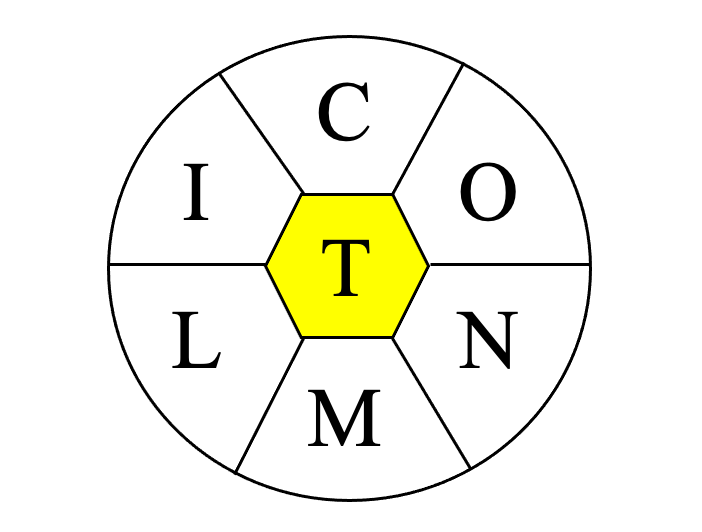
C, I, L, M, N, O, and center T (all words must include T)
Merriam-Webster says…
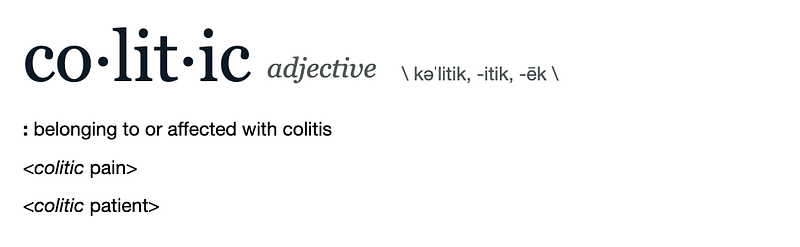
Silly little dictionary! Don’t you know that colitic can’t possibly be a word if The New York Times says it ain’t?
For further fascinating facts, check out the Spelling Bee Master.
What’s your favorite dord* from today’s puzzle?
My Two Cents
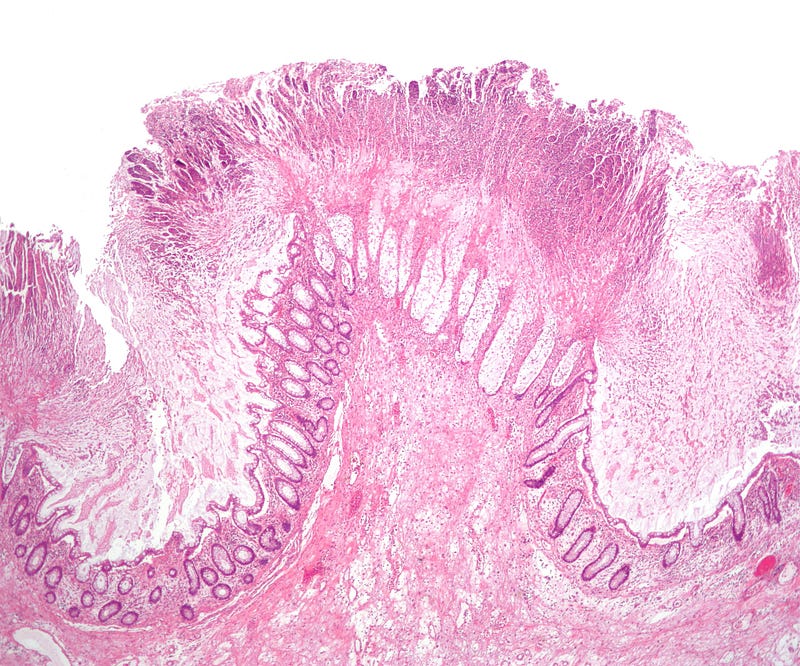
If you recognized what the photo at the top of today’s column shows, I’m impressed. Double kudos. No, triple! It’s not a close-up picture of cotton candy I bought at the country fair two months ago. And it’s not one of those colorful, fancy glaciers or ice floes from an obscure and freezing part of Norway.
Technically speaking, the image is a micrograph of a colonic pseudomembrane. In layperson’s terms, what you’re looking at is a photo of an inflamed bowel, taken under a microscope. The inflammation of the large bowel (colon) is known as colitis. In medicine, the -itis suffix is used to designate anything that’s swollen. If your tonsils hurt when you swallow, it’s likely tonsillitis; when you need emergency surgery due to an inflamed appendix, it’s because you had appendicitis.
To my knowledge, the Spelling Bee game has never included the letter “s”. So the word colitis will probably never be an accepted answer. But it’s still odd that colitis was rejected in today’s puzzle. After all, it’s not like people who speak English couldn’t make the logically linguistic jump from the noun to the adjective form. Especially those of us who watched The Nanny in the 1990s. (More about that later.)
In any case, if you want to know who Lady Mondegreen is and how she’s connected to colitis, read on! (And if you don’t, please just scroll down slowly to help me earn those daily 13 cents.)
Bowel power
Our friends at Merriam-Webster tell us that colitis is New Latin, combining the prefix col- (large intestine) and -itis (inflammation). And the dicitonary further tells us that colon comes from “Latin, large intestine, from Greek kolon; perhaps akin to Lithuanian skiɫvis belly, Armenian kʽałird guts.”
If you still have all of your colon ––I don’t, but that’s a story for another day–– you might want to peruse the handy guide below to get to know its four sections better.
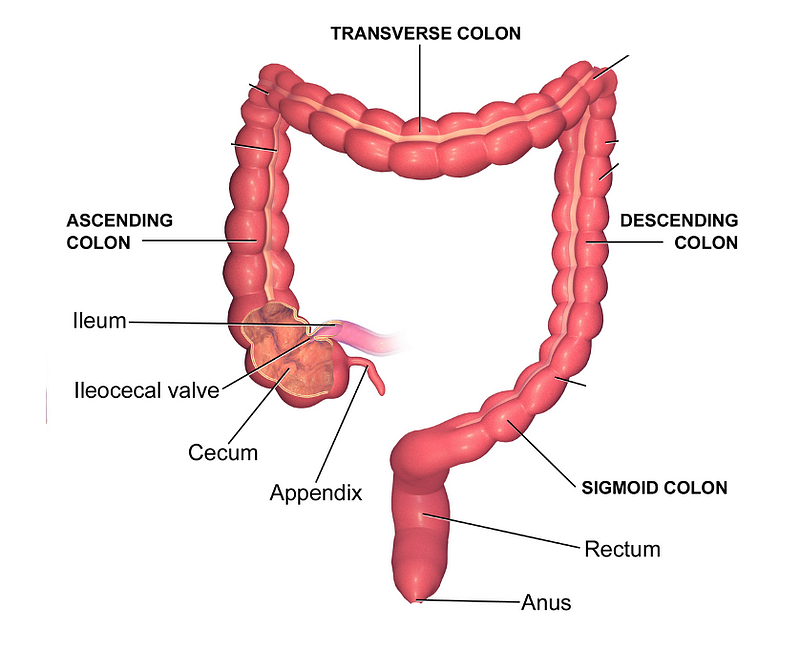
And if you want to read about the cecum (and help me earn an additional 13 cents today), please check out my article on that word, written in March.
Colitic digestive disease can either be acute (short term) or chronic. One of the better-known lifetime colitic conditions is Crohn’s disease, a genetic inflammatory bowel disease (IBD) whose symptoms include abdominal pain, diarrhea, fatigue, weight loss, and nutrition issues. Although Crohn’s typically attacks the colon, it can also be present in the small intestine. In addition, people with Crohn’s tend to suffer from inflammation in other parts of the body, kidney stones, and anemia, or iron deficiency.
Similar to Crohn’s is the ulcerative colitis, which tends to occur in the descending (left) colon and the rectum. This colitic syndrome includes the development of sores (ulcers) in the digestive tract ––hence its name. Although both ulcerative colitis and Crohn’s are not considered to be autoimmune diseases per se, the immune system does seem to be involved in generating these diseases.
Other types of colitis include:
- Microscopic, in which the bowels appear normal to the naked eye, but inflammation can be detected by viewing tissue under a microscope.
- Ischemic, or vascular, in which the colon does not receive an adequate supply of blood. This tends to happen mostly in elderly people.
- Infectious, due to parasites or bacteria, particularly the one known as C-diff colitis. Even though this bacterium may be present in your digestive system and cause no symptoms, people who are treated with certain types of antibiotics may be particularly susceptible. That’s because other bacteria in the digestive tract are killed, with the Clostridioides difficile then multiplying and releasing toxins at levels that can cause damage to the colon.
- Caused by certain treatments, including radiation and chemotherapy.
As always, we here at Silly Little Dictionary! recommend that you check with your friendly neighborhood spider… no, I mean, doctor… if you come down with any unusual digestive symptoms.
The girl with colitis goes by
We’ve all done it at some point or another: misheard a lyric in a favorite song and blurted it out for everyone to find out. Did you know that this phenomenon has a name, now an official entry in the dictionary?
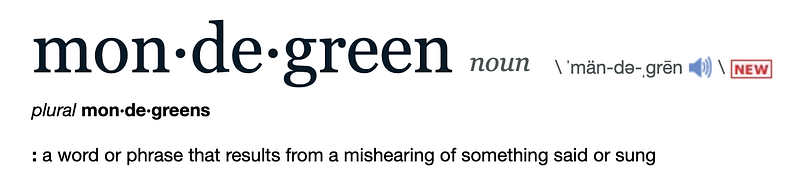
As The New York Times explained in a 1998 article:
According to the word watcher William Safire of The New York Times, the term mondegreen dates from a 1954 magazine article by Sylvia Wright in which she said she had misheard the folk lyric ‘’and laid him on the green’’ as ‘’and Lady Mondegreen.’’ But it remained relatively obscure until its recent adoption by Web sites. The 1954 article employed the term to refer to any aural misinterpretation of a song, hymn, aphorism, advertising slogan, and the like. But on the Net, it applies almost exclusively to misheard lyrics, especially in rock songs.
The folk lyric mentioned above is ‘The Bonnie Earl of Moray’, and the stanza in question goes as follows:
Ye Hielands and ye Lowlands, O, whaur hae ye been? They hae slain the Earl o’ Moray, And laid him on the green.
Sylvia Wright misheard the last line as “And Lady Mondegreen”, probably thinking the Earl’s wife had been killed, too. And thus was born a new term, mondegreen, to describe something people had been doing forever but no one had thought of coining a word for.
Among the lyrics mentioned in the Times article are “Hold me closer, Tony Danza” and “The girl with colitis goes by”. The first example was made famous by the character of Phoebe in the TV show Friends (as “Hold me close, young Tony Danza”):
The second lyric is from the Beatles’ song ‘’Lucy in the Sky With Diamonds’’, in which “The girl with kaleidoscope eyes” is mentioned. I first heard the mondegreen “The girl with colitis goes by” on the 1990s show The Nanny. I couldn’t find the video clip of Fran Drescher saying it, but here is a link to the transcribed dialogue, courtesy of IMDB.
The Times piece also mentions a couple of websites that sprung up to collect mondegreens online. One of them was named The Ants Are My Friends as a tribute to the misheard line “The answer, my friends” from the Bob Dylan song “Blowin’ in the Wind”. That website no longer exists, seemingly, although there is a book by that title. However, the author is not the same person who created the online version.
One website that’s still around from back then is Kiss This Guy, so named in honor of one of the most famous mondegreens in the world of rock music: “ ‘scuse me while I kiss this guy” for “ ‘scuse me while I kiss the sky,”’ from Jimi Hendrix’s “Purple Haze”. The site has a search function and also allows you to submit lyrics.
What’s your favorite misheard lyric? Two of mine are English to Spanish crossover mondegreens. One comes from Christopher Cross’s song “All Right”. The chorus begins with the words “All right, think we’re gonna make it”, but many Spanish-speakers here “All right, pingüino Rodríguez”, which translates as “All right, Rodriguez the penguin”.
And then there’s the famous Twisted Sister song “We’re Not Gonna Take It”. While the band was on tour in Latin America, they found out that Chileans sung the chorus to very different lyrics. Dee Snider’s reaction was epic.
(Huevos con aceite y limón = Eggs with oil and lemon)
That’s it for today! Next time you’re feeling some pain in your belly, you can tell your doctor you suspect you might be colitic. Don’t be surprised if you end up having to explain to them that your bowels are swollen. Not because the physician you picked is a quack… but because the editors of the Spelling Bee decided that colitic is a dord*.
You can check out my previous entry on another dord* here:
*What the heck is a dord, you ask? Here’s the answer: