
Biggin
No need to be biggin us; we’ll tell you all about this word

Today’s New York Times Spelling Bee letters:
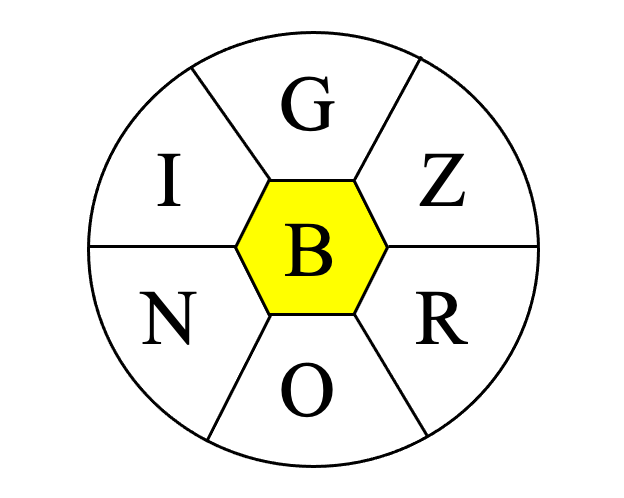
G, I, N, O, R, Z, and center B (all words must include B)
Merriam-Webster says…
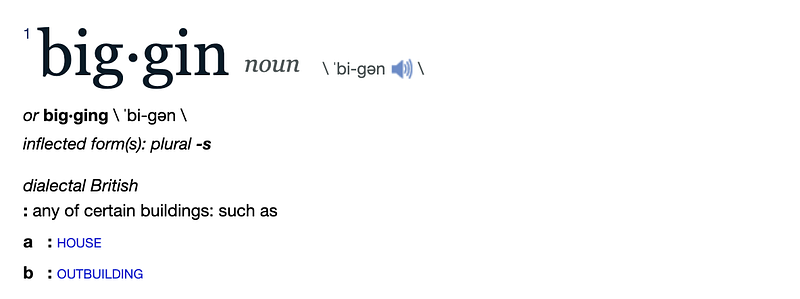
…and…
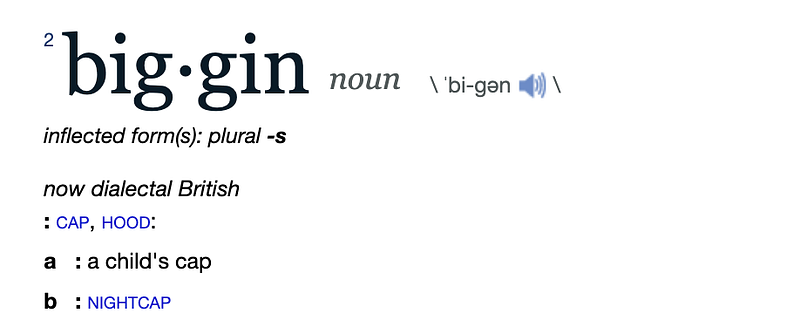
…and…
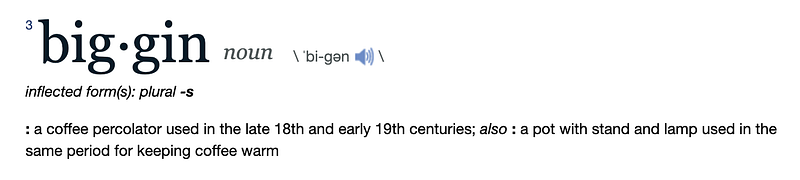
Silly little dictionary! Don’t you know that biggin can’t possibly be a word if The New York Times says it ain’t?
For further fascinating facts, check out the Spelling Bee Master.
What’s your favorite dord* from today’s puzzle?
My Two Cents
You may be wondering what the picture at the top of today’s column has to do with any of the three definitions of briggin I provided. I have the answer to that: nothing.
If you’re wondering how phil anderson took that amazing color photo of a World War II Spitfire with an explosion in the background, well, that I don’t have the answer to. Maybe phil was in the Battle of Britain and is really really really old; maybe he had an ancestor who flew for the Royal Air Force in the 1940s. Or maybe the image is not an original photo, but a retouched one, or even a digitally-created image.
In any case, anderson’s work was one of only three pictures Unsplash provided when I typed “biggin” into its search function. But Spitfires and the Battle of Britain are connected to our daily dord*. Read on to find to find out how.
lowercase b
The dictionary has three separate entries for biggin. Let’s go through them briefly. Briefly, because it was really hard to find information about them.
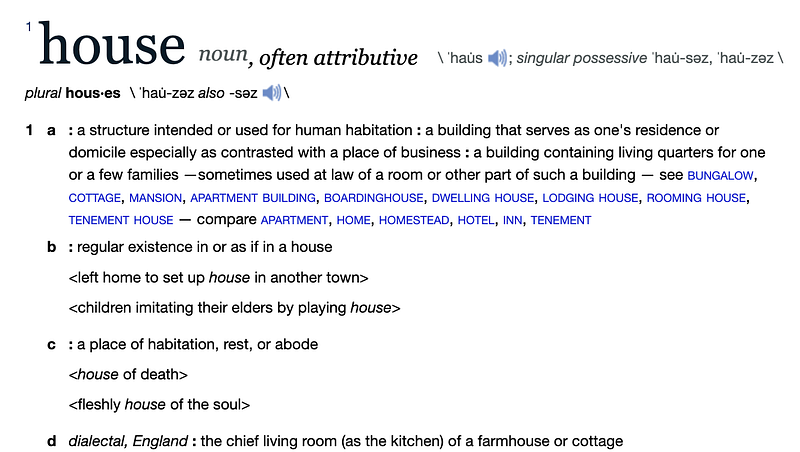
§ Biggin 1 is dialectal British for either a house or an outbuilding. Most people know what a house is, but if you don’t, please don’t feel bad. And here’s a refresher:
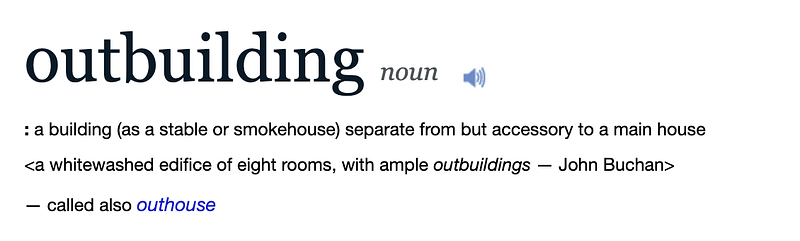
As far as outbuilding is concerned…
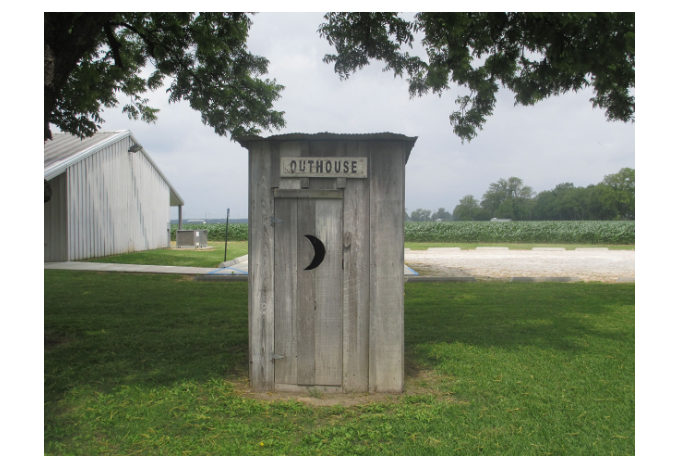
Most Americans probably think of an exterior toilet when they see or hear the word outhouse.
As for the origin of this meaning of biggin, our friends at Merriam-Webster tell us that it came from the Middle English words bigginge, bigging, from biggen (to build, dwell, inhabit) + -inge, -ing -ing. It’s first known use was in the 14th century.
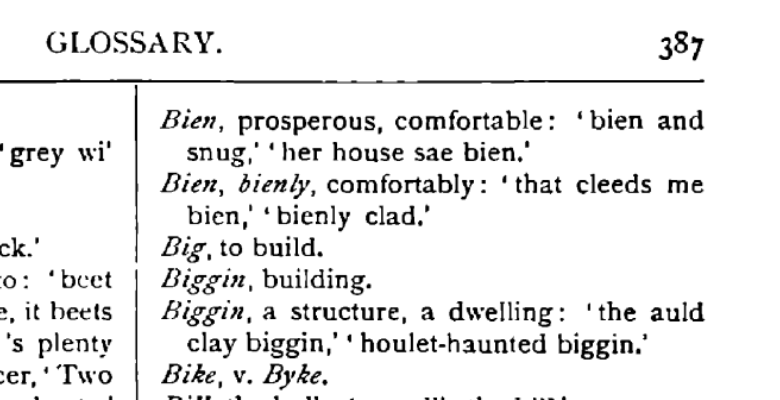
I found this in the glossary section of a book called The Complete Poetical Works of Robert Burns:
§ Biggin 2 is also dialectal British for “cap” or “hood”, specifically a child’s cap or a nightcap:
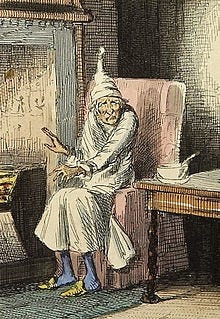
The above is an illustration by John Leech of Ebenezer Scrooge (from Charles Dickens’s A Christmas Carol) wearing a nightshirt and nightcap. Because of the biggin’s association with Ebenezer Scrooge, it has become typical nightwear for people sleeping in comical drawings, cartoons, and children’s stories, plays, and films.
The dictionary explains that biggin came from the Middle French beguin, from beguine (Beguine), from the Old French. Today béguin has two seemingly unrelated meanings in French:
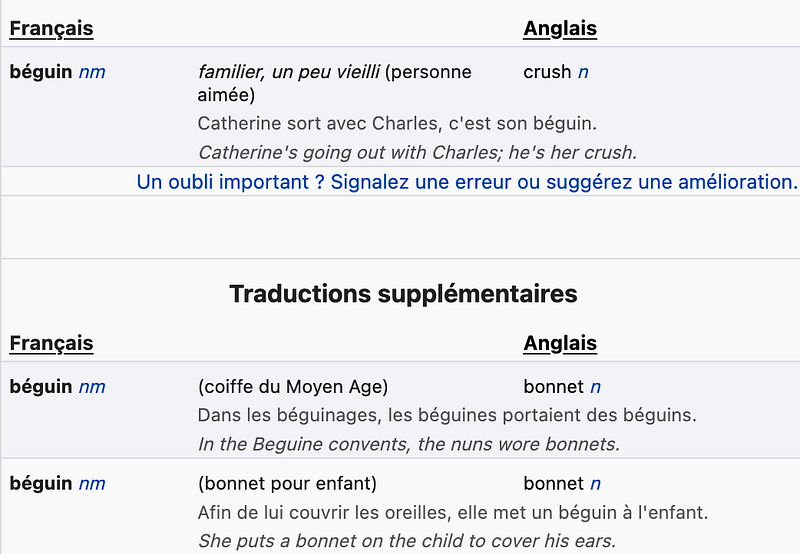
Notice the example sentence underneath the first “bonnet”, the one that mentions Beguine convents. Well, the Online Etymology Dictionary explains this:
From French béguine (13c.), Medieval Latin beguina, “a member of a women’s spiritual order professing poverty and self-denial, founded c.1180 in Liege in the Low Countries.” They are said to take their name from the surname of Lambert le Bègue “Lambert the Stammerer,” a Liege priest who was instrumental in their founding, and it’s likely the word was pejorative at first… A male order, called Beghards founded communities by the 1220s in imitation of them, but they soon degenerated (compare Old French beguin “(male) Beguin,” also “hypocrite”) and wandered begging in the guise of religion; they likely were the source of the words beg and beggar, though there is disagreement over whether Beghard produced Middle Dutch beggaert “mendicant” or was produced by it… Compare English biggin “child’s cap” (1520s), from the French word.
§ Biggin 3 refers to “coffee percolator used in the late 18th and early 19th centuries”. I found no information or references for this in Wikipedia or the Britannicas (the 1911 edition and the current one). I did find a couple of websites that discussed it. But first… Merriam-Webster had an odd origin explanation for the term, and I quote: “after Mr. Biggin flourished1800 its inventor”. Not sure what that “flourished” means.
I found the text of William Ukers’ book All about Coffee, first published in 1922. In Chapter 36 he explains this about the origins of the coffee-making device known as biggin:
About the year 1817, the coffee biggin appeared in England. It was simply a squat earthenware pot with an upper, movable, strainer part made of tin, after the French drip pot pattern. Later models employed a cloth bag suspended from the rim of the pot. It was said to have been invented by a Mr. Biggin; and Dr. Murray, of dictionary fame, seems to have become convinced of this gentleman’s existence, although others have doubted it and thought the name was of Dutch origin, the article having been first made for Holland. It has been suggested that, in all probability, the name came from the Dutch word beggelin, to trickle, or run down. One thing is certain, coffee biggins came originally from France; so that if there was a Mr. Biggin, he merely introduced them into England.
The online version of this book does not provide any images of a biggin, and I couldn’t find any copyright-free ones anywhere, so below is a link to French Garden House, where they have a few photos of this type of coffeepot, as well as instructions on how to use it.
Uppercase B
Biggin wth a capital B refers to several locations in England, including:
- Biggin the village in the Derbyshire Dales district of Derbyshire, England, previously known as Newbiggin. Monks had settled there back then and set up a ranch of sheep at Biggin Grange, where there is still an ancient outbuilding… or biggin.
- Biggin by Hulland is also in Derbyshire, from which it distinguishes itself by using the last name “Hulland”.
- The Selby District of North Yorkshire has both a civil parish and a village named Biggin. Or else the same Biggin is both a civil parish and a village. I’m not sure.
- Biggin is a hamlet and manor in Chadwell St Mary, which forms part of the borough of Thurrock. Thurrock is located in Essex county.
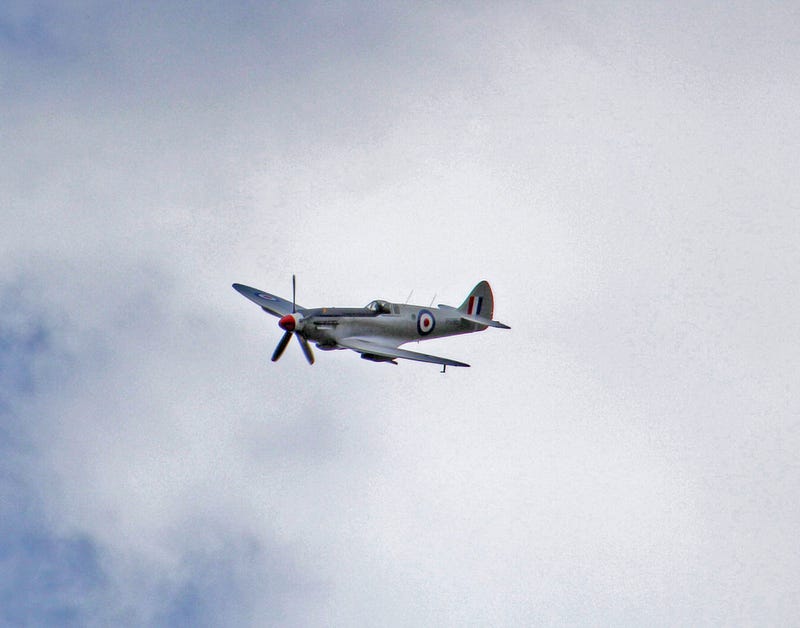
By far the most remarkable Biggins, at least historically, may be Biggin Hill, a district on the south-eastern outskirts of Greater London. As of 2011, it had close to 10,000 residents. It’s importance lies in the fact that its airport used to be Royal Air Force station RAF Biggin Hill, when it served as one of the principal fighter bases protecting London and South East England from German bombers during the Battle of Britain. The squadrons based at Biggin Hill –-consisting mostly of Spitfires and Hurricanes–– claimed to have destroyed 1,400 enemy aircraft, at the cost of the lives of 453 of their aircrew.
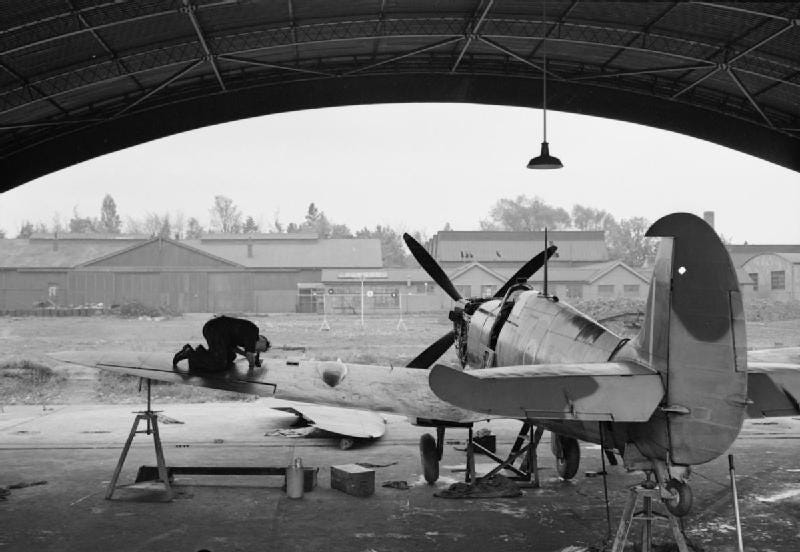
Aha! Now you know why Unsplash offered me three pictures of Spitfires when I searched for biggin. Here’s another one:
That’s it for today! Next time you’re in an outhouse, wearing your nightcap and preparing coffee the old-fashioned way, you can brag to your friends and family you had a triple biggin. They’ll all think you’re crazy, of course… because the editors of the Spelling Bee decided that biggin is a dord*.
You can check out my previous entry on another dord* here:
*What the heck is a dord, you ask? Here’s the answer: