
Kine
Cows, movies, and Japanese ice cream
Today’s New York Times Spelling Bee letters:
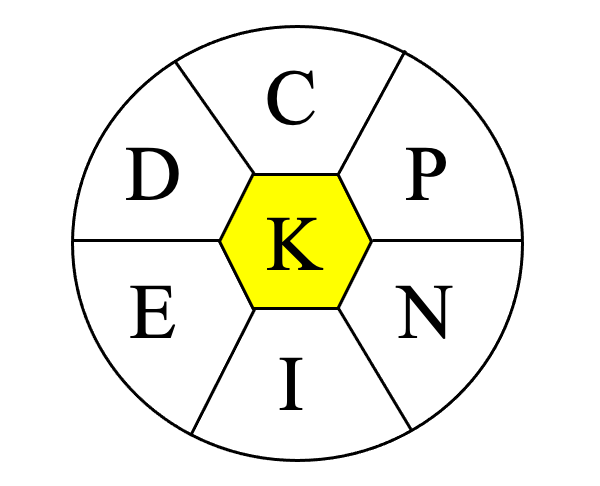
C, D, E, I, N, P, and center K (all words must include K)
Merriam-Webster says…

…and…

…and…

Silly little dictionary! Don’t you know that kine can’t possibly be a word if The New York Times says it ain’t?
For further fascinating facts, check out the Spelling Bee Master.
What’s your favorite dord* from today’s puzzle?
My Two Cents
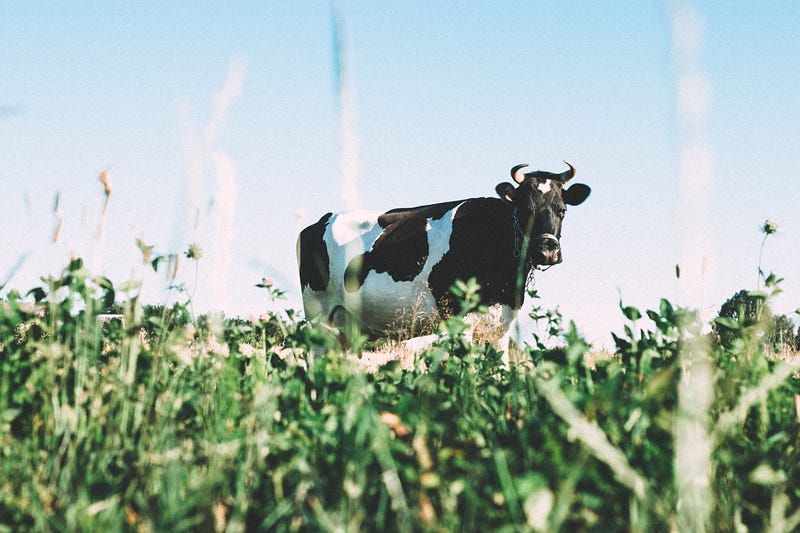
The picture at the top of today’s column is the only one that Unsplash provided when I type “kine” into their search feature. It’s a sharp, clear photo with good composition and taken from an interesting angle. And I am thankful that Angelina Litvin took it and provided it to us free of charge. But there’s one small problem with the image.
It shows only one cow.
Kine is a synonym of cattle, and both are plurale tantum, or plural nouns that do not have a singular form. Other examples in English include jeans, scissors, and heroics. Other languages have them, too. For example, in Hebrew the word for water (mayim) is always named in the plural. And yes, the first name of actress Mayim Bialik (Amy Farrah Fowler in The Big Bang Theory) means exactly that: “water”.
Conversely, there are also singulare tantum, which as you may have guessed are nouns that have no plural. Information, dust, and wealth are three examples.
Still, I decided to use that picture of a lonely cow in the middle of a pasture, if only to have an excuse to write today’s introduction. Kine was not my first choice for this article. I wanted to write about the dik-dik, but unfortunately the dictionary does not accept the variant without the hyphen. Hyphenated words are a big no-no in the Spelling Bee rules.
English kine
The dictionary provides three separate entries for the word kine in English.
§ Kine 1 Regarding the origin of the word as the plural of “cow”, our friends at Merriam-Webster do not provide an explanation. But the Online Etymology Dictionary says this:
archaic plural of cow (n.); a double plural (compare children) or genitive plural of Middle English kye “cows,” from Old English cy (genitive cyna), plural of cu “cow.” The old theory that it represents a contraction of Old English cowen has been long discarded.
The word kine appears in a few articles of the 1911 Encyclopedia Britannica. The one about the Guru Granth Sahib, the holy scripture of the Skihs, explains that “It is also generally believed that the Sikhs are bound to abstain from the flesh of kine. This, too, is a mistake, arising from the Sikh adoption of Hindu usages. The two Granths of the Sikhs and all their canonical works are absolutely silent on the subject.” And in another, about Ireland, the author states that “Wealth consisted in cattle. Those possessed of large herds of kine lent out stock under various conditions.”
The term was also commonly used in older English translations of the Bible. In the King James Version, the word kine appears 24 times. Here are a couple of examples from the story of Joseph and the Pharaoh. Pharaoh has a dream about cattle that Joseph interprets correctly, earning his favor and a get out of jail card. These verses are from Chapter 41 of the book of Genesis.
2: And, behold, there came up out of the river seven well favoured kine and fatfleshed; and they fed in a meadow. 3: And, behold, seven other kine came up after them out of the river, ill favoured and leanfleshed; and stood by the other kine upon the brink of the river.” 4: “And the ill favoured and leanfleshed kine did eat up the seven well favoured and fat kine. So Pharaoh awoke.
§ Kine 2 is defined as “ a variant of cine”. Clicking on the link takes us to this entry:
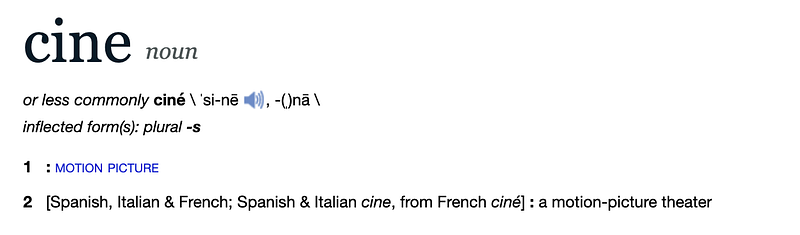
As for the origin of cine, Merriam-Webster explains that it is partly short for cinema, partly from French ciné, short for cinématographe. The year of first known use is given as 1920, but only for sense 1.
As for sense 2, I can tell you that in Spanish the word cine is used to refer to both the movie and the theater where it’s screened. Thus, the Spanish expression Vamos al cine could be translated as either “Let’s go to the movies” or “Let’s go to the theater”.
§ Kine 3 is simply defined with the link blue kinescope, which we also clicked out of sheer obligation to our readers.
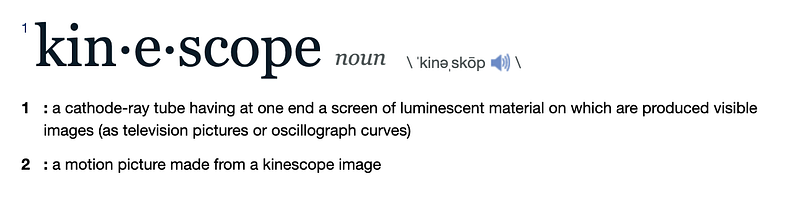
This term originally referred to the cathode ray tube used in television receivers, as named by its inventor, Vladimir K. Zworykin in 1929. And the recordings of television program on motion picture film made directly via a lens focused on the screen of a video monitor were known as kinescope films or kinescope recordings. In Britain the tech was also called telerecording.
Here is a General Precision Laboratories (GPL) kinescope (c.1950–1955); you can see the movie camera bolted to the top of the cabinet to film the video images.
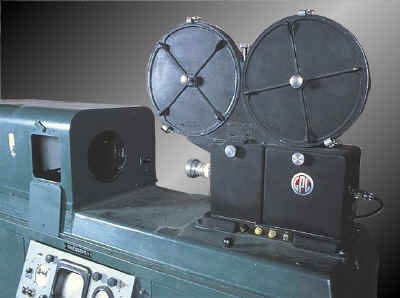
Kinescopes were mostly used for immediate rebroadcasts or for occasional reruns of prerecorded shows. Which means that, unfortunately, only a small fraction of kinescope recordings still exist today.
Japanese kine
Perhaps you’ve heard of mochi, the Japanese cake made from short-grained sticky rice.
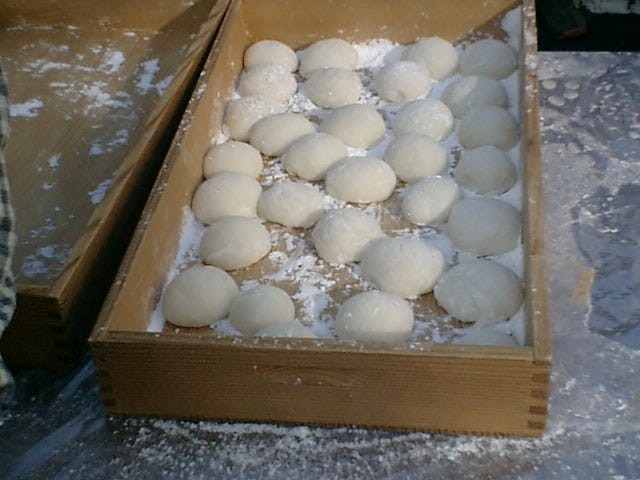
In Japan it is traditionally made in a ceremony called mochitsuki. Mochi is a traditional food for the Japanese New Year, and is typically sold and eaten during that time. However, it is also eaten year-round and on special occasions other than the new year. Mochi covering is used to wrap ice cream to make… you guessed it! Mochi ice cream.
The traditional process of mochitsuki involves whole rice as the only ingredient, and has three basic steps:
- Polished sticky rice is soaked overnight, and then steamed.
- The steamed rice is mashed and pounded with wooden mallets (kine) in a traditional mortar (usu). The work involves two people, one pounding and the other turning and wetting the mochi.[20] They must keep a steady rhythm or they may accidentally injure each other with the heavy kine.
- The sticky mass is cut or formed into shapes, for example spheres.
My eagle-eyes readers surely noticed the word kine in Step 2. That is the huge mallet you can see in this video, which will have you on the edge of your seat as you wonder if Mitsuo Nakatani will get his hand smashed and swollen like a character in a 1950s Bugs Bunny cartoon.
Now you know. Next time you’re in Japan, see if you can check out a live demonstration of mochi-pounding, and be sure to take some pictures of the kine they use. Just don’t refer to Japanese cows using that word… because the editors of the Spelling Bee decided that kine is a dord*.
You can check out my previous entry on another dord* here:
*What the heck is a dord, you ask? Here’s the answer: