
Donna
Look hands, no Ma-
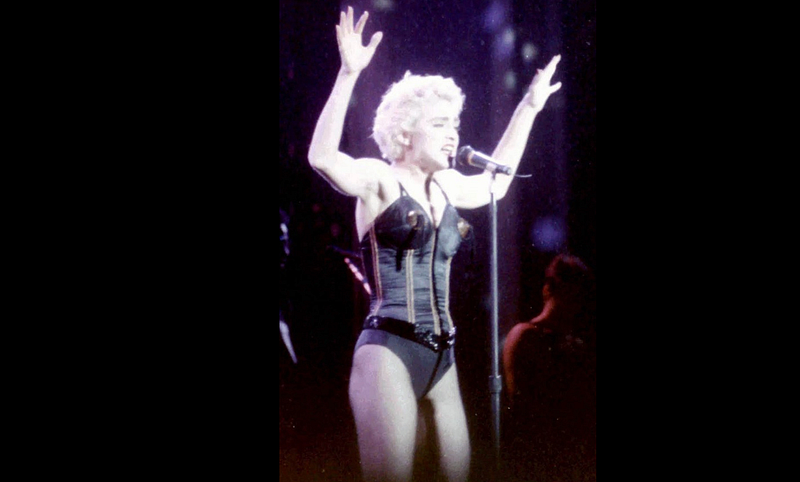
Today’s New York Times Spelling Bee letters:
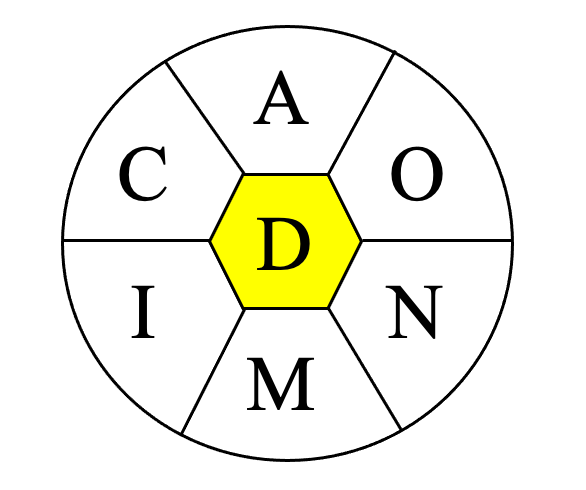
A, C, I, M, N, O, and center D (all words must include D)
Merriam-Webster says…
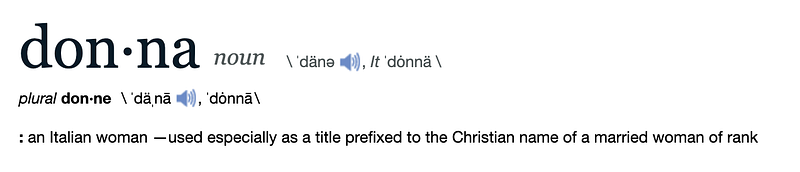
Silly little dictionary! Don’t you know that donna can’t possibly be a word if The New York Times says it ain’t?
For further fascinating facts, check out the Spelling Bee Master.
What’s your favorite dord* from today’s puzzle?
My Two Cents
I hope that bit of cognitive dissonance I created by saying there was no madonna and then posting a picture of Madonna made you curious enough to keep scrolling down. And no, today’s article is not about the Queen of Pop, although I will mention this factoid I did not know about until today: Madonna trademarked her name in the U.S. in the 1980s, and even won an international lawsuit in 2000 via the United Nations’ arbitration at the World Intellectual Property Organization. So, if you decide to name your kid Madonna, you do so at your own risk of becoming destitute once the singer’s lawyers find out.
In any case, if you want to find out more about donna without the ma- prefix, read on.
One, twice, three times a lady
Our friends at Merriam-Webster explain that English borrowed donna from the Italian; it came to that language from the Latin domina , meaning “lady”. In a similar vein, madonna was also borrowed from the Italy, but this word came from the Old Italian expression ma donna, which literally means “my lady”. Today the expression in modern Italian is mia donna.
The plural of donna is not donnas, but donne.
Donna was also the shortened form of nobildonna, the female equivalent of the honorific don in Italian. Don comes from the Latin dominus, a term that more or less means “lord” or “master”. Don is also used in Spanish-speaking countries, particularly in Spain, while Dom is the Portuguese version. For women, the honorific titles are Doña in Spanish and Dona in Portuguese.
English-speakers who hear the word donna may associate it with prima donna (first lady), a term originally created to describe the lead female singer in an opera company, to whom the best roles would be given. Most often these singers were sopranos. As Wikipedia explains:
At times, these prime donne (the Italian plural form) were grand with their off-stage personalities and demands on fellow troupe members, musicians, set and wardrobe designers, producers and other staff, but were deferentially tolerated because of their consummate talent and their draw at the box office. From this experience, the term prima donna has come into common usage in any field denoting someone who behaves in a demanding, often temperamental fashion, revealing an inflated view of themselves, their talent, and their importance.
In that sense, prima donna is equivalent to the more commonly-used diva. Now, please don’t act like a prima donna and have me beg you to keep reading.
I had a girl…
At the tender age of 17, Richard Steven Valenzuela had a Number 2 hit on the Billboard Hot 100. The song was “Donna”, and if the singer’s name doesn’t sound familiar, perhaps his non-ethnic stage name might: Ritchie Valens. Valens was the youngest person on the fated charter flight that crashed on February 3, 1959 ––“The Day the Music Died”. The others were Buddy Holly, J.P. Richardson, Jr. (The Big Bopper), and Roger Peterson, the pilot of the aircraft. (An interesting tidbit: Waylon Jennings, who was Buddy Holly’s bassist and became a household name in 1970s as the balladeer on The Dukes of Hazzard, was originally scheduled to be on the flight but let J.P. Richardson take his seat.)
For years afterwards Valens became “and that other guy” who died… until Lou Diamond Phillips starred in La Bamba, the 1987 biopic about Ritchie written and directed by Luis Valdez. The movie put Valens back on the musical scene, so to speak. The “La Bamba” song, which had never charted in the top twenty on Billboard, spent three weeks as the top during the summer of 1987, courtesy of the Los Lobos cover.
“La Bamba” was released towards the end of 1958 as the B-side of “Donna”, which Valens had dedicated to his high school sweetheart named… Donna. (doh!) She and Ritchie had been dating before Valens became a rock’n’roll sensation. Unfortunately Donna Ludwig’s parents did not approve of Valens because he was Hispanic. Eventually the relationship became complicated because of Valens’s growing popularity and constant touring on the road. But Ludwig went to her sweetheart’s funeral and, in 1987, attended the premiere of the La Bamba film.
The online Britannica sums up Valens’s life thusly:
Valens grew up in suburban Los Angeles in a family of Mexican-Indian extraction. While in high school, he used an electric guitar made in shop class to front a band and came to the attention of Bob Keane, owner of Del-Fi records, who produced the sessions at Gold Star Recording Studios that resulted in Valens’s hits. His first hit, “Come On, Let’s Go” (1958), was followed later that year by “Donna,” a ballad written for an ex-girlfriend, and “La Bamba,” Valens’s best-remembered recording, a rock and roll reworking of a traditional Mexican wedding song, sung in Spanish (though Valens hardly spoke the language)… Valens left a small legacy of recordings, but his compositions (often based on only three or four chords), exciting guitar style, emotional singing, and stylistic versatility influenced generations of rock musicians… In 2001 Valens was inducted into the Rock and Roll Hall of Fame.
Some people argue that the rumor about Valens not Speaking Spanish is false. I have no idea; although I’m getting up there in years, I was not even a spark of an idea in either of my parent’s teen mind when Ritchie died in 1959. However, whenever I heard “La Bamba” in its original version, it struck me that Valens made a grammatical error in the first verse.
Para bailar La Bamba, para bailar La Bamba se necesito una poca de gracia. Una poca de gracia pa’ mí, pa’ ti, ay arriba, ay arriba. Ay, arriba, arriba, por ti seré, por ti seré, por ti seré.
(This translates roughly as: “To dance the Bamba, to dance the Bamba, one needs a bit of flair. A bit of flair for me and you; come on, come on; come on now, I’ll do it for you, I’ll do it for you.”)
Thing is, that phrase se necesito (translated above as “one needs”) should really be se necesita. Necesito with an “o” at the end would be grammatically correct if the subject was yo (I). But with the impersonal “se” form, the correct conjugation for the verb necesitar is necesita with an “a”. A native speaker or even someone who had grown up with Spanish at home and was fluent in it would naturally use the correct verbal form.
Whether or not he spoke Spanish does not diminish Valens’s legacy. He was a pioneer of Chicano and Latin rock, becoming successful a time when discrimination against people of Mexican heritage was more rampant and open than it is now. In the 1950s, there were few Hispanics involved in rock music in the U.S. Valens not only crossed over into mainstream rock, he did with a song in Spanish! His influence can be seen in later acts like those of Los Lobos, Los Lonely Boys, and even Carlos Santana.
Here is Richard Steven Valenzuela’s original version of “Donna”:
Now you know. Next time you hear the song “Donna” playing, you can tell your family and friends the entire Ritchie Valens story. Just don’t confuse them by explaining that donna means “Italian woman”… because the editors of the Spelling Bee decided that donna is a dord*.
You can check out my previous entry on another dord* here:
*What the heck is a dord, you ask? Here’s the answer: