
Cenacle
Exclusive clique-y forums existed before the internet
Today’s New York Times Spelling Bee letters:
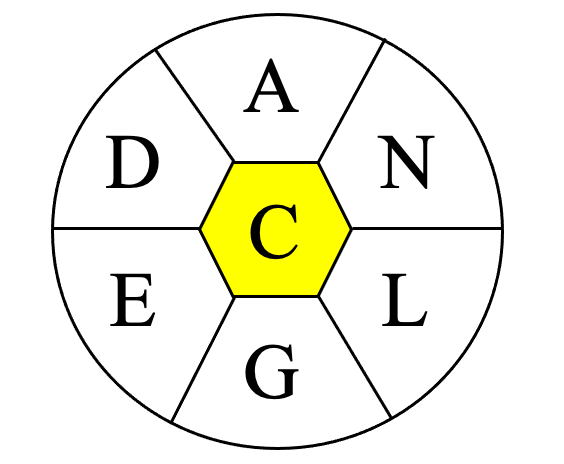
A, D, E, G, L, N, and center C (all words must include C)
Merriam-Webster says…
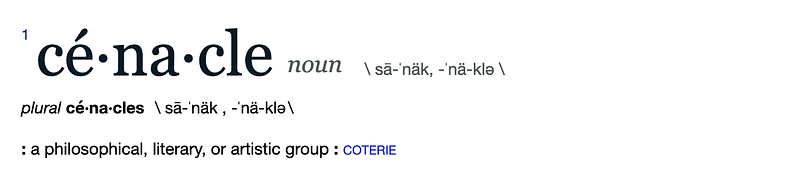
…and…
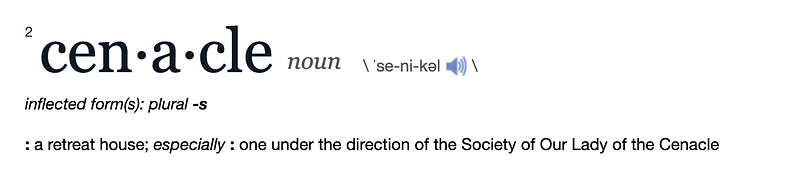
Silly little dictionary! Don’t you know that cencacle can’t possibly be a word if The New York Times says it ain’t?
For further fascinating facts, check out the Spelling Bee Master.
What’s your favorite dord* from today’s puzzle?
My Two Cents
During my intensive 15-minute online research, I found a cenacle that was not included in the dictionary’s two entries. In reality, it’s not “a cenacle”, but “The Cenacle”, or Upper Room. If you’re a practicing Christian, you may need no further explanation. If you’re not, here’s a brief summary as found in the 1911 edition of the Encyclopedia Britannica:
COENACULUM, the term applied to the eating-room of a Roman house in which the supper (coena) or latest meal was taken. It was sometimes placed in an upper storey and reached by an external staircase. The Last Supper in the New Testament was taken in the Coenaculum, the “large upper room” cited in St Mark (xiv. 15) and St Luke (xxii. 12).
In the above entry the authors used the Latin term coenaculum, or cenaculum, from which the English cenacle and the French cénacle originated.
The text in both Mark 14:15 and Luke 22:12 (NIV) are very similar: “He will show you a large room upstairs, all furnished. Make preparations there.”
According to the New Testament, the eleven remaining apostles continued to meet in the Cenacle where the Last Supper took place after the death of Jesus, and it was there where the Holy Spirit alighted upon them on Pentecost.
The room currently identified as the Cenacle is located on a hill in Jerusalem, just outside the walls of what is known as the Old City. The hill is called Mount Zion, and it is also the location of the Abbey of the Dormition (a Catholic abbey said to mark the spot where Mary, mother of Jesus, died), and King David’s Tomb –-which most historians don’t consider the true burial site of the biblical king. The tomb is on the ground floor of the same building where the Cenacle is. I visited both in 2017. Here is a panoramic of the Cenacle:
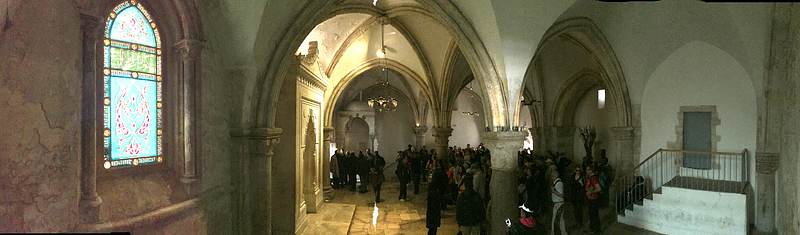
Now, that Cenacle has a capital C and therefore could never be included in the Spelling Bee, because proper nouns are verboten. So let’s discuss the other two cenacles, which the dictionary lists with lowercase c’s.
With an accent
Cénacle is a French word, and Merriam-Webster includes the synonym coterie in weblink blue. So we clicked on that…
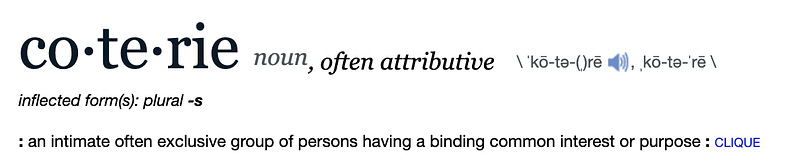
…and then clicked on clique…
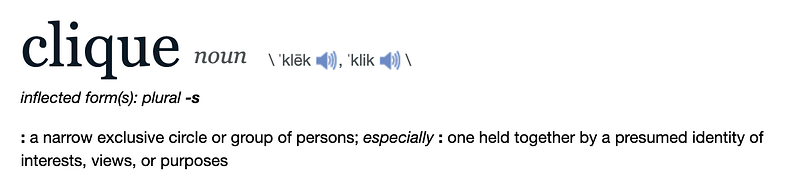
The word clique brings to mind high school and college, both for the groups I was a part of and the ones that would have nothing to do with me.
So, a cénacle might be defined as a group that gets together to discuss a very specific matter about which they all agree or enjoy. In the past, that could have been an old-fashioned literary or philosophical circle that met at a coffee shop. Today people meet online via social media, internet forums, and WhatsApp or Telegram chat groups. And because all of these have become echo chambers, for the most part, we can certainly call them modern cenacles.
The original French Cénacle began during the Romantic movement in early 19th-century France. Romanticism was an artistic, literary, musical, and intellectual current that peaked between 1800 to 1850 and emphasized emotion and individualism, idealization of nature, and glorification of the past. However, this past was not the ancient classical one but the medieval period. Romantics were suspicious of science and industrialization as a way of rejecting the scientific rationalization of nature of the Age of Enlightenment that had brought along Rationalist and Classicist literature along with it.
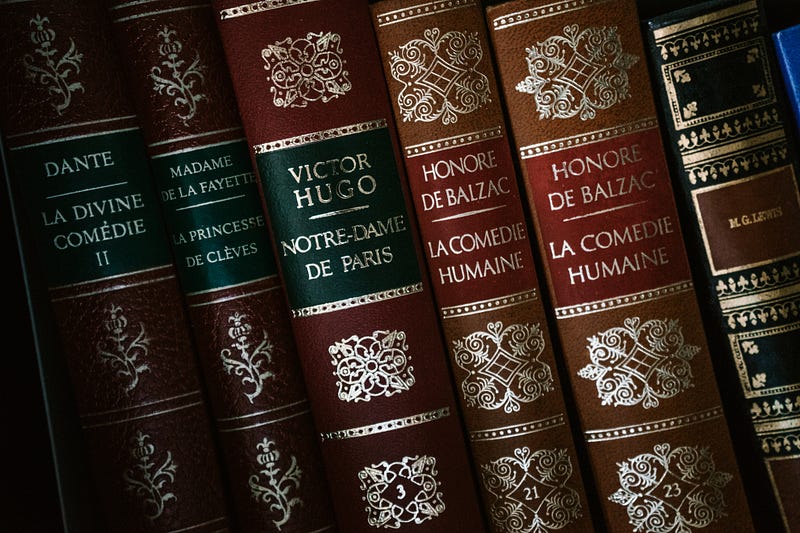
The photo at the top of today’s column shows a book and author very much associated with Romanticism: The Hunchback of Notre Dame, by Victor Hugo. (In French the novel was called simply Notre Dame de Paris, or “our lady of Paris”.) No need to scroll up; here it is again:
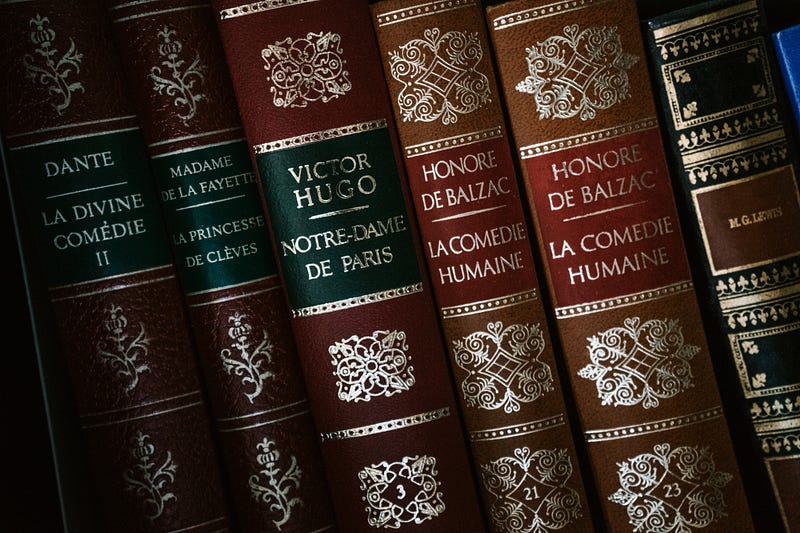
What’s interesting about this photo is that the book immediately to the left of Hugo’s –-Madame de La Fayette’s La Princesse de Clèves–– belongs to the Classicism movement, while the author of the two books to the right of Victor’s ––Honoré de Balzac–- is a key exponent of the Realism movement that followed Romanticism.
Well, Hugo along with other French Romantics formed the literary clique known as the Cénacle. The online Britannica explains there were actually more than one:
An early cénacle formed around the brothers Deschamps, literary editors of the short-lived but influential Muse Française. When the review ceased publication in 1824, the young contributors shifted to the salon of Charles Nodier, who was then librarian of the Bibliothèque de l’Arsenal, second of the great French libraries. The activities of that group — which included Alphonse de Lamartine, Alfred de Vigny, Alfred de Musset, and Victor Hugo — are described in the Mémoires of Alexandre Dumas père. Three years later, Hugo and the critic Charles Augustin Sainte-Beuve formed a cénacle at Hugo’s house in the rue Notre-Dame-des-Champs, where other young writers — including Prosper Mérimée, Théophile Gautier, and Gérard de Nerval — joined the group… When Hugo’s poetic drama Hernani was performed in 1830, their clamour and applause supporting the play overwhelmed the scorn of the traditionalists who had come to disparage it, thus ending the battle of the Romantics — the so-called battle of Hernani — for the demise of the outmoded dramatic conventions of Classicism.
There are plenty of other authors and novels I’m sure you’ve heard of (and may have even seen in the movies) are classified as Romantics. Among them are Edgar Allan Poe (“The Raven”, “The Cask of Amontillado”), Samuel Taylor Coleridge (The Rime of the Ancient Mariner), and Mary Shelley (Frankenstein).
The poems of Albery Allson Whitman, known as the “Poet Laureate of the Negro Race”, was influenced somewhat by writers in the Romantic current, except “Whitman went beyond sentimental ideals in his understanding of literature”, according to the book Black American Writing from the Nadir: The Evolution of a Literary Tradition, by Dickson D. Bruce.
Accent-less
Although cenacle meaning “a retreat house” likely also came from the French, (because the Society of Our Lady of the Cenacle was founded in of Lalouvesc, France), English seems to have borrowed it without the accent mark, as evidenced from the dictionary’s entry.
The international website of the Cenacle Sisters explains that…
The Cenacle is rooted in the faith and efforts of Saint Thérèse Couderc and Father Stephen Terme. Father Terme began his journey of faith in the wake of the French Revolution and its destructive impact upon the faith and the religious formation of the people. As a parish priest and missionary, he helped people rediscover their faith and love of Jesus. On one of his missions, he met a young woman who told him of her desire to enter religious life. She was Marie Victoire Couderc, who would become Mother Thérèse Couderc. Together they opened a hostel for women pilgrims visiting the shrine of St. John Francis Regins, SJ, in the small French village of Lalouvesc in 1826. With the help of God, providing safe accommodations for pilgrims and providing retreats in those accommodations, especially for women, lead to the foundation of dozens of Cenacle Retreat Houses around the world.
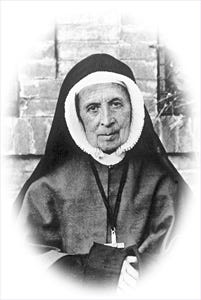
By 1828 Couderc became Mother Superior of this congregation, and later she was named Superior General. She worked tirelessly almost until her death at age 80 in 1885. She was beatified in Saint Peter’s Basilica by Pope Pius XII on November 4th, 1951, and was canonized as a saint in 1970 by Pope Paul VI.
Today the different congregations of Our Lady of the Cenacle continue their main purpose of providing spiritual and religious retreats for women all over the world. At the beginning of 2021, there were still 327 active sisters and 9 novices. Some of the countries the Cenacle operates in include the United States, Australia, Brazil, Canada, Madagascar, and Singapore.
Now you know. Next time you plan a trip to Jerusalem, take your closest clique of friends and go visit the Upper Room on Mount Zion to discuss some highbrow literature. Then you’ll be able to claim you were in a double cenacle. And if no one understand what you’re talking about… it’s because the editors of the Spelling Bee decided that cenacle is a dord*.
You can check out my previous entry on another dord* here:
*What the heck is a dord, you ask? Here’s the answer: