
Coaching
What is Coaching? Let’s find out.
Part 3— My ‘WHAT’ as a coach in a corporate world
Inspired by Simon’s book, “Start with why”, in my previous articles, I started with WHY, moved over to HOW and here, I will be focusing on the WHAT.

A few years fast-forward to today from the days I started as a graduate software engineer to moving in all directions in my career, touching the realms of Engineering, Product, and Delivery; coaching was the most minor expected skill I’d imagined to master. Nevertheless, here I am, on my journey of self-discovery through coaching.
Before I dive into what coaching is, let’s see what doesn’t fit into the concepts of coaching.
Coaching isn’t
- therapy
- consulting
- mentoring
- training
- counselling
- managing
These were the words I acquired from people when asked about coaching. Coaching has been mistaken and misconstrued by many including myself. So let’s unlock the true potential of coaching by first understanding what it means.
Are you prepared?
According to Wikipedia, coaching is applied in sports, performing arts, acting, business, education, health care, and relationships. Coaches use a range of communication skills such as targeted restatements, listening, questioning, clarifying, etc. to help clients shift their perspectives and thereby discover different approaches to achieve their goals. These skills can be used in almost all types of coaching.
Coaching is a gradual process where insights and learning emerge not only in the coaching sessions, but also between them.
It is a process of development, where you are the product. The coach will support you to achieve a goal, overcome an obstacle or push the boundaries of your comfort zone. It is a slow process which requires time and patience, to notice the behaviour and mindset shift. I’ve seen few of my clients experience the benefits in the first session itself, while some took 3–5 sessions. It solely depends on your pace of progress and the goals you set for yourself.
In an era of personalization, one size never fits all.
This is why an initial chemistry session with a Coach works wonders, especially in understanding your coaching needs and tailoring the structure of coaching conversations that best suits you.
Coaching isn’t valuable when
- you need the knowledge to perform a task
- a deadline is near
- you do not have an open mindset to grow
- you don’t hold yourself accountable for your actions
- you don’t speak your mind
- you are not committed to goals
Don’t ever ask a player to do something they don’t have the ability to do. They’ll just question your ability as a coach and not theirs as an athlete.
Every client is an expert in their field. Rather than advising those experts, why not give them a thinking environment in a safe and non-judgmental space and help them to get comfortable with the uncomfortable. That’s how coaching comes into practice for people who wish to change the way they lead.
Coaching improves performance when the
- responsibility to progress lies with the client
- client makes choices for themselves
- time is given to think & reflect
- the client is committed to learning & unlearning
You EARN your trophies at practice, you just pick them up at competitions.
Personally, the benefits I’ve gained from my Coach are,
- Challenging my limiting beliefs and thoughts
- Discovering my inner potential
- Raising my self-awareness
- Pushing me into the growth zone
- Safe space to think
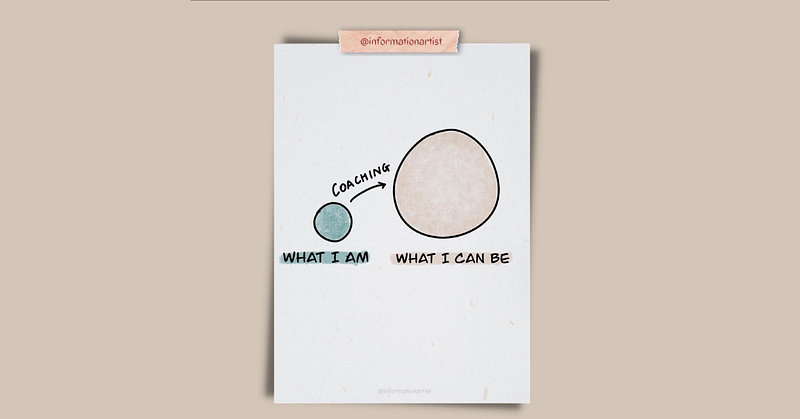
A good coach can change a game. A great coach can change a life. — John Wooden
If you’d like to go the extra mile to support me as a writer, please consider buying me a coffee or joining Medium using my referral link.


