
Cinderella and Childhood Trauma:
Running Away from the Love We Always Wanted
Cinderella suffers a dead mother, an abusive stepmother who triangulates through her horrid daughters, and a father who allows this to avoid being alone. Unconditional love dies with Cinderella’s mother, with everyone else in the family system thereafter meeting their own needs at her expense.
The fairy tale, whether in the mainstream Disney version or ‘original’ Grimm’s (the earliest version traces back to Ancient Greece), at this point invokes magic. The poor slave-girl, who for want of a bed sleeps in the ashes (hence, Cinder-ella), magically gains a gown, cleanliness, and a coach — all the materialistic boons that indicate lovability to a prince. He chooses her to be his bride — but the magic just as mysteriously disappears, and so she abruptly leaves love.
This is the behavior of the traumatized adult who finally meets love. If we consider the realistic elements of the fairy tale — an abused child who suffers trauma and loses love — the rest of the tale plays out as the fantasies born of that trauma. The misery, abuse and poverty represent her reality whereas the subsequent magic, wealth and romance represent her fantasy.
The fairy godmother, beautiful gown and signs of wealth are precisely what a traumatized, neglected and impoverished girl would dream of. Cinderella takes on an ego idealization just as children dream of becoming heroes. Her fantasy life is by definition the antithesis of her reality: the less likely, the more pleasing. We see the same with the poor Charlie Bucket serendipitously winning a golden ticket in Charlie and the Chocolate Factory. Both children are poor, lost their same-gendered parent, and then gain a fortune through the guidance of a surrogate figure of the same gender as the dead parent (fairy godmother, Willy Wonka) thanks to their surreal powers.
The clock striking midnight ending the magic marks the return of reality, and with it, Cinderella running from the love she had finally found. This is what traumatized individuals often do when they finally find love: run. For they believe it will leave them, and so they pre-emptively abandon love before love can abandon them. Defense mechanisms prevent abandonment by preventing love.
The Prince pursues her despite her inexplicable ghosting. Isn’t this what we want when we run from love? We want it to chase us! The drama of disorganized attachment: running to love until it is reached only to turn and run away. Cinderella only knows love is safe once she abandons it and sees that love still wants her. Cinderella sabotages love by doing to it what she fears it will do to her: leave. And so she ritualizes trust; the traumatized girl traumatizes her lover to bond with him.
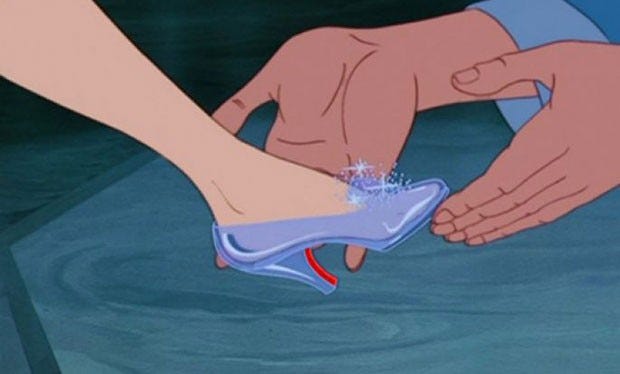
The glass slipper fitting her foot is an allegory for perfect lovemaking. Is there really not another woman in the entire kingdom whose foot fits this slipper? Or is this ‘fit’ not about feet, but sex? The Prince and Cinderella discovered their love through physical passion, not footwear. This is further bore out by the impracticality of slippers being made of glass, demonstrating this is a symbol: something that stands for anything other than itself. So that he first wants her because of what she isn’t, wealthy, but keeps her because of what she is, his lover.
The stepsisters not fitting the glass slippers becomes horribly phallic in the Grimm version. The stepsisters’ feet are too large to fit. The stepmother has the one cut off her big toe and the other cut off her heel to fit the glass slipper. Each time, the prince believes he has found his love until birds sing him the truth that the flowing blood he somehow did not notice despite the slipper’s transparency belie the fit. Men don’t initially notice blood during sex, whether of the hymen or menstruation. When one considers the glass slipper with its perfect fit as vaginal fit and the heel and toe as phallic symbols, the castration motif is apparent. As if this were not enough, in Grimm, at the wedding, pigeons peck out the stepsisters’ eyes, completing the castration motif. Freud is with us.
The Prince and Cinderella did it. Cinderella does not bleed when her shoe is…filled. Anyone wanting to marry the prince would have been a virgin and bled during sex. But not the woman who made love with the prince at the ball. So, for once, a misogynistic fairy tale equating feminine beauty to worthiness of love rewards a woman for getting her rocks off.
To follow me: https://medium.com/@myartman
To subscribe: https://medium.com/@myartman/membership
Also read What Snow White is Really About: The Child-Sacrificing Devil and the Christ Child and Harry Potter: The Fatherless Son.