
chink
chipping away at armors and prejudices
Today’s New York Times Spelling Bee letters: C, E, H, I, N, T, and center K (all words must include K).
Merriam-Webster says…
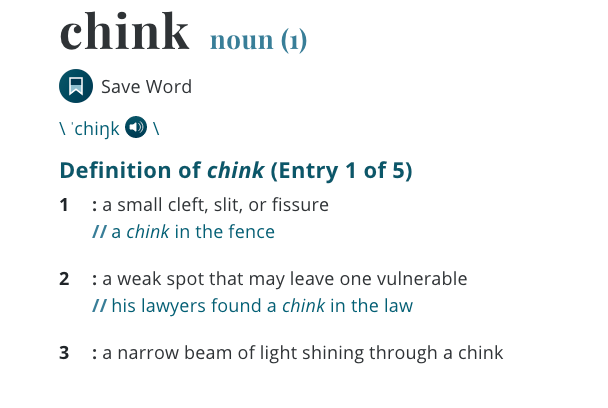
Silly little dictionary! Don’t you know chink can’t possibly be a word if the New York Times says it ain’t?
For further fascinating facts, check out the Spelling Bee Master.
What’s your favorite g.n.a.w. from today’s puzzle?
My Two Cents
There’s a reason I did not use Title Case for today’s column header. I wanted to make it clear which definition of chink I was talking about. Perhaps (and hopefully), if you’re young enough, you haven’t heard or been exposed to the slurry usage of the word that was around 350 years before it became an offensive term used against Asians. That term is commonly spelled with an uppercase C.
Having said that, I am issuing a trigger warning for those of you who are sensitive to this word or ethnic slurs in general.
Aside from the Spelling Bee, I am an assiduous New York Times crossword puzzle solver (currently on a 135-day streak — yay me!). Last year chink appeared as an answer in one of the puzzles, and it caused a big brouhaha in the comments section. I don’t recall if the word has been accepted in previous editions of the Spelling Bee, but in today’s puzzle it is not an answer.
I was also tempted to go with kike as today’s g.n.a.w., having promised to do so when I wrote about hided on January 30. And since part of my heritage is Jewish, I feel I have earned the right to talk about that
But kike, as far as the dictionary and I know, is used only as a slur. The word chink was used in its original sense for 350 years before it became ill-reputed in the late 19th century.
So I thought maybe I’d take the opportunity of discussing it in today’s column.
A small weakness
If you check the image of the Merriam-Webster definition, you’ll notice chink has (noun) 1 next to it. I didn’t offer a screenshot of the entire dictionary listing because it’s too long and would take up too much space vertically. But just know that five definitions are listed in total for chink with a lowercase c:
- (verb) 1: to fill the chinks of (as by caulking)
- (noun) 2: (a) archaic: coin, money (b) a short sharp sound
- (verb) 2: to make a slight sharp metallic sound
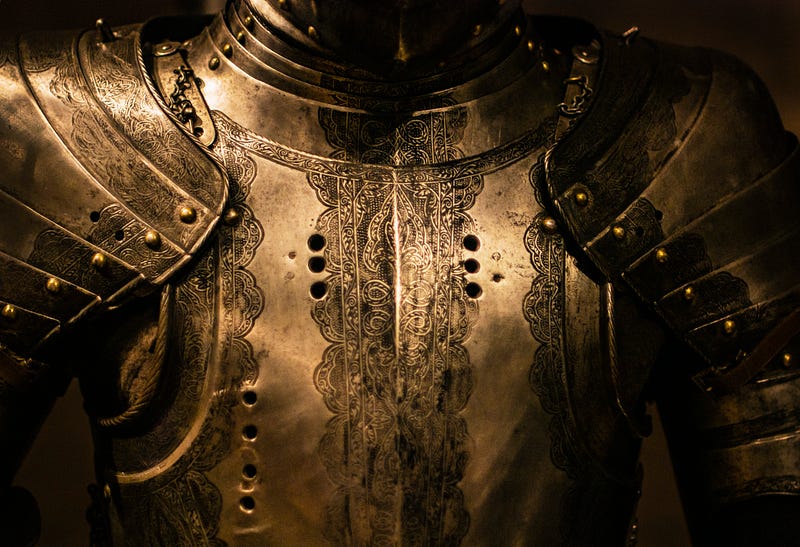
The etymology of chink as a slit or weak spot comes from Middle English in the second half of the 14th century, the theory being the word chine was tagged with -k, a suffix used to form descriptive names. Chine itself is British slang for a ravine formed in rock by running water, so you can see the visual relation to a “chink in armor”.
As a “coin” or “metallic sound”, chink’s origin is mostly self-explanatory. I don’t remember hearing chink used in that sense when I was growing up, or even as a grown-up. (Those who are laughing at me for calling myself a grown-up… please stop.)
I do recall hearing and reading and using chink when talking about a flaw or vulnerability. The expression “ a chink in one’s armor” is used as a metaphor for weakness, whether it be physical or mental. When it came to insulting Asians, the word I most heard was Chinaman.
A huge weakness
So… how did the word chink become the slur Chink?
It didn’t, really.
According to the dictionary and other sources I checked, Chink became a slur as an alteration of Chinese; or the Chinese word ching-ching; or Qing, as in the dynasty.
The adjective form, chinky, appears to have preceded the noun by a couple of years, around 1878. By the early 1900s it was a well-known term, possibly spread across the country by Edmund. A Smith’s invention of the mechanized fish-butchering machine, which he named “Iron Chink”.
And although Chink refers to Chinese people, due to ignorance and bigotry it became a racist catch-all term for any person of Asian descent. Its use grew in “popularity” during the Korean and Vietnam conflicts, for obvious reasons.
(Curiously, in India the slur chinki is thrown with malice at people from the north-eastern part of the country, and Nepal.)
Chink appears to have been a popular nickname for non-Asian sports players in the 20th century. There was “Chink” Crossin and “Chink” Alterman, both American professional basketball players; and “Chink” Heileman, “Chink” Outen, “Chink” Taylor, and “Chink” Zachary, all of them American Major League Baseball players. I don’t know what the origins of all their nicknames are, but we can take a wild guess…
You’d have thunk Chink would become patently inappropriate over the last twenty years, but no:
▹ Sarah Silverman used the word — unbleeped — during an appearance on Late Night with Conan O’Brien. In 2001.
▹ New York City radio station Hot 97 aired the “Tsunami Song” whose lyrics included the phrase “screaming chinks”. In 2004.
▹ Two ESPN employees used the headline “Chink in the Armor” in reference to Jeremy Lin, an American basketball player of Chinese and Taiwanese descent. In 2012.
▹ A Philadelphia eatery called Chink’s Steaks was asked in 2004 by Asian community groups to change the name. The restaurant was eventually renamed Joe’s. In 2013.
In any case, I can say that in these “modern times” people who intentionally use Chink to insult or offend or oppress or cause controversy… clearly show that they are the ones with a “chink in their armor”, namely a boulder-sized chip under which their bigoted shoulders are publicly sagging.
The debate about whether or not the original non-slur should also be eliminated from regular usage is one that probably does not need a non-Asian to enter.
So I won’t.
And regardless of whether or not you think “chink with a lowercase c” should be used when no prejudice is intended, the editors of the Spelling Bee said “Gee, Not A Word”.
Check out my previous entry on words that g.n.a.w. at you: